
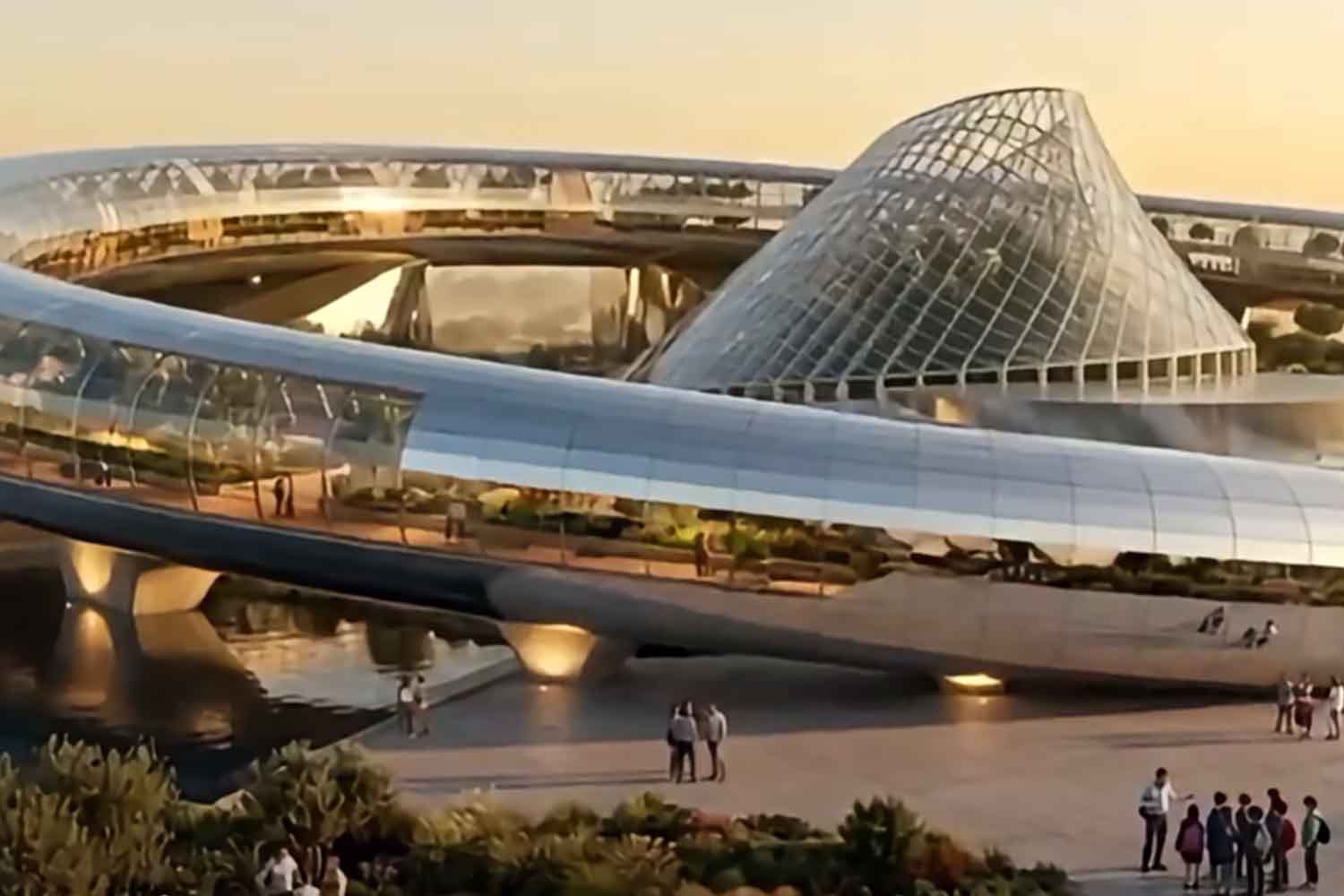
Where 250 thousand Ultimo fans gathered last July, we can now imagine a gigantic greenhouse two kilometers long, a large botanical garden dedicated to Mediterranean biodiversity and laboratories in which to study plants, conserve their genetic heritage and experiment with new agricultural techniques. We are in Tor Vergata, in the south-eastern outskirts of Rome, where on 4 July 2026 the Roman singer-songwriter held his record-breaking concert, The fairy tale foreverin the large esplanade near the Vela di Calatrava. An event which, according to Roma Capitale, attracted 250 thousand paying spectators.
Four months later, a new transformation proposal arrives for the same Roman quadrant. It is called City of Knowledge of Tor Vergata and was presented on 16 November 2026 to the Chamber of Deputies. The idea is to recover the Vela di Calatrava area, one of the most famous unfinished buildings in the capital, transforming it into a scientific, environmental and cultural hub. Greenhouses, gardens, research centers and spaces dedicated to training are imagined around the enormous structure designed by the Spanish architect. The project is currently being examined by the State Property Agency and, according to the promoters’ estimates, also envisages the creation of approximately 14,000 jobs.
A two kilometer long greenhouse to protect Mediterranean biodiversity
The protagonist of the new City of Knowledge would be green. The project involves a Large Greenhouse approximately two kilometers long, inserted in a vast botanical system intended for the conservation of plant species and scientific research. The intervention would develop in the Vela di Calatrava area, a complex of approximately 48 hectares, where botanical collections, laboratories and environments for the study of biodiversity would find space.
Among the planned structures is a Germplasm and Biodiversity Bank, intended to conserve seeds and genetic material of indigenous and Mediterranean species at risk. A precious heritage, especially in an area like the Mediterranean, where increasingly higher temperatures, drought and ecosystem transformations put numerous plant species under pressure. Conserving this material means keeping available genetic resources useful for research, for the recovery of natural environments and for the development of agricultural varieties capable of adapting to difficult climatic conditions.
There would also be space for precision agriculture, with laboratories and experimental areas dedicated to the study of crops and technologies that allow water, nutrients and other resources to be used more efficiently. The idea is to connect botany, agriculture, biotechnology and environmental research, transforming the botanical garden into a place in which to conserve plants and, at the same time, study their possibilities of use.
Leading the scientific committee of the City of Knowledge is Antonella Canini, professor of Botany at the University of Rome Tor Vergata, who during the presentation of the project to the Chamber of Deputies explained the role envisaged for the new botanical centre. The Garden should become a gene bank to safeguard spontaneous and agri-food species, a laboratory to study adaptation to climate change and a space capable of offering new professional opportunities to young researchers.
In Tor Vergata there already exists a botanical garden that studies plants and preserves seeds
The proposal also has an interesting peculiarity: the University of Tor Vergata already has a botanical garden dedicated to research, plant conservation and scientific dissemination. A structure that belongs to the Department of Biology and which over the years has developed activities related to the protection of native species, plant biotechnology and environmental recovery. The City of Knowledge could therefore expand a scientific heritage already present in the area, creating new possibilities for collaboration between universities, research centers and companies.
Among the activities of the University Botanical Garden there is already a Germplasm Conservation Centre, committed to the recovery of ancient agricultural varieties and the protection of threatened plant species. Researchers also study the use of plants for the remediation of polluted water and soil, the ability to absorb carbon dioxide and the selection of species that require less water and maintenance. Activities described by the university itself on the page dedicated to the scientific purposes of the Botanical Garden.
The new project would also give greater space to international collaboration. According to Canini, connecting the botanical gardens of different countries means distributing plant collections in multiple locations, comparing the data collected by researchers and increasing the chances of species conservation. A network that could also contribute to food security, through the study and protection of agricultural varieties useful for dealing with the consequences of climate change.
From Calatrava’s Vela to a great center for nature and research
To understand the extent of the transformation we must return to the story of Calatrava’s Vela. The complex was designed to become the City of Sport of Rome, also destined for the 2009 World Swimming Championships. However, the construction site stopped, leaving a gigantic incomplete structure, after investments of around 250 million euros. For years that white sail remained there, visible from afar, a reminder of how cumbersome a public work can become when it is interrupted halfway.
In 2021, the management of the area passed to the State Property Agency, which started an important recovery program. According to the official documentation on the redevelopment of Tor Vergata, around 80 million euros were invested to consolidate the structures, recover the external areas, create car parks and improve traffic. The complex has returned to hosting events, including the 2025 Youth Jubilee, while the prospect of creating a large green area dedicated to health and research has begun to take shape.
The City of Knowledge would represent a further step. Alongside the Great Greenhouse and the Botanical Garden, a planetarium, an immersive sphere, spaces for visual arts and literature, laboratories dedicated to biotechnology and sports facilities are planned. These include two regulation swimming pools, twelve multi-purpose courts and a fencing room. A set of activities that should connect scientific research, culture, sport and training, with the University of Tor Vergata among the main scientific references.
After all, the idea of transforming sailing into a hub of knowledge has been around for some time. Already in June 2024 the Lazio Region had started an institutional table dedicated to the recovery of the area, expressly providing for the expansion of the university botanical garden towards the Calatrava structure. The November 16 presentation added new details to this perspective, giving greater visibility to the architectural and scientific project.
When could the Grande Serra di Tor Vergata be born?
The project must now face the steps necessary for its realization. The State Property Agency has started a procedure to collect proposals from private investors interested in the redevelopment of the complex, also through forms of public-private partnership. The deadline for submitting proposals expired on September 30, 2026 and the City of Knowledge is currently being examined by the institution. A definitive timetable for the construction of the Great Greenhouse has not yet been announced.
The prospect, meanwhile, is to dedicate a huge area of the Roman outskirts to research, biodiversity conservation and training, making new green and cultural spaces accessible to citizens. For Tor Vergata it would mean combining university activities with a large botanical center capable of attracting researchers, students and visitors, while at the same time recovering one of the most discussed architectural complexes in the city.
La Vela di Calatrava was created to host swimming pools and sports competitions. Now it could become the symbol of a project that puts plants, research and biodiversity at the centre. After almost twenty years spent looking at an incomplete structure, seeing something grow around those enormous white arches would already be a nice change.
