
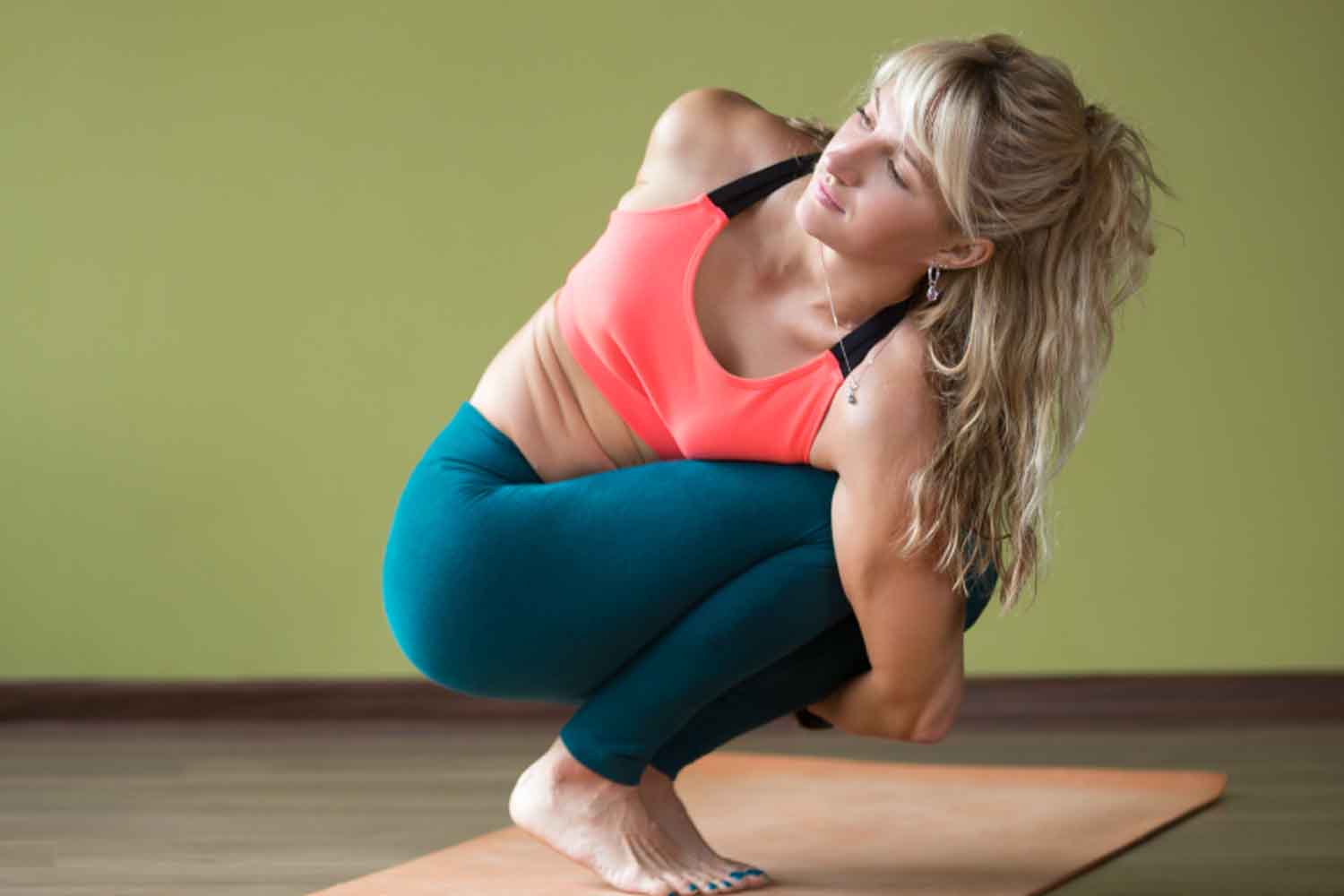
Squat down, keep your heels on the ground, rotate your torso and try to clasp your hands behind your back. Easy, at least when you watch it done by someone who has been practicing yoga for years. It’s called Pasasana, also known as the noose pose, and is one of the most challenging twists in Ashtanga Yoga. It involves the shoulders, back, ankles and legs, requiring a good amount of mobility, balance and body control. And possibly even a little patience, because joints don’t always share our enthusiasm.
Pasasana opens the second series of Ashtanga Yoga, an advanced sequence that requires progressive preparation. Its peculiarity lies in the combination of two movements that are already challenging if performed separately: a deep squat and a twist of the torso. Then when you add the intertwining of the arms, the difficulty increases. However, this position can be approached through preparatory exercises, also using a wall or a yoga block to work on mobility without forcing the body into movements that it cannot yet support.
The twist starts from the feet
The first difficulty comes even before rotating your torso: staying crouched with your heels resting on the floor. Those who have little mobility in their ankles may find that they are unable to lower their pelvis without lifting them. To prepare for Pasasana, you start standing, with your feet close together and well placed on the mat. Gradually bend your knees, trying to go down towards the floor and keeping your weight distributed on your feet. The squat must respect the mobility of the joints, without turning into an endurance test.
Once a stable position has been found, the twist is introduced. The torso slowly rotates to one side, while the knees remain oriented in the direction of the feet and the breath accompanies the movement. To start, you can keep one hand in support or use the arm opposite the leg you are rotating towards, bringing the elbow to the outside of the thigh. The rotation should mainly involve the upper part of the back, avoiding pushing laterally on the knees to gain a few centimeters. The shoulders remain away from the ears and the chest seeks space.
The complete position requires an additional step: slide your arm around your legs and reach for your other hand behind your back, until you grab your wrist. Once you have reached the weave, you maintain the posture for a few breaths, then slowly dissolve it and repeat on the other side. It seems like a pretty linear sequence, until you find yourself on the mat looking for a hand that, for some mysterious reason, seems to have moved to the other side of your body.
A wall and a block can make a difference
When the balance is precarious, a wall can become an excellent ally. By positioning yourself sideways near the wall, you can gradually lower yourself into a squat and use your hands as support while twisting. In this way you can concentrate more on the rotation of the torso, the lengthening of the spine and the opening of the chest, without having to manage all the difficulty of balance at the same time. The wall also allows you to better understand how to distribute weight and maintain a stable position.
Another option is to use a yoga block under your pelvis. By sitting on the support, with your feet flat on the floor, you can work on the rotation of your back and the movement of your shoulders. When the position allows it, a yoga belt can help bring the hands together behind the back without forcing the entanglement. They are particularly useful tools for those who are learning, but also for more experienced practitioners who wish to focus on a specific movement. After all, the block serves to support the body: it certainly must not support our pride.
How Pasasana works on shoulder mobility
The shoulders play a key role in this twist, because they must move in a coordinated manner with the upper back. To be able to bring the hands behind the body it is necessary to create space in the chest, keep the shoulder blades stable and accompany the rotation without stiffening the neck. Pasasana therefore allows you to work on the mobility of the shoulders and spine, as well as requiring strength in the legs and stability in the ankles. Gradual practice helps to become familiar with movements that we rarely perform in combination in daily life.
The benefits of movement, moreover, are also recognized by research. The National Center for Complementary and Integrative Health, an organization of the US National Institutes of Health, reports that the practice of yoga can contribute to physical well-being, balance and the management of some musculoskeletal disorders. In the case of Pasasana, the practical goal is to gradually develop mobility and control through twisting. Naturally, those suffering from knee, shoulder or back problems should evaluate the most suitable variations with a professional, avoiding forcing the joints.
The position that also teaches you to let go
There is another interesting aspect of Pasasana, which concerns less the joints and a little more our attitude towards difficulties. In the philosophy of yoga there is the concept of avidyagenerally associated with a distorted perception of reality. Its manifestations include the ego, attachment to desires, aversion to what puts us in difficulty and the fear of losing what we are used to. Mechanisms that can also appear during a lesson, when we persist in reaching a position for which the body is not yet prepared.
Let’s think about the temptation to imitate the teacher, perhaps trying to interlace our arms at all costs, or the frustration of having to use a support while the person on the next mat seems to have no difficulty. It’s easy to turn a personal practice into a silent competition. Pasasana, with its complexity, offers the opportunity to observe these attitudes and work on them. You can dedicate an entire session to ankle mobility, stop at a preparatory twist, or use the wall for weeks. Progress remains progress even when it doesn’t look like a photograph of a perfect position.
Learning to recognize your limits also means understanding when it is time to continue and when it is best to stop. Breathing should remain regular, movement controlled, and pain should be a signal to stop exercising, not something you endure to achieve your goal. Pasasana takes time, especially when the shoulders are stiff or the ankles do not yet allow deep squatting. The hands behind the back, for the moment, can also wait.
