
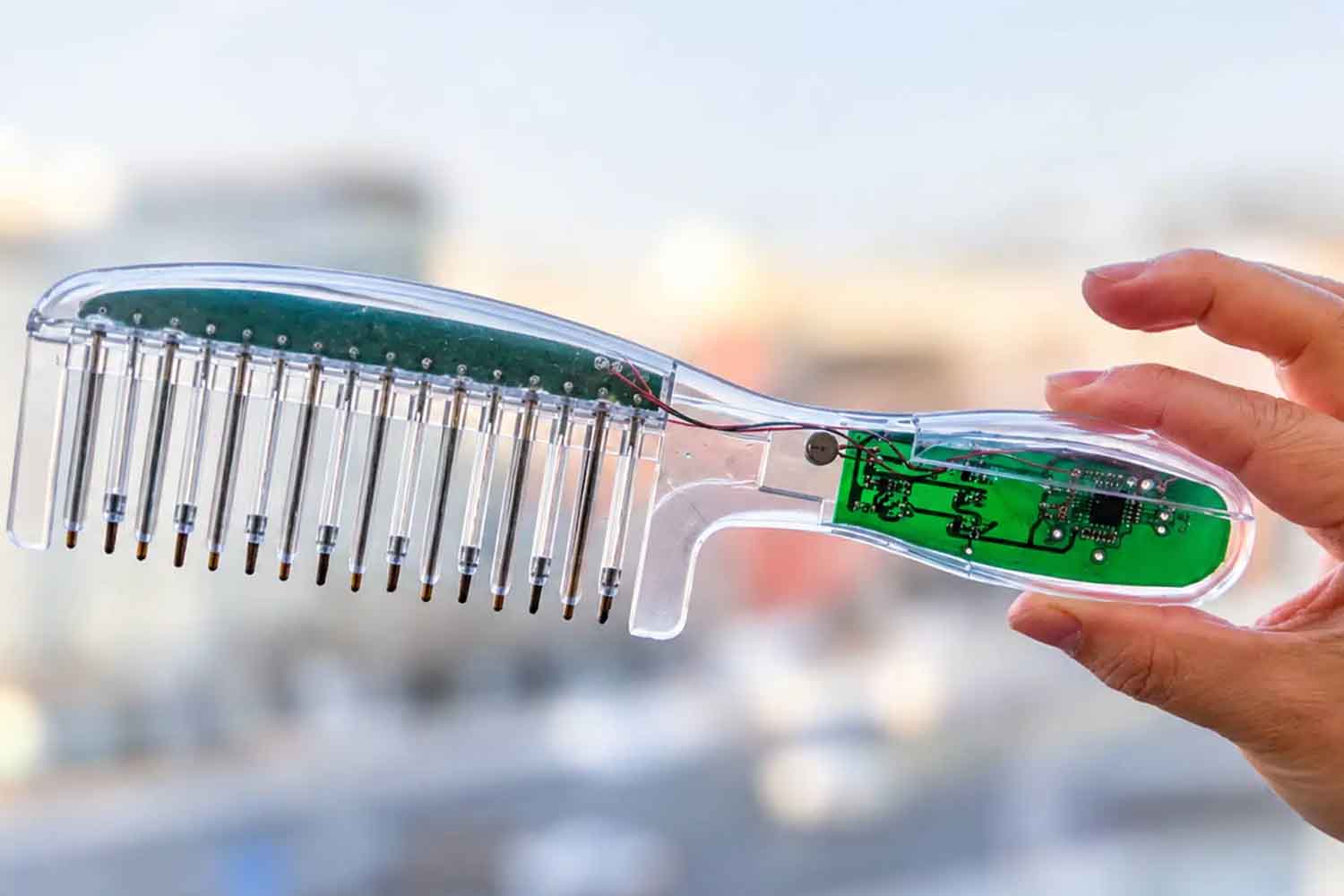
An electric comb, a few pulses and after 28 days the treated surface is almost completely covered with hair again. It is the result obtained by a group of Chinese researchers who developed Detangle, an experimental device against baldness capable of stimulating hair follicles and transporting therapeutic substances deep down. The prototype resembles a normal comb, although it hides electrodes and small reservoirs between its teeth. In preclinical tests conducted on animals, the complete treatment made it possible to recover almost 98% of the surface covered with hair, even surpassing the results obtained with minoxidil, one of the most used drugs against hair loss.
The research, published on Nature Communicationsbears the signature of a group of scholars from Beihang University in Beijing, together with other Chinese research institutes and the City University of Hong Kong. The goal is to address theandrogenetic alopeciathe most common form of progressive hair loss, affecting both men and women. A condition on which genetic and hormonal factors weigh and which, for many people, also represents a self-esteem problem. Treatments already exist, but they don’t always produce the desired results. Hence the idea of working directly on the follicles, using an object that normally serves to pass through the hair.
How the Detangle electric comb works
Detangle owes its name to the Disney animated film Rapunzel – The Twist of the Towerwhose original title is Tangled. A rather ambitious reference for an object intended for those who have less and less hair. Its peculiarity lies in the teeth of different heights, designed to generate a localized electric field when the device is passed over the skin. According to the researchers’ measurements, this arrangement produces an electric field 2.63 times more intense compared to that obtained with electrodes of the same height.
Electrical impulses perform two functions. On the one hand, they directly stimulate the hair follicles, favoring some cellular processes linked to hair growth. On the other hand, they temporarily make cell membranes more permeable through a mechanism called electroporation, which facilitates the entry of therapeutic substances. In tests, the system was able to transport molecules up to approx 660 micrometers deepreaching the hair follicle regions much more effectively than simple external application.
The comb also contains small reservoirs that release substances through a mechanism similar to that of a ballpoint pen. The researchers chose two molecules with different functions: a plasmid that promotes the production of VEGFA, a protein involved in the formation of blood vessels, and a small interfering RNA, called siRNA, designed to reduce the activity of the SRD5A2 gene. The latter is involved in the production of dihydrotestosterone (DHT), the hormone which in genetically predisposed people contributes to progressively shrinking the follicles, making the hair increasingly thinner.
The idea is therefore to intervene simultaneously on two important mechanisms for hair growth: improve the blood supply to the follicles and reduce the production of DHT. All using a device that could be used through the simple gesture of combing your hair. An interesting prospect, especially considering that currently available drugs require regular applications and may have limitations in effectiveness or side effects.
A regrowth close to 98% after just 28 days
To verify the effectiveness of Detangle, researchers experimentally reproduced some conditions characteristic of androgenetic alopecia, comparing different treatments. The device was being used once every three dayswhile minoxidil and finasteride, used as comparators, were administered daily. After four weeks, the differences were clearly visible.
With electrical stimulation alone, without the addition of therapeutic molecules, the surface once again covered with hair had reached approximately 40%. A result that suggests how electrical impulses can also contribute to activating growth mechanisms. However, when the same impulses were associated with the two therapeutic substances, the coverage reached 97.85%. In tests with minoxidil, used as a reference, the value stopped at around 70%.
The difference depends above all on the combined action of the system. The two molecules, used individually through Detangle, had already promoted significant regrowth, but together they produced the best results. Tissue analyzes also showed increased activity of hair follicles, increased vascularity and cellular signals associated with hair growth. The researchers also observed a reduction in levels of DHT and some markers of inflammation in the treated areas.
The checks carried out during the experiments did not highlight significant damage to the skin or tissues in the conditions studied. An important element, because Detangle aims to transport therapeutic molecules without having to pierce the skin with needles. The device could therefore become a system for administering localized treatments directly to the follicles, overcoming one of the problems of traditional applications: reaching in sufficient quantities the structures found in the deeper layers of the skin.
When will we be able to use Detangle against hair loss?
Detangle remains an experimental prototype for the moment and the results obtained still belong to the preclinical phase of research. Before imagining a product to be used regularly at home, it will be necessary to verify the safety of the electrical impulses on the human scalp, the effects of the molecules used and the duration of any regrowth. It will also be necessary to understand whether periodic applications are necessary to maintain the results over time.
The prospect, however, is interesting. A localized treatment, relatively simple to use and capable of acting simultaneously on multiple hair loss mechanisms it could offer a further possibility against androgenetic alopecia. The advantage of Detangle, according to the researchers, lies precisely in integrating electrical stimulation and administration of molecules in a single device, without resorting to invasive procedures.
For now, in the laboratory, applications every three days have been enough to obtain almost complete regrowth within four weeks. Before finding Detangle next to brushes and hairdryers, however, it will be necessary to demonstrate that the same results can also be achieved on people. The comb is ready. The clinical trial has yet to begin.
