
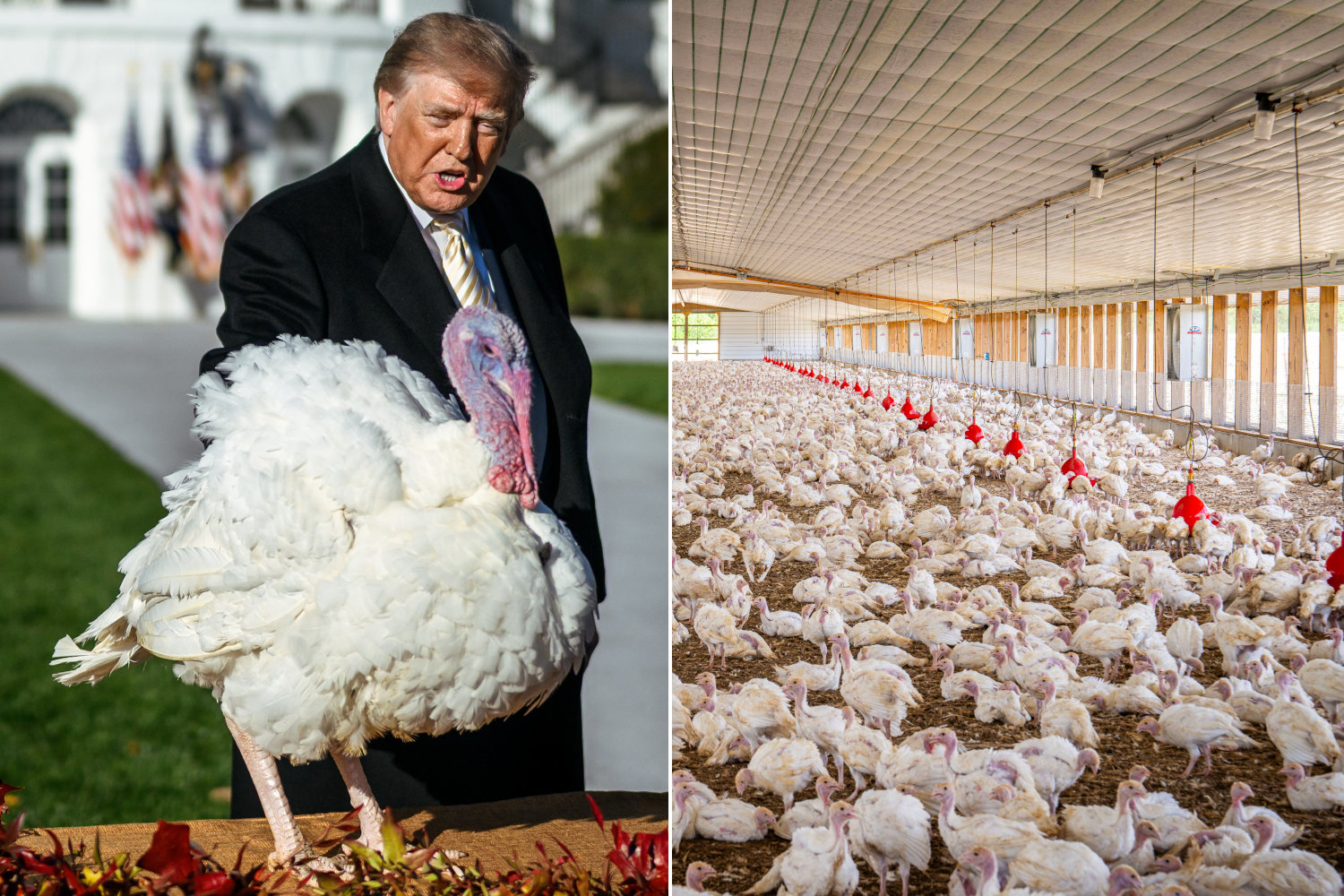
The scene at the White House, on the eve of Thanksgiving, seemed to follow a well-tested script now in its 79th edition: after a stay in a suite at the Willard InterContinental hotel in Washington, the two turkeys selected for the ceremony – Freedom and Feathers – were awaited in front of the President of the United States Donald Trump to receive the traditional presidential pardon, inaugurated with the delivery of the birds by the National Turkey Federation to Harry Truman in 1947 and made official pardon by George HW Bush in 1989.
View this post on Instagram
At the time of the rite, however, only Freedom appeared in front of the cameras, while Feathers disappeared without a trace: a US Air Force official assured that both were in excellent health, a second representative of the administration claimed that the second specimen was relaxing in the gardens of the residence and Donald Trump himself, noticing the sudden outburst of the bird during the event, tried to play down the situation by explaining that Feathers had escaped into the bushes and in any case confirming the pardon for both, so that they could live “forever”.
Congratulations on your unconditional pardon, Freedom & Feathers!
Happy Thanksgiving, patriots.
pic.twitter.com/4MYix7vty1
— The White House (@WhiteHouse) November 24, 2026
Nothing but salvation! Over 500 million turkeys are slaughtered worldwide every year
Yet, beyond the smile that Washington’s political news tries to wring, the rescue of Freedom and Feathers remains a microscopic and symbolic parenthesis compared to the real dimensions of a supply chain that places turkeys among the most bred and slaughtered land animals in the world for meat production, surpassing even cattle, for which in the same year there were around 305 million specimens.
Hundreds of millions of their peers continue to be raised and slaughtered for human consumption. According to FAO data (FAOSTAT), approximately 504 million turkeys were slaughtered worldwide in 2024. An average of almost 1.4 million animals per day. Turkeys are thus among the most slaughtered land animals in the world for meat production, even surpassing cattle, of which around 305 million specimens were counted in the same year.
In the United States, 35 million turkeys are slaughtered during Thanksgiving
The size of the US industry is captured by the United States Department of Agriculture (USDA). According to the Poultry Production and Value 2025 Summary report, released in April 2026, 194 million turkeys were raised in the United States in 2025, with a total production value of $5.58 billion.
In the same year, according to a further USDA report, nearly 191 million turkeys were slaughtered in federally inspected facilities, or more than 523,000 animals per day. In the months of October and November 2025 alone, close to the Thanksgiving holidays, slaughters involved a total of almost 35 million specimens, although not all were necessarily destined for Thanksgiving tables.
Over 170 million turkeys are raised in Europe and Italy is among the main producers
The phenomenon, however, does not only concern the United States. According to data presented by the European Food Safety Authority (EFSA) in October 2026, over 170 million turkeys were farmed in the European Union in 2023. Italy is among the main European producers. According to European Commission data reported in a study on turkey farming systems commissioned by EFSA, around 23.8 million turkeys were slaughtered in our country in 2023. Numbers lower than those recorded in Poland (35.7 million), Germany (30.1 million), France (28.7 million) and Spain (25.9 million), but which still place Italy in fifth place among the European Union countries.
Turkeys do not yet have specific European legislation to protect them
The European regulatory framework makes the contradiction between the traditional presidential pardon and the conditions in which these animals live even more evident. Despite the size of the sector, there is still no specific legislation in the European Union dedicated to the welfare of turkeys on farms, to which the general provisions on the protection of animals bred for production purposes apply.
In February 2026, EFSA published its first scientific opinion dedicated to the welfare of turkeys on farms, identifying 19 relevant negative consequences for the health and welfare of these animals. Among the main critical issues are the limitation of movements, locomotion disorders, skin lesions, the impossibility of expressing natural behaviors and the consequences of genetic selection aimed at rapid growth.
Two turkeys spared in front of the cameras thus become the symbol of a leniency that rarely finds space in the production chain. For all the others, hundreds of millions of animals invisible to the general public every year, no ceremony is planned.
