
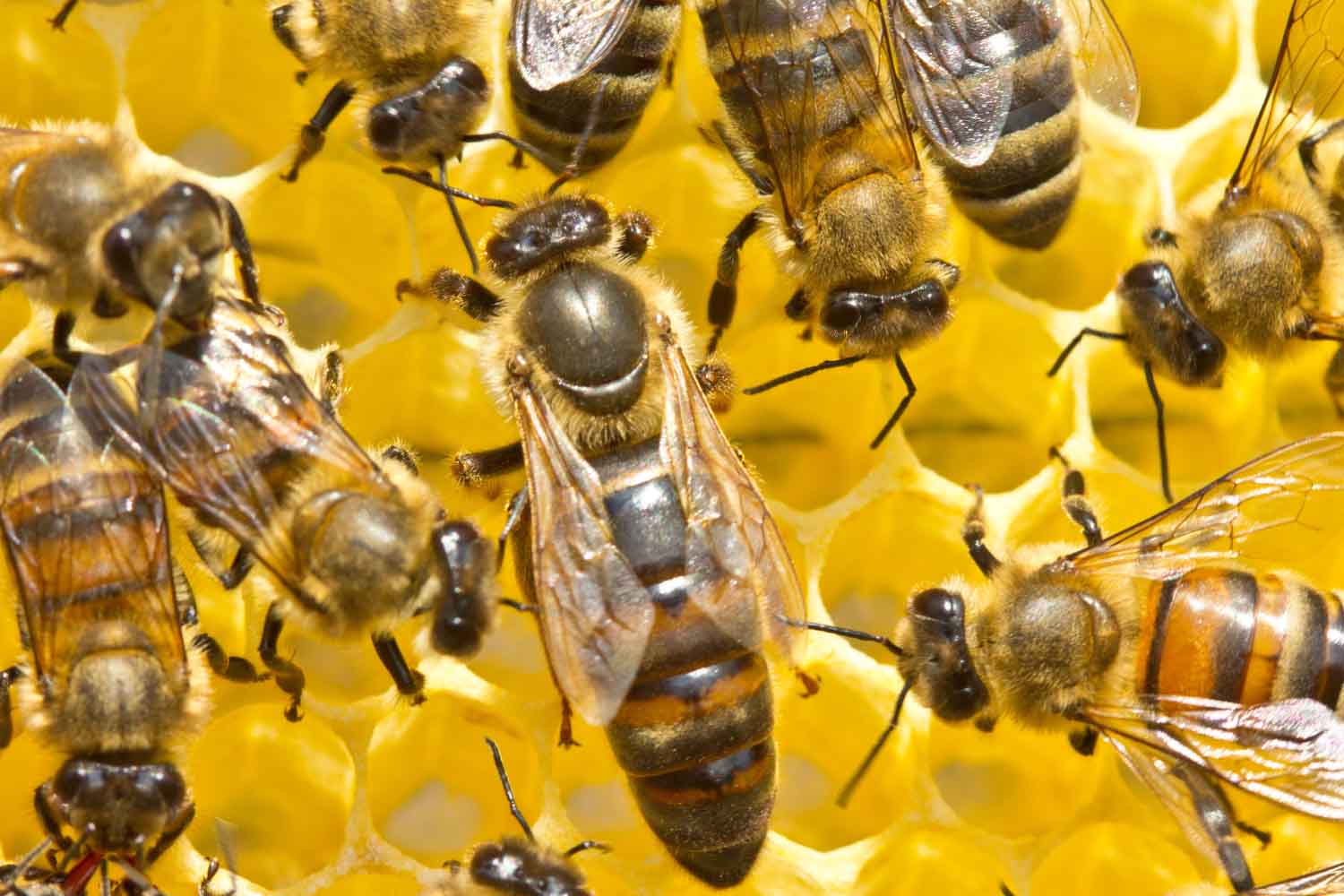
In a small plastic structure, with the bottom covered by a net, a queen marked by a dot of paint continues to lay while sixty worker bees circle around her. They feed her, clean her, and process the food before it reaches her system. For ten days, however, together with pollen and water they also receive reduced doses of a pesticide. The contaminant slowly passes through this tiny society, stops in the wax, passes into the bodies of the workers and, when the collective defenses begin to fail, reaches the queen.
That’s when something never before documented with such precision happens in honey bees. The queen bee transfers some of the accumulated pesticides directly into her eggs, lightening the load on her body. The mechanism is called maternal offloadingmaternal discharge, and emerges from a study published in Current Biology and coordinated by the University of California at Davis.
The word “sacrifice” describes the visible effect well, even if it attributes to the queen a conscious choice that the experiment naturally does not demonstrate. The biological result remains rather harsh: the body of the only individual capable of guaranteeing the continuity of the colony is protected, while a greater share of the contamination ends up in the generation still enclosed within the cells.
Sixty workers and a queen
To observe the entire journey of the toxic substances, the researchers built nanocolonies, miniature hives made up of a queen and sixty workers. The transparent containers allowed the movements of the insects to be followed and the wax, the bee bodies, the queen’s ovaries and the laid eggs to be analyzed separately.
The colonies received pollen, water and food mixed with sublethal amounts of methyl parathion, an organophosphorus pesticide. The substance had been marked with a very low intensity radioactive tracer, so that it could be traced even in minimal concentrations through a technology called BioAMS, capable of measuring the signal down to the atomic scale.
During the first day, the workers managed to block approximately 95% of the pesticide. Some was absorbed by their organisms, some was deposited in the waxy structure of the colony. The wax therefore functioned as a sort of chemical warehouse: it kept the substances away from the queen, while still leaving them inside the hive.
By day 10, the filter’s efficiency had dropped to 86%. The difference may seem small, yet in a colony subjected to continuous exposure it means an increasing quantity of contaminant free to reach the individual that the workers try to protect more than anyone else.
When the hive filter fails
Worker bees represent the first barrier against what enters through food. The queen lives surrounded by a group of assistants who feed and take care of her, therefore she receives food already processed by other individuals. This system offers significant protection as long as exposure remains limited.
As the days pass, however, the pesticide begins to accumulate. The workers retain an increasingly larger share in their own tissues and wax, while the rest reaches the queen. The contamination reaches the ovaries and is then transferred to the eggs during their formation.
Maternal discharge allows the queen to get rid of some of the toxic substances. From the point of view of the immediate survival of the colony, the mechanism has a precise logic: a queen can lay between 1,500 and 2,000 eggs a day and is the only individual in the hive capable of generating the next population of workers. Its loss would quickly disrupt the turnover needed to keep the entire community alive.
The price is shifted to eggs. When their contamination grows too much, development can slow down, be damaged or stop. Scholars speak of a possible threshold beyond which the queen’s protection system ends up weakening the colony from within, through a progressive reduction in new births.
The poison stays inside
The discovery also changes the way we read the contamination of beehives. An exposure can leave traces much longer than the presence of the pesticide in the surrounding environment. The substances remain in the wax, pass through different castes and reach the eggs, continuing to circulate after the first contact.
The hive thus acts like a collective detoxification network. Each component absorbs part of the problem: the workers filter the food, the wax collects residues, the queen transfers the load to the eggs. The system holds as long as the amount of contaminant remains within manageable limits. Chronic exposure, even at doses unable to immediately kill insects, can slowly wear down this ability.
The effects may appear with a delay. A colony may still appear to be active, have a live queen and workers busy harvesting, while inside the cells an exposed generation grows before hatching. The authors hypothesize that such accumulation could contribute to forms of gradual collapse, difficult to link to a single agricultural treatment or a precise episode.
The duration of maternal discharge, the consequences on the development of the larvae and the differences between the various pesticides remain to be understood. The experiment used a single substance and colonies much smaller than a real hive, where tens of thousands of bees can coexist and other stress factors, from parasites to food shortages, act simultaneously.
The observed mechanism, however, leaves an image that is difficult to shake off. The pesticide enters with food, passes from body to body and even finds its way into eggs. The queen remains at the center of the hive, alive and productive. Inside the cells, meanwhile, the bill has already arrived.
