
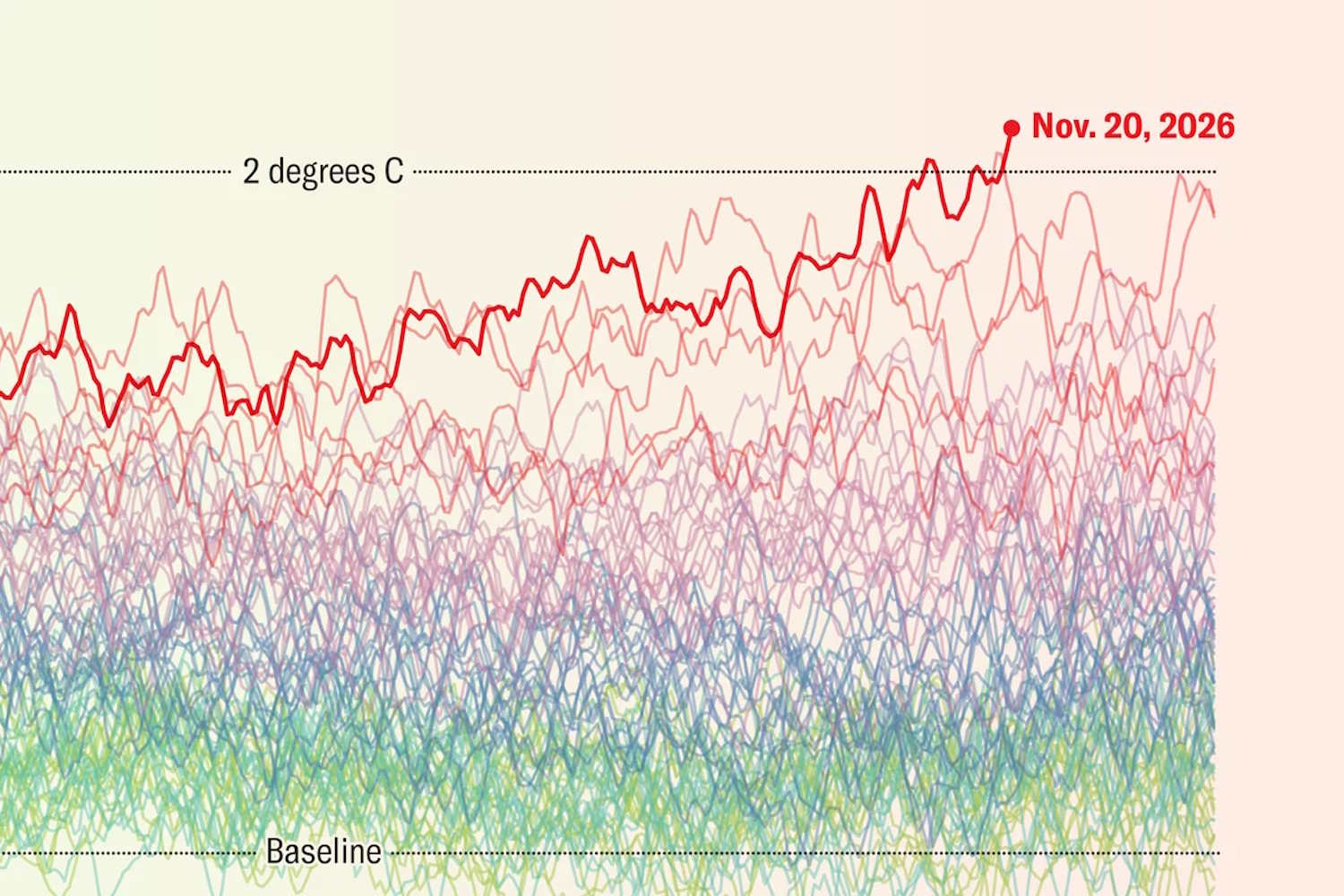
It was exactly Friday 20 November, the day with the highest thermal anomaly ever recorded on Earth, that is, the day in which the average global temperature was 2.12 degrees Celsius higher than pre-industrial levels, those preceding the warming of the planet caused by the massive use of fossil fuels.
This is stated by preliminary data from the Copernicus Climate Change Service (C3S), reported by Scientific American. A record that comes just as the COP31 climate negotiations in Antalya, Türkiye concluded without a global agreement on how to contain global warming.
In short, while international diplomacy struggles to find a common path, temperatures continue to rise. This time, it is the combination of two factors that weigh: anthropogenic climate change and El Niño which could be the most powerful of the last thousand years. And the good thing is that temperatures could break new records in the coming months.
El Niño has not yet reached its peak, which is expected around the next month. This means that we could see more days when the average global temperature will be at least 2 degrees higher than in pre-industrial times. The heat released by El Niño in the Pacific Ocean takes time to impact global temperatures. This is why the most significant effects are expected during 2027, which, according to the forecasts reported by Scientific Americanwill almost certainly become the warmest year on record.
@Copernicus Climate Change Service
Both 2026 and 2027 are also expected to see average global temperatures more than 1.5°C above pre-industrial levels, a threshold that, on an annual basis, had so far only been crossed in 2024.
Have we already exceeded the limits of the Paris Agreement?
Not exactly. And it is good to make a distinction. With the 2015 Paris Agreement, signed at COP21, countries committed to keeping global warming well below 2°C above pre-industrial levels and to continue efforts to limit it to 1.5°C.
Exceeding the 2°C threshold for a single day, or even for an entire year, does not imply that the limit established by the Agreement has been definitively exceeded. The reference is in fact to the average temperature calculated over a period of many years. According to the United Nations, based on this criterion, global warming has now reached almost 1.4 °C compared to pre-industrial times.
In any case, the prospect is not at all reassuring: the UN itself recently recognized that exceeding the 1.5 °C threshold is now inevitable, with an increase in global temperatures expected to reach 1.8 °C.
In this scenario, COP31 in Antalya ended, in which the United States did not even participate with an official delegation and from which no shared final agreement emerged. A stalemate on the document that was supposed to outline the path to follow to reduce greenhouse gas emissions and adapt to the consequences of the climate crisis.
And instead, the Planet gives us another record.
