
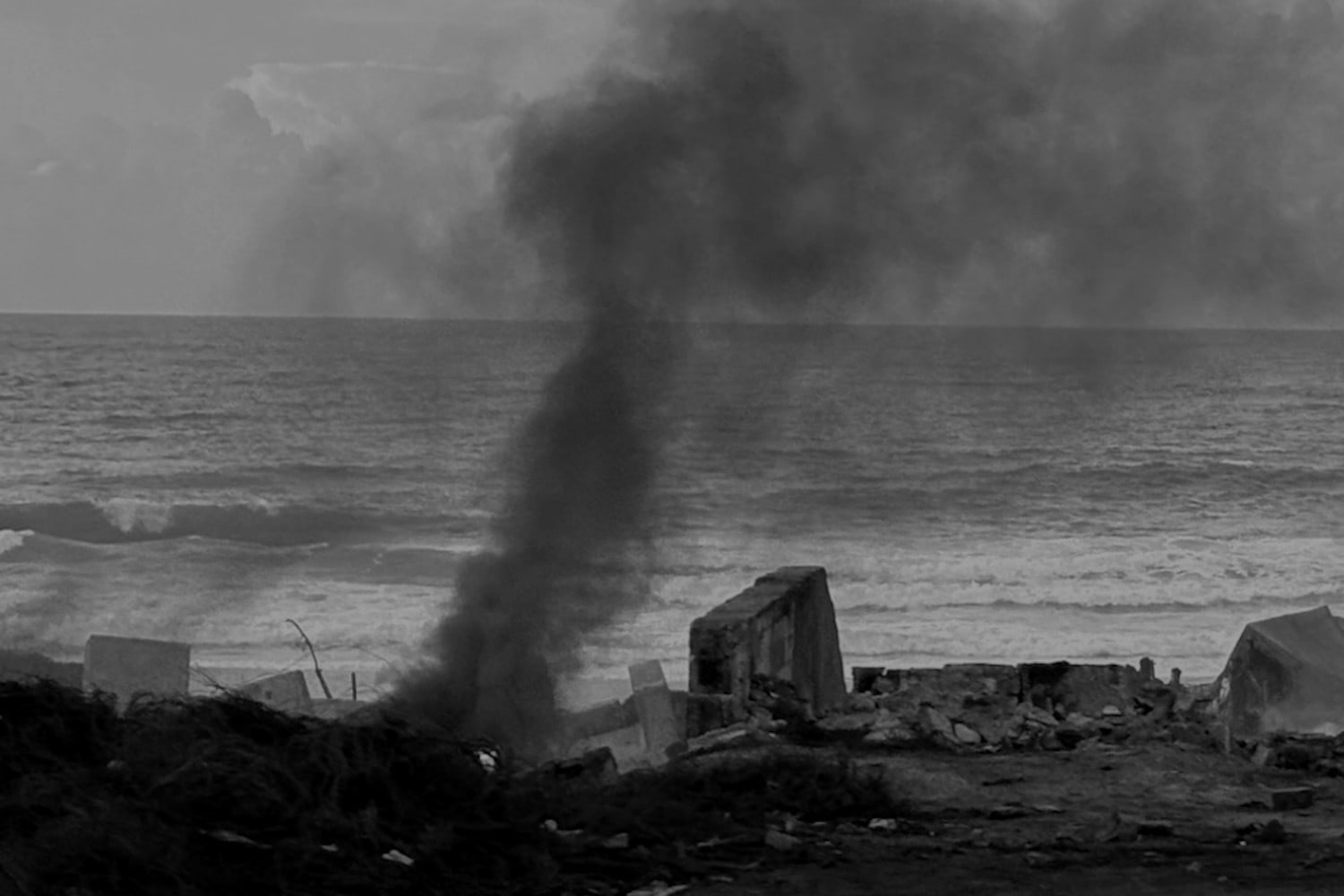
61 million tons of rubble, the equivalent of approximately 29 tons for each inhabitant, and over 99% of the territory in which indicators of potential environmental contamination have been identified. Gaza is now an immense expanse of debris, with toxic dust, heavy metals and contaminated water. And the consequences on the health of the population risk lasting for decades.
This is what emerges from the new report Environmental War Crimes: How Israel’s military assault has turned Gaza into a toxic wasteland, threatening human survivalpublished by Oxfam in collaboration with the Conflict and Environment Observatory (CEOBS), which documents the devastating effects of the Israeli military offensive on the environment and natural resources of the Strip.
We have spoken to you several times about the environmental impact of wars and how armed conflicts represent a catastrophe even on an ecological level. But what is happening in Gaza reflects the extent of a disaster destined to survive the war itself: the bombs may stop falling, but the toxic substances they release into the environment cannot. Through satellite images, remote sensing analyses, databases on war events and scientific literature, in fact, the researchers estimated that Israeli ground military operations would have directly affected approximately 78% of the surface of the Strip, while indicators of at least one potential source of contamination were identified in over 99% of the territory.
@Oxfam
Another piece of data reported in the dossier gives the measure of the devastation: according to United Nations estimates cited by Oxfam, in less than two years over 200 thousand tons of explosives were dropped on Gaza, releasing a total energy equivalent to that of 13 atomic bombs like the one on Hiroshima.
This does not mean that the concentrations of toxic substances in the entire Strip have been measured in the field. The restrictions imposed by Israel on the entry of independent experts and monitoring equipment, Oxfam reports, still prevent a complete environmental assessment. However, the available evidence is sufficient, according to the authors, to establish that the contamination is widespread, serious and destined to have lasting consequences.
Which areas of Gaza are the most contaminated and what pollutes the most
According to analyzes by Oxfam and CEOBS, the five areas in which the highest risk of contamination is concentrated, both in terms of severity and variety of pollutants, are:
@Oxfam
But not even the areas less directly affected by the bombings, such as the coastal strip between Al Mawasi and Az-Zawaideh, where thousands of displaced people have concentrated, can be considered safe. Pollutants move through wind, precipitation and water flows, even reaching places distant from those where they were originally released.
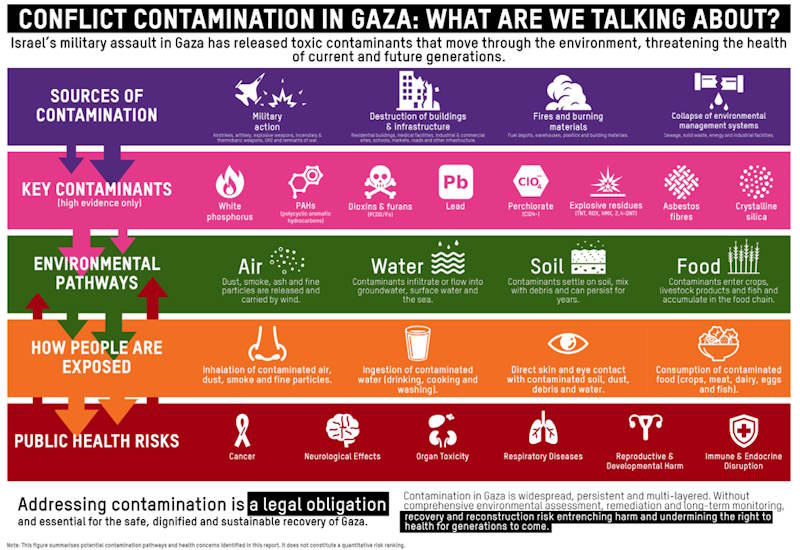
What worries experts above all is the overlap of different sources of pollution. In fact, there are not only substances released by explosions, but also those coming from the destruction of civil infrastructures and the collapse of waste and wastewater management systems.
Here are the main sources of contamination identified in the report:
Of the 79 groundwater wells analyzed in July 2026 by the local Ministry of Health, 19% were contaminated with fecal coliforms, compared to 2% reported in 2021. A proportion almost ten times higher, which testifies to the deterioration of the microbiological quality of groundwater. About 85 percent of Gaza’s water infrastructure has been damaged or destroyed. As of April 2026, despite humanitarian interventions and emergency repairs, overall water availability was just 39% of what it was before the conflict.
Things are no better on the wastewater front: all six purification plants were destroyed, while in April just 19% of the pumping stations were operational and only 30% of the sewerage network remained partially functional.
The result? Every day around 40 thousand cubic meters of untreated sewage end up in the Mediterranean, while another 15 thousand are dispersed through leaks in the sewer system and cesspools, contributing to the contamination of the subsoil and aquifers.
As for agricultural land, only 3% of the arable area is still accessible and intact, according to FAO data from August 2026 cited in the report. The areas of Beit Hanoun, Wadi Gaza and north-east of Khan Younis are also particularly vulnerable to the accumulation of contaminants, due to the greater presence of clay in the soils. The problem, therefore, will not only be to go back to cultivating the land, but to understand whether what grows on that land can be consumed without risks. And the same goes for fishing and livestock products.
On the air pollution front, however, the potentially most critical situations are recorded in Gaza City, Jabalia and in the North Gaza governorate. The dust produced by the destruction of buildings settles on the surfaces and is then recirculated by the wind, the passage of vehicles and the rubble removal operations.
It goes without saying that prolonged exposure to these substances increases the risk of chronic respiratory diseases, tumors, cardiovascular diseases, kidney and liver damage, neurological disorders, alterations of the endocrine system and reproductive health. Particularly vulnerable are children, pregnant women and the workers themselves who will be involved in reconstruction.
How much will it cost to rebuild Gaza?
And what about the impact of the war on the climate? A 2026 study, cited by Oxfam, estimates that direct emissions from the conflict had already exceeded 1.3 million tonnes of CO₂ equivalent in January 2025. A figure that rises to 33.2 million tonnes when also considering pre-conflict military infrastructure and emissions expected from future reconstruction. The latter would represent approximately 95% of the overall estimated emissions, equal to 31.4 million tonnes of CO₂ equivalent.
But even before rebuilding, we will have to understand how to reclaim an area in which almost two million people live exposed to contamination whose nature and extent are not yet fully known.
Oxfam is therefore calling for an independent environmental assessment on the ground, unrestricted access to the necessary experts and equipment, the restoration of Palestinian laboratories and long-term health and environmental monitoring. The organization also demands that Israel compensate for environmental damage resulting from violations of international law and that reconstruction be led by the Palestinians themselves.
The dossier raises serious questions about respect for international humanitarian law and human rights. The authors point out that their analyzes also contribute to the evidentiary framework relevant for the purposes of the Genocide Convention, although they are not sufficient, on their own, to demonstrate all the constituent elements of this crime.
Rebuilding houses, schools and hospitals without first worrying about the healthiness of the water, air and land on which they will be built would mean exposing entire generations to the consequences of war. Even those that have yet to be born.
