
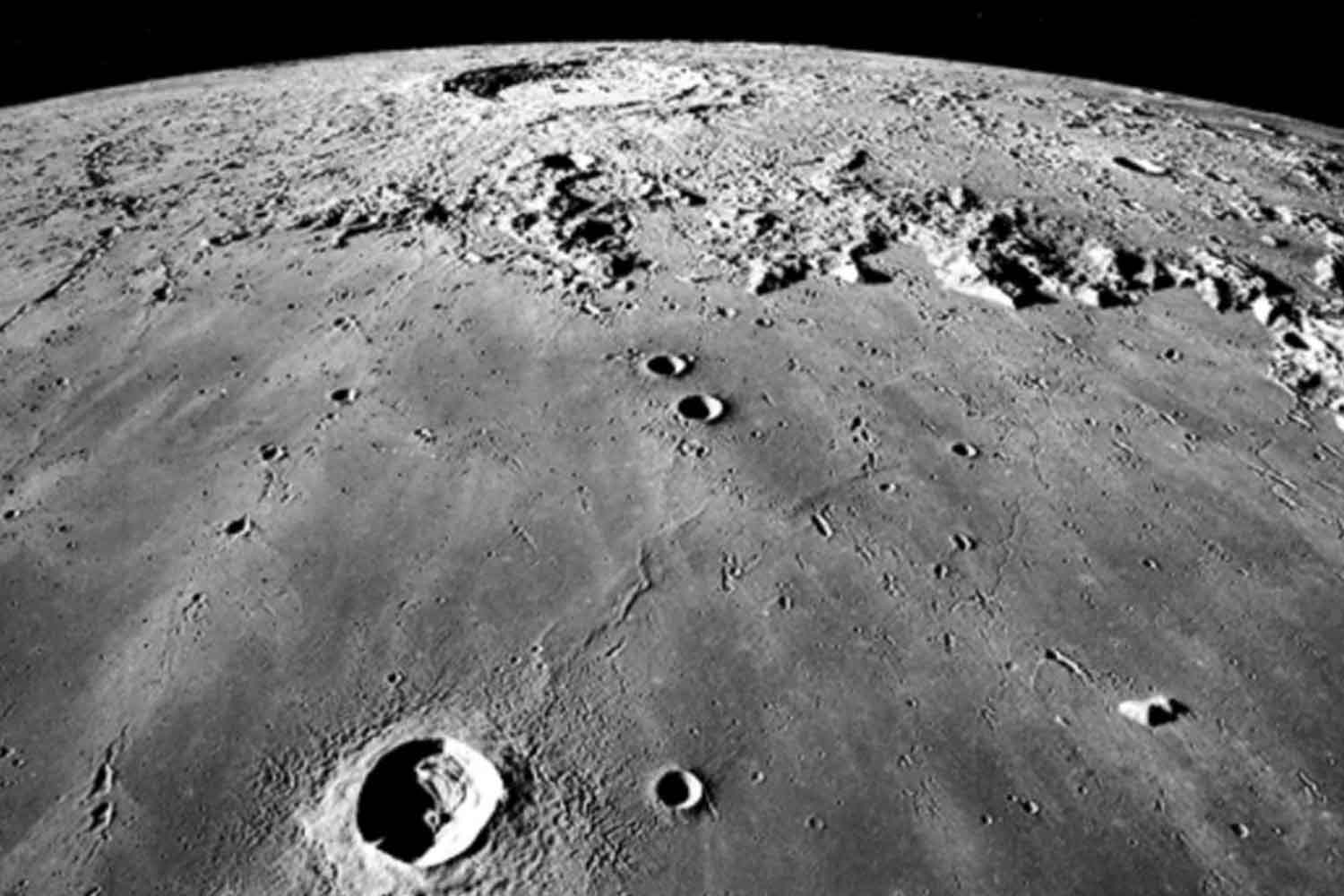
Who would have thought that the moon, our natural satellite, always considered an arid and inhospitable place, could conceal a resource as precious as water inside? Yet, thanks to an extraordinary discovery, Chinese researchers found a way to Extract water directly from the lunar soiltaking advantage of the hydrogen imprisoned by the sun wind. This method could change forever the way we imagine spatial exploration and the possibility of living permanently on the moon.
For billions of years, the surface of the moon has been bombed by the sun wind, a continuous flow of charged particles coming from the sun. This process has meant that hydrogen atoms were trapped in the minerals that make up the regulation, the thin layer of dust that He holds the moon.
Thanks to the samples collected by the Chinese mission Chang’e-5scientists have discovered that it is possible to transform these hydrogen atoms into water. The process is as simple as revolutionary: by heating the lunar soil at temperatures above 1,000 ° C, hydrogen interacts with iron oxides in the regolite, producing elementary iron and water vapor. The latter, once condensed, turns into liquid water.
The numbers of this discovery are impressive. With a gram of regolite it is possible to produce between 51 and 76 milligrams of waterwhile a ton of lunar soil could provide beyond 50 kilograms of watersufficient to meet the water needs of 50 people for a whole day.
Ilmeniite: the treasure hidden in the lunar soil
Not all the minerals of the moon are the same, and some have proved more suitable than others for the extraction of the water. Among these, theilmeniite (fetio3) It stands out as the most promising. This mineral, abundant on the lunar surface, is particularly rich in hydrogen thanks to its unique structure, which houses small tunnels capable of absorbing and holding large quantities of sun wind particles.
The researchers discovered that lunar ilmeni is different from the terrestrial one: its wider atomic structure allows you to store more hydrogen, making the extraction process even more efficient.
In addition, the experiments have shown that it is possible to drastically lower the temperature necessary for the extraction of the water. From 1,000 ° C initial, the process can also be performed to temperatures of only 200 ° Csignificantly reducing energy consumption and making the whole operation more sustainable in an environment like the lunar environment, where energy resources are limited.
The Chang’e-5 mission
2020 was a crucial year for lunar exploration. The mission Chang’e-5 He reported on earth 1,731 grams of lunar championsoffering scientists a precious opportunity to analyze the composition of the lunar soil and its potential as a resource for spatial exploration.
These samples have confirmed that lunar regolite is not only a set of inert powders, but a real reserve of useful elements, including the hydrogen necessary to produce water.
This discovery has enormous implications: water is not only essential for human sustenance, but it is also essential to generate hydrogen -based oxygen and fuel, fundamental elements for long -lasting spatial missions. In addition, being able to count on water resources directly on the moon reduces the need to transport water from the earth, reducing logistical costs and complexity.
Where to find the water on the moon
The distribution of hydrogen on the lunar surface is not uniform. Scientists have discovered that the equatorial regions of the moon, being more exposed to the solar wind, are particularly suitable for converting hydrogen into the water. On the contrary, the areas located in higher latitudes retain greater quantities of hydrogen, thanks to the lower exposure to solar radiation.
These data will be crucial for future space missions, which will be able to precisely map the richest areas of resources, identifying the best places to extract water and other raw materials indispensable for human survival in space.
The extraordinary discovery of Chinese researchers is not only a scientific goal, but a concrete step towards a new era of space exploration. Exploiting the natural resources of the moonlike the hydrogen trapped in the regolite, and developing increasingly efficient technologies, humanity is increasingly approaching the dream of establishing a permanent basis on our natural satellite.
In addition to representing a unique opportunity for scientific and technological development, this discovery is an example of how human ingenuity can transform even the most inhospitable places into a resource for the future.
