
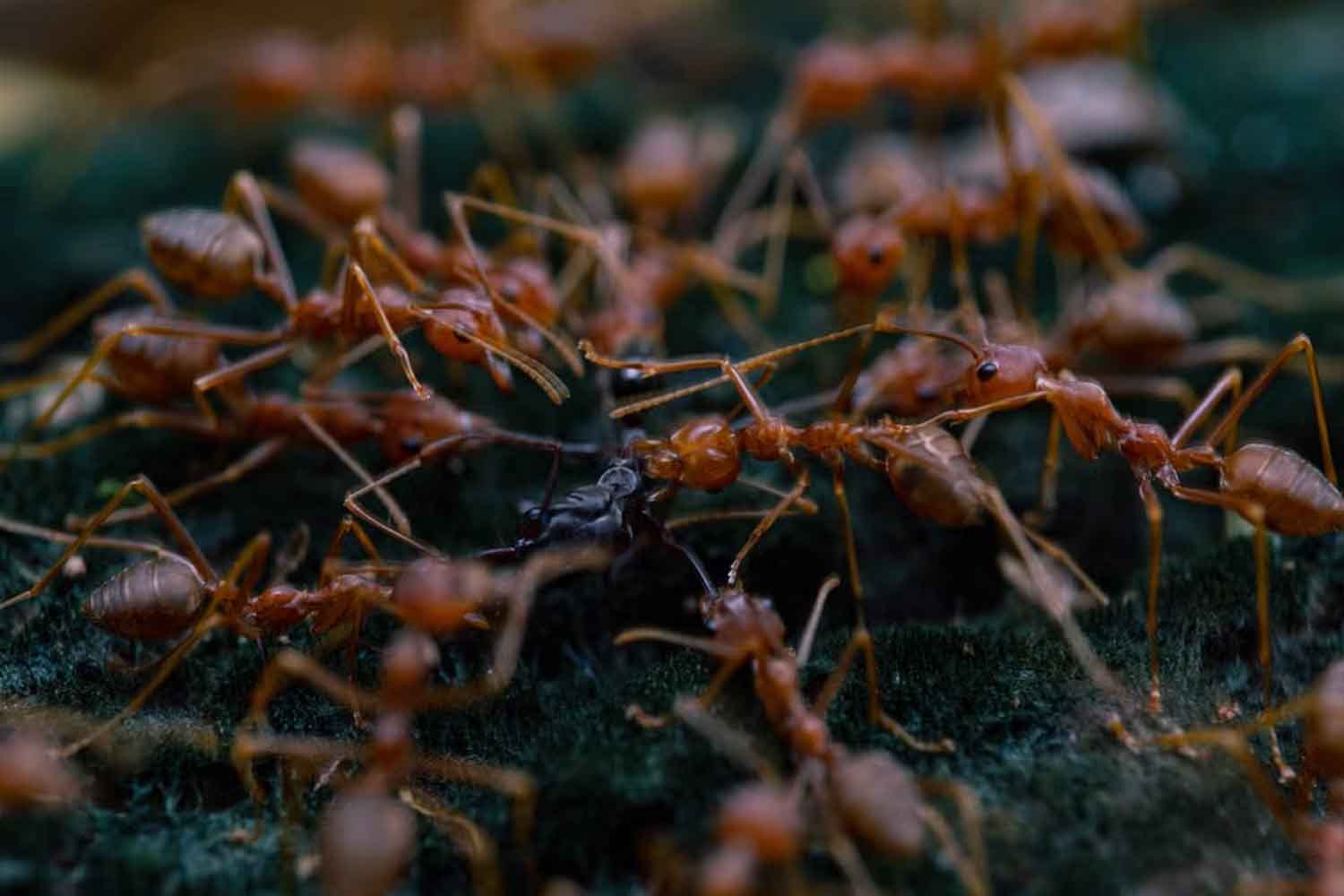
Place two ants in a small test tube for ten minutes. One comes from an Italian population, the other may have been collected thousands of kilometers away. They touch each other with their antennas, they study each other and, if they belong to the same gigantic supercolony of Argentine ants, the fight simply doesn’t start. This is how researchers discovered an animal society capable of extending for about 6,000 kilometers along the coasts of southern Europe, with millions of nests and billions of workers that behave like members of the same enormous community.
And huge is almost an understatement. Its extension was documented as early as 2002, in a study published in PNASafter analyzing populations distributed along 6,004 kilometers of European coastline. More than a single underground city, it is a network of cities that have stopped considering themselves foreign.
How you discover a colony the size of half of Europe
The protagonist’s name is Linepithema humilethe Argentine ant, a small species native to South America that accidentally arrived in Europe through human activities. In Portugal it had already been reported at the end of the nineteenth century; in Italy it appears in recordings from the beginning of the twentieth century. Outside its original area it has found particularly favorable conditions in areas with a Mediterranean climate.
In 2000, Tatiana Giraud, Jes S. Pedersen and Laurent Keller collected samples from 33 European populations distributed along 6,004 kilometers of coastline and put the workers face to face in a long series of aggressiveness tests. The result was almost binary: in 1,131 trials out of 1,151 the ants either fought decisively or tolerated each other without showing antagonism.
Two groups thus emerged. A small Catalan supercolony included three of the populations analyzed; almost all the others belonged to the gigantic main supercolony. Among individuals of the latter, even from very distant locations, no aggression was observed. However, when workers from the two rival supercolonies were brought together, the meetings were anything but diplomatic: in the tests between the two groups, a worker was killed in 235 cases out of 241.
This is the mechanism called unicoloniality. The individual nests remain physically distinct, but their inhabitants can mix and cooperate without behaving like strangers. Workers living at opposite ends of the supercolony will likely never meet during their short existence. Socially, however, they belong to the same system. For them, geography seems to have very elastic boundaries.
Billions of ants that have stopped fighting each other
In the original South American range the situation is different: the populations of Linepithema humile they have a more fragmented structure and workers from different colonies can be aggressive towards each other. In invasive European populations, the loss of aggressiveness among an enormous number of nests has eliminated a large part of the costs associated with defending territories. This allows it to reach very high densities and concentrate energy and workers on collecting resources and competing with other species.
The authors of the 2002 study described the European supercolony as made up of millions of nests and billions of workers, calling it at the time the largest cooperative unit ever recorded. So no “half a billion” measured one by one: the dimensions are estimated on the basis of the enormous distribution and the number of nests, and the scientific literature explicitly speaks of billions.
The matter got even stranger a few years later. In a study published in Evolutionary Applicationsresearchers compared invasive populations from Europe, North America, Japan, Australia, New Zealand and Hawaii. Some of the large supercolonies on different continents showed very similar genetic and chemical profiles and, when the workers were put together, they accepted each other as belonging to the same group. The authors went so far as to describe this intercontinental network as the most populous known animal society.
An impressive city, with much less fascinating effects on ecosystems
Seen from above, the idea of billions of ants cooperating from Portugal to Italy is irresistible. From an ecological point of view, the story loses a lot of poetry. Linepithema humile it is an invasive species capable of reaching enormous densities and displacing native ant communities, with consequences that can also spread to the relationships between insects and plants.
An experiment conducted in a Mediterranean forest in north-eastern Spain, for example, found the complete replacement of native ant species involved in seed dispersal in the invaded area. The Argentine ants quickly identified the food, however a much smaller share of the interactions ended with the actual transport of the seeds to the nest: 7.4% in the invaded area versus 41.9% in the area where the local species were present. A small ant can therefore also change the way a plant can move its seeds.
For Italy the problem is very real. A scientific assessment published in 2024 placed the Argentine ant among the already established alien species with the highest invasive risk, together with the fire ant Solenopsis invicta. The authors point out that L. humile it has already demonstrated the ability to penetrate and deteriorate Mediterranean ecosystems and is associated above all with coastal areas and environments heavily modified by man.
And it continues to be observed. An Italian dataset published on Scientific Databuilt with 4,698 reports collected between 2011 and 2024 and validated by experts, confirms its presence also near Genoa and Bari. These data document the species; alone they do not allow us to assign every Italian population to the gigantic supercolony described in the European experiments. For that, behavioral, chemical or genetic comparisons are needed.
The 6,000 kilometer long “city”, therefore, does not have a center or even a single network of tunnels. It has millions of different addresses and inhabitants who can go their entire lives without meeting. Yet, when two of those tiny workers end up in the same test tube, they often recognize each other on the same side. The tunnels stop much earlier. Cooperation, evidently, is not.
