
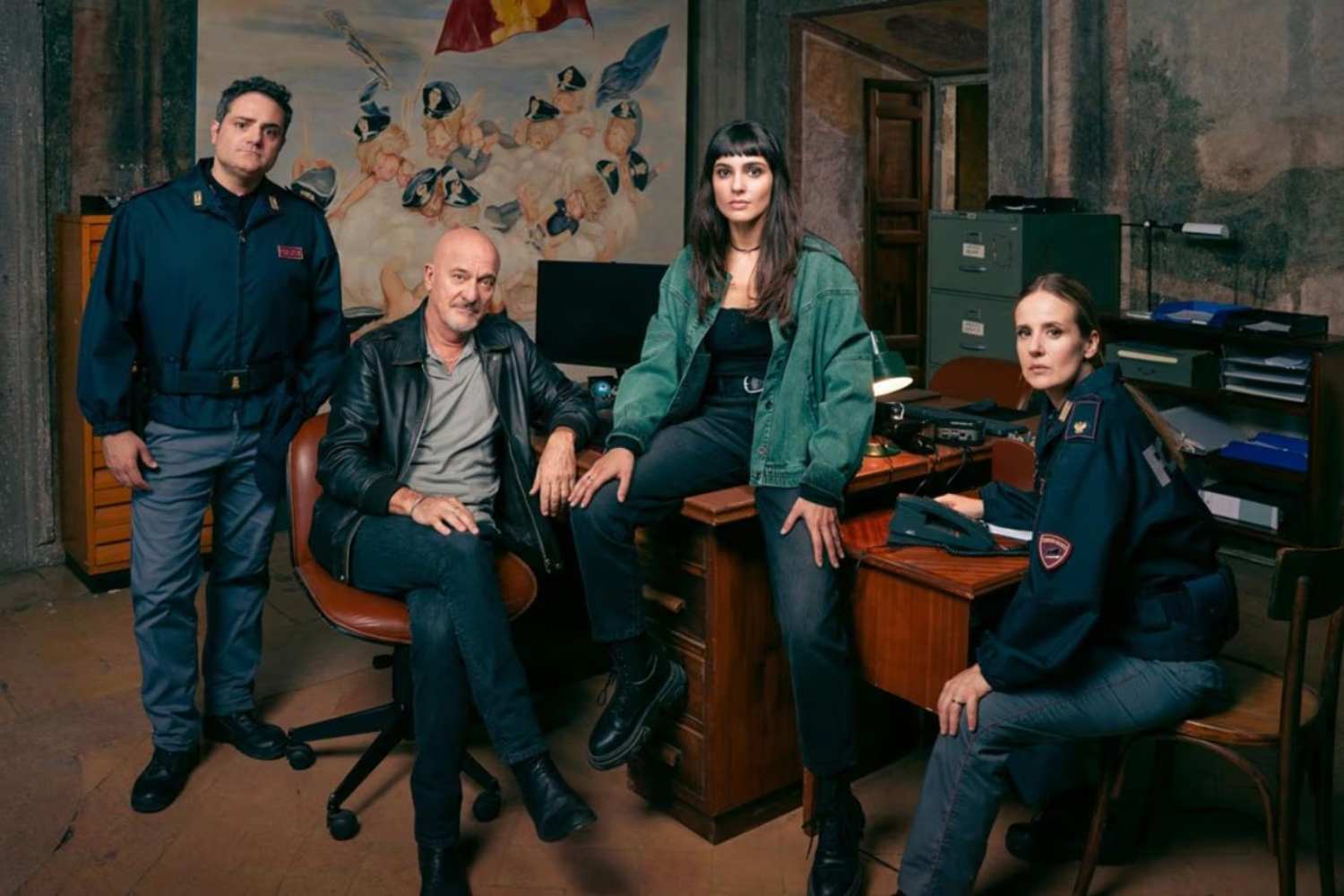
Claudio Bisio plays the role of commissioner Vasco Benassi, protagonist of the new fiction A cop in the Apenninesarriving on Rai1 this evening, 9 April, at 9.30pm for four prime time slots, but with the first two episodes already available on RaiPlay from 7 April. The character is an expert investigator, considered the best policeman in Bologna, whose career comes to a sudden halt after a professional mistake. The consequence is a punitive transfer to Muntagò, a small imaginary town in the Apennines where Benassi was born and which he had left years earlier.
The return to the origins is not just a change of location, but a true comparison with the past. Between old family ties, suspended loves and village dynamics, every investigation becomes personal. The commissioner thus finds himself working in a context far from the city, where relationships are more direct and each case involves the entire community. The tone of the series mixes crime, comedy and drama, building a narrative that alternates investigative tension and more intimate moments.
View this post on Instagram
The Apennines as protagonist and the theme of depopulation
More than just a setting, the Apennines become one of the main protagonists of the series. Muntagò represents the many mountain villages marked by depopulation, the closure of services and the difficulty of retaining young people. The fiction tells of a fascinating but fragile territory, where natural beauty coexists with the feeling of isolation and the memory of a more populated past.
The personal stories of the characters reflect precisely this scenario. Some have chosen to stay, others have returned after years, still others are looking for a distant future. The series showcases a community that resists, showing traditions, relationships and conflicts typical of small towns. The investigations thus become a pretext to tell the identity of a territory and its contradictions, avoiding the classic scheme of a purely procedural mystery.
A team between family, irony and old wounds
In Muntagò, Benassi meets his cousin Gaetana, inspector of the police station, a determined and direct woman who embodies the rough spirit of the mountains. Next to her is her husband Bruno, the commissioner’s old rival, and the young agent Fosco, who decides to follow him to the Apennines out of respect and trust. The group creates an unusual team, marked by complex personal relationships and an irony that eases tensions.
Among the key characters, Amaranta, a young Neapolitan policewoman who arrived as reinforcement, also emerges. Determined and impulsive, she sees a mentor in Benassi, while he develops a relationship that is difficult to define, suspended between professional guidance and an almost familial bond. Their collaboration becomes one of the central elements of the narrative, with investigations that test trust and method.
View this post on Instagram
The return of a love and the bonds of the past
The return to Muntagò also brings Nicole Poli, mayor and great platonic love of youth, back into the commissioner’s life. Played by Valentina Lodovini, Nicole is a strong figure but marked by complex personal experiences. Their relationship oscillates between nostalgia and the present, as they both seek a new balance.
The younger ones also revolve around them, such as Nicole’s son and Gaetana’s, who represent a generation divided between the desire to leave and the desire to repopulate the territory. The series thus introduces the theme of depopulation in a concrete way, showing how the choices of children influence the future of small Apennine towns.
An atypical detective story between mysteries and identities
A cop in the Apennines stands out for a different approach to the genre. The cases don’t just serve to uncover the culprit, but to explore the characters, their traumas and relationships. The tone alternates investigative moments with everyday situations, building a choral story where the community becomes an integral part of the investigations.
Inspector Benassi is not the perfect hero, but an ironic, abrupt and vulnerable man, forced to deal with the past. His return home becomes a path of reconciliation with his roots, while the country faces the challenges of modernity and depopulation. In this balance between mystery and humanity, the fiction tries to tell a less explored Italy, made up of villages, memories and relationships that resist over time.
You might also be interested in:
