
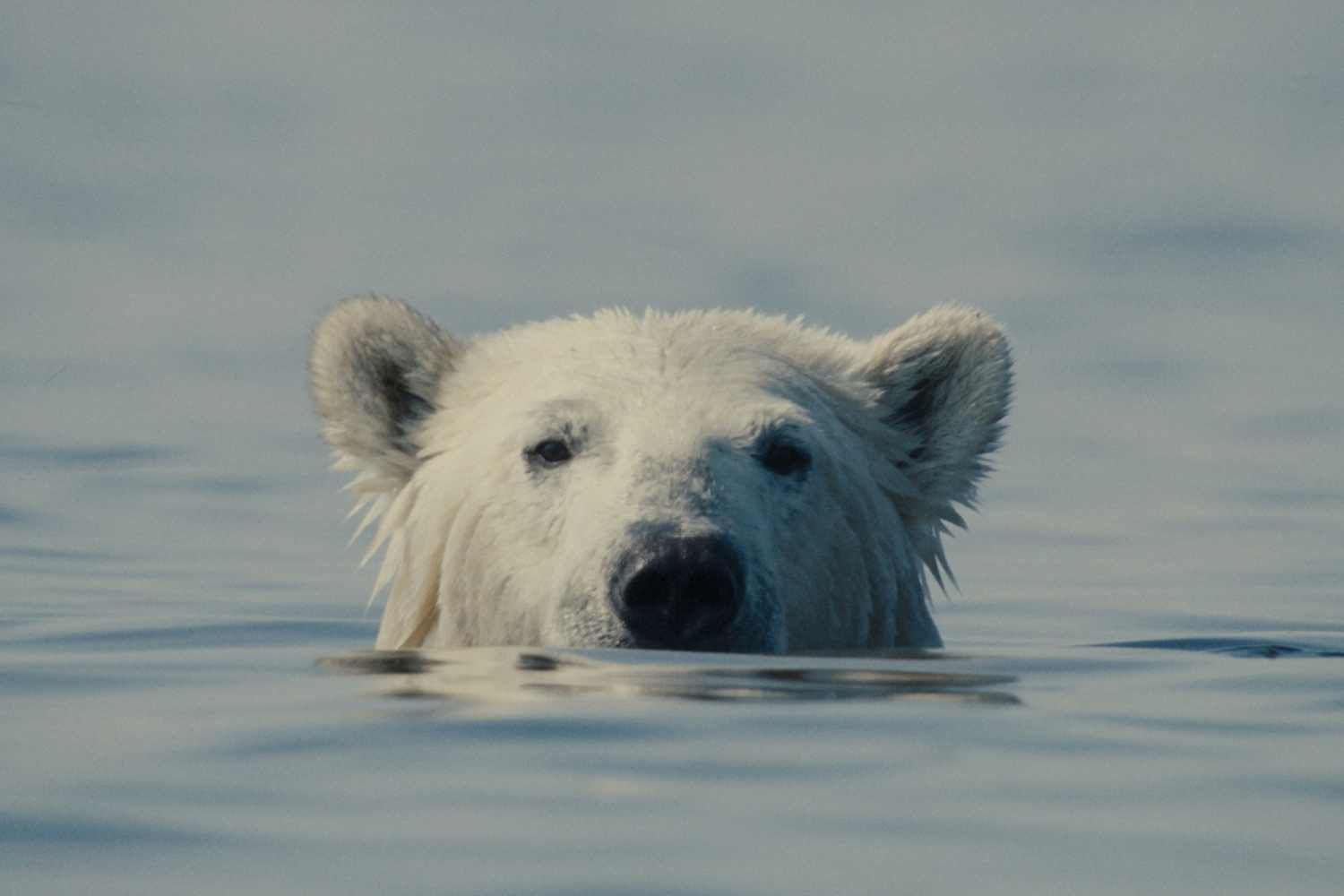
Imagine an increasingly disoriented polar bear wandering among the tourists of a Canadian town. Or a Brazilian community buried by sand after a devastating flood. Or a Bolivian child growing up in the bowels of a silver mine that fuels our “green” technologies. These are some of the stories awarded at the 29th CinemAmbiente Festival of Turin, the most important festival dedicated to environmental cinema in Italy, which ended on 7 June 2026.
Forty-five films in competition, from all over the world, to tell the ecological crisis without giving up beauty, emotion and poetry. Here are the winners.
The best documentary tells the increasingly difficult coexistence between man and wildlife
The Asja Award for best international documentary (€5,000) went to “Nuisance Bear” by Jack Weisman and Gabriela Osio Vanden (USA/Canada/UK, 89′). The title in Italian sounds like “Problem Bear” — and in fact that is precisely what the film is about: the polar bears of Hudson Bay, forced by climate change to push ever further towards the human settlements of Churchill, Manitoba, the city that has proclaimed itself the “Polar Bear Capital of the World”.
The jury awarded it as a “visually bewitching” film, which dances in contrasts: funny, tragic, paradoxical, capable of telling the story of animal extinction without losing empathy. To guide us on this journey, an Inuit voice off-screen – bearer of ancestral knowledge that calls into question every certainty of the modern world. The film also won the Piemonte Parchi Award, which includes the planting of 100 trees in the shared forest of the Piedmontese Po.
The public chooses submerged Brazil
Festival spectators awarded the IREN Audience Award (€1,500) to Rua do Pescador, nº 6 by Bárbara Paz (Brazil, 72′), which also obtained a special mention from the international jury. The film documents the 2024 flood that engulfed Rio Grande do Sul: 600,000 displaced, entire neighborhoods under water for weeks, streets of Porto Alegre transformed into rivers. But the director – already known for the documentary on Babenco which won an award in Venice and was nominated for an Oscar – chooses to tell the tragedy through the intimate stories of a small community, that of the Arquipélago neighborhood (The Islands), where the houses were literally buried by the sand. The result is a powerful portrait of human resilience in the face of climate collapse.
The short film that turns ecological collapse into pain
For shorts, the SMAT Award went to A Voyage of Eulogies by Jean-Pierre Pillay (Singapore, 21′): in the near future, a director searches for traces of life on Earth after an ecological disaster. An environmental science fiction film that transforms ecological collapse into personal pain, into memory, into elegy. The jury rewarded him for his ability to make perceptible what the data cannot communicate.
Special mention to the tender Amma, Do Giraffes Cry? by Kartikeya Saxena (Czech Republic, 26′), in which a director takes his zoologist mother to the Prague zoo to film the animals: a gorilla terrified of the spotlight, penguins chasing their own shadow, a sleepless anaconda. A film that questions the boundary between the animal and human worlds with rare delicacy.
Italy in the foreground between wolves, the Tiber and intensive fishing
Among Italian films, the “Gaetano Capizzi” special recognition for the Made in Italy section went to Torneranno i wolves by Bianca Vallino (52′), set in the hills of Monferrato: three generations of women facing an unspoken pain, the infinite cycles of nature, tarot cards, wolves. The graduation film by the young Turin director succeeds in the rare feat of transforming a personal story into a universal reflection on the bond with the earth.
Special mention for Tevere corsaro by Pietro Balla and Monica Repetto (95′): following the “Pasolini Path” from Rome to the Idroscalo of Ostia, the film intertwines the defense of the environment with that of collective rights. A courageous work, created also thanks to Pietro Balla, who passed away during filming in 2021.
The Casacomune Award – an original engraving by the artist Francesca Capirone – went instead to Ma Prière à la mer (My prayer to the sea) by Davide Marino (60′): an African tale steeped in magical realism set on the Senegalese coasts, where the fish have disappeared due to intensive foreign fishing. The Roman director, visual anthropologist, transforms ecological denunciation into spiritual prayer through the cosmology of the Lebu.
The other works that stood out
The Slow Food Award went to the delightful animated short film Labouyi Bannann (Banana Soup) by Geena Gasser (Switzerland, 7′): starting from the myth of the creator goddess Timbehes, who generated humanity by fertilizing herself with a banana, the film denounces the paradoxes of consumerism and industrial agriculture in seven minutes. Colorful, ironic, surprising.
The Environment and Society Award, awarded by the workers of the Cooperativa Sociale Arcobaleno, went to Silver by Natalia Koniarz (Poland/Norway/Finland, 79′): a journey into the silver mines of Potosí, Bolivia, among the oldest in the world. The silver mined at the cost of human lives now fuels the very “green” technologies that are supposed to save us. A short circuit that the film tells through the eyes of twelve-year-old Juvi. Special mention to Andrea Marinelli’s Enemies of the People, on oil drilling in Basilicata and the Amazon, for “its ability to make us understand how with multinationals the rule of law is in danger both on the other side of the world and in our own backyard”.
How to watch movies for free
A selection of 45 films from the festival can be viewed for free online until 14 June 2026 on the OpenDDB platform, through the official website www.festivalcinemambiente.it (attention: availability limited to 300 accesses per title).
