
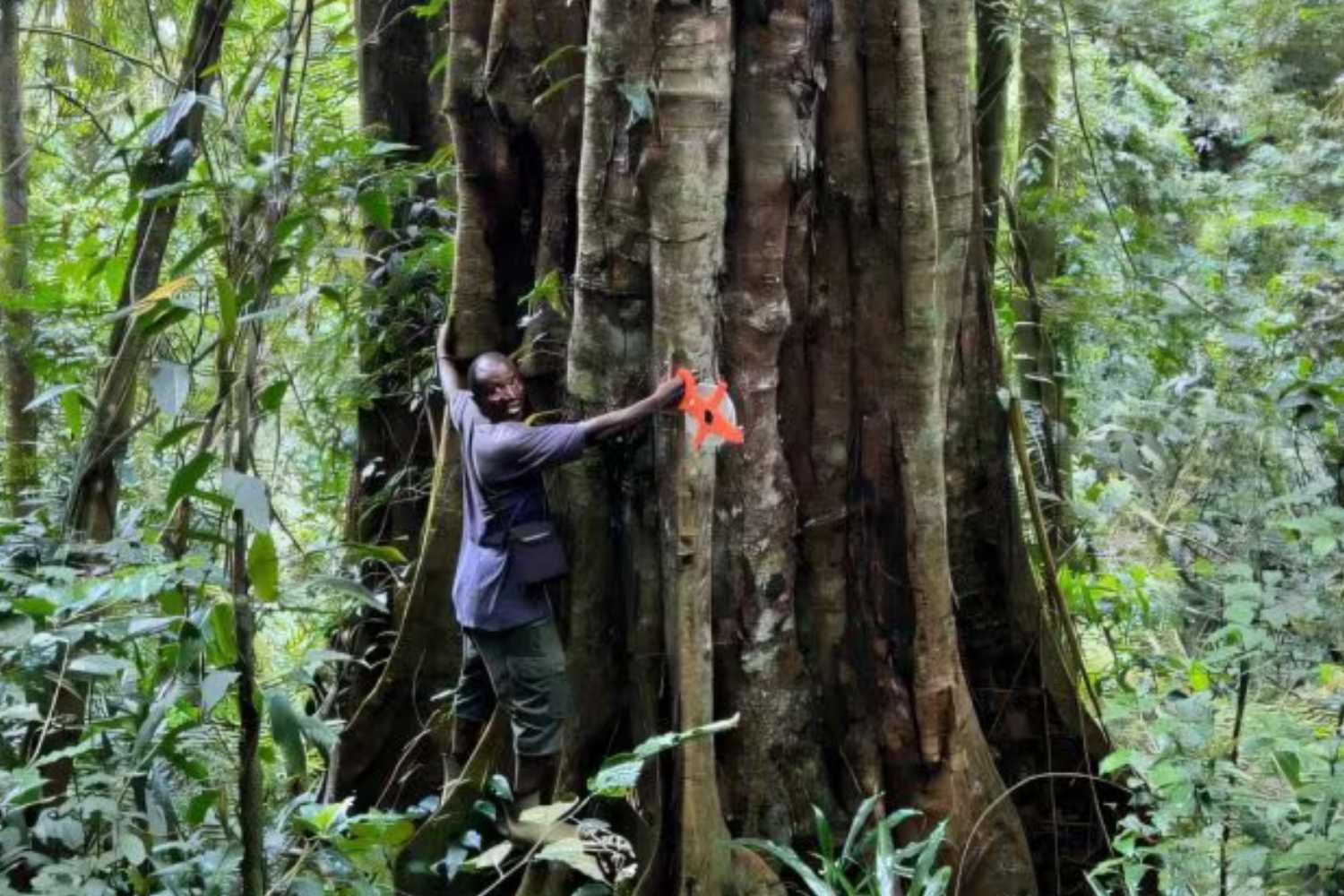
In the green heart of Tanzania, among the dense mists of the rainforest of the Udzungwa mountains, a group of scientists made an extraordinary discovery: a new species of tree, majestic and very ancient. His name is Tessmannia Princeps and boasts record numbers: he can reach 40 meters in height and live up to 3,000 years. One of those giants who, silent and impressive, observe time to flow without haste.
The name is not accidental: the genre Tessmannia He pays homage to the German-Brazilian botanist Günther Tessmann, while “Princeps”, in Latin, means “eminent”. A spot on choice, since it stands on the rest of the vegetation as an undisputed king of the forest.
An epic flavor expedition
It all started in 2019, when an international research team, with a strong Italian component, undertaken an expedition between the branches of one of the richest areas of biodiversity in the world. Among the scientists involved, the researchers of the Muse – Trento Science Museum – led by dr. Andrea Bianchi – who worked side by side with colleagues from African and international institutes.
As they entered the forest, the researchers met a colossal tree, with unusual characteristics, which, although resembling another species already known, Tessmannia densiflora, presented peculiarities that made it unique, a new titan of nature still unknown to science.
A slow growth giant
Analyzing the plant, the botanists discovered several fascinating details. Unlike Tessmannia densiflora, which stops around 25 meters, the new species can exceed 40, has a straight and cylindrical trunk, without branches up to 20 meters high, with a maximum diameter of 2.7 meters.
The most incredible feature of Tessmania Princeps (here the publication of the article) is the extraordinary longevity: the growth process is extremely slow, given that the tree gains just one inch of circumference every 15 years, which means that the biggest specimens could have an estimated age around 3,000 years.
When humanity lived empires and revolutions, these trees were already there, to observe the changes of the world.
How did it come to the discovery?
To measure the dimensions of the Tessmannia Princeps, the researchers had to climb through the aid of ropes and harnesses, using tools such as the telemeter and even drones to capture lke images from above. Samples of leaves, flowers and cortex were collected for an in -depth analysis in the laboratory.
The differences compared to the species already known are not limited to size: the flowers, for example, are white and not red, while both sepals and petals have small dimensions compared to the similar plants.
Do you want to know a really curious detail? The petals have small yellow bulbs on the tip, a characteristic element that helped botanists to recognize it as a completely new kind.
A heritage to be protected
The discovery of Tessmannia Princeps is great news for science, but it also brings a challenge with it: conservation. Currently, these trees are located within a protected area, but their number is extremely limited: the specimens identified are just over a hundred, and the very slow growth makes them particularly vulnerable both to environmental changes and to any human interventions.
For this reason, scientists have proposed to classify it as “vulnerable” in the red list of the IUCN (International Union for the conservation of nature), a due recognition, which will be able to guarantee the Princeps Princes greater protection and the possibility of continuing to live and tell its story for the millennia to come.
