
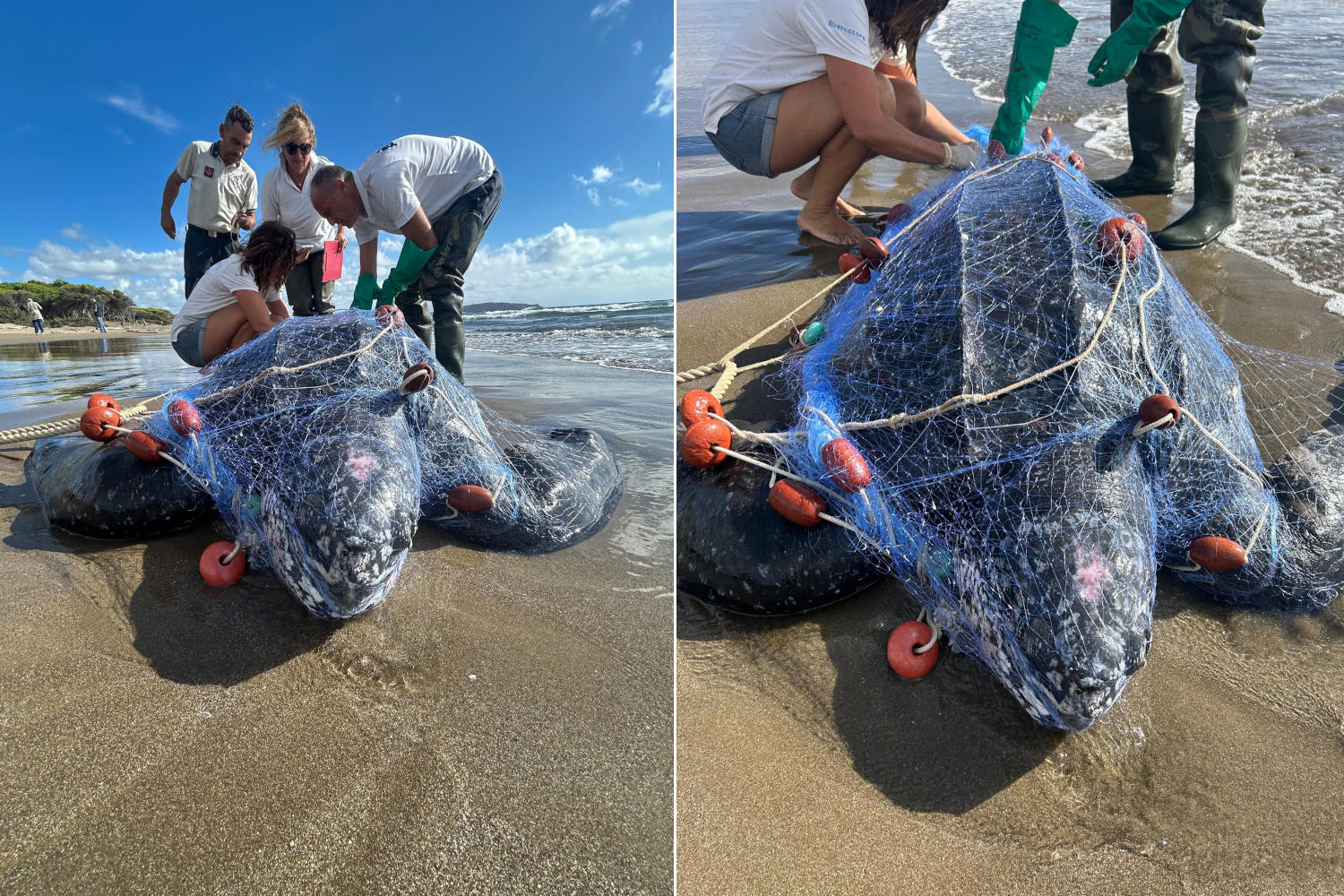
On the Feniglia beach, near the La Zonca bathing establishment in the municipality of Orbetello, in the province of Grosseto, on the morning of Friday 9 October the lifeless body of a rare specimen of leatherback turtle, scientific name, was found Dermochelys coriacea. The first report came from Massimo, operator of the plant, activating a timely and detailed recovery intervention coordinated by the Port Authority together with the experts from the tartAmare association, the Arpat technicians and the researchers from the University of Siena.
Biometric measurements carried out on the carcass revealed impressive dimensions: a carapace 139 centimeters long and a total length of 180 centimeters between head and tail. According to experts’ estimates, it was a female aged between 20 and 30 years old, pushed ashore by the currents after being dramatically trapped in a tangle of gill nets that left her with no escape.
The incredible biology of the evolutionary giant of the seas
The presence of the leatherback turtle in the Mediterranean Sea represents an exceptional and very rare event, as it is the largest sea turtle species on the planet and the only reptile without a rigid bony shell. Its evolutionary history has its roots back over 100 million years ago, spanning the era of the dinosaurs and reaching us practically unchanged.
Instead of the classic scaly shell of Caretta carettathis giant has a robust leathery skin reinforced by thousands of bony plates, a feature that allows it to dive to record depths of more than 1,200 meters without the flexible armor shattering under the devastating pressure of the water. Furthermore, the species exploits the phenomenon of gigantothermy: an imposing body mass combined with a thick adipose layer allows it to maintain its internal temperature up to 18 °C above that of the water, allowing it to swim even in the freezing seas of the North Atlantic.
Yet another death caused by human activities
The dramatic episode in Orbetello puts the spotlight back on the fragility of marine ecosystems and the deadly dangers that threaten these thousand-year-old animals. Incidental capture in fishing gear and ingestion of waste or plastic are the main threats to a species classified as vulnerable and endangered. Faced with similar tragedies, the tartAmare association and the authorities renew their heartfelt invitation to boaters and fishermen to immediately report any sighting of fauna in difficulty by contacting the Coast Guard’s toll-free number 1530 or local recovery centres.
