
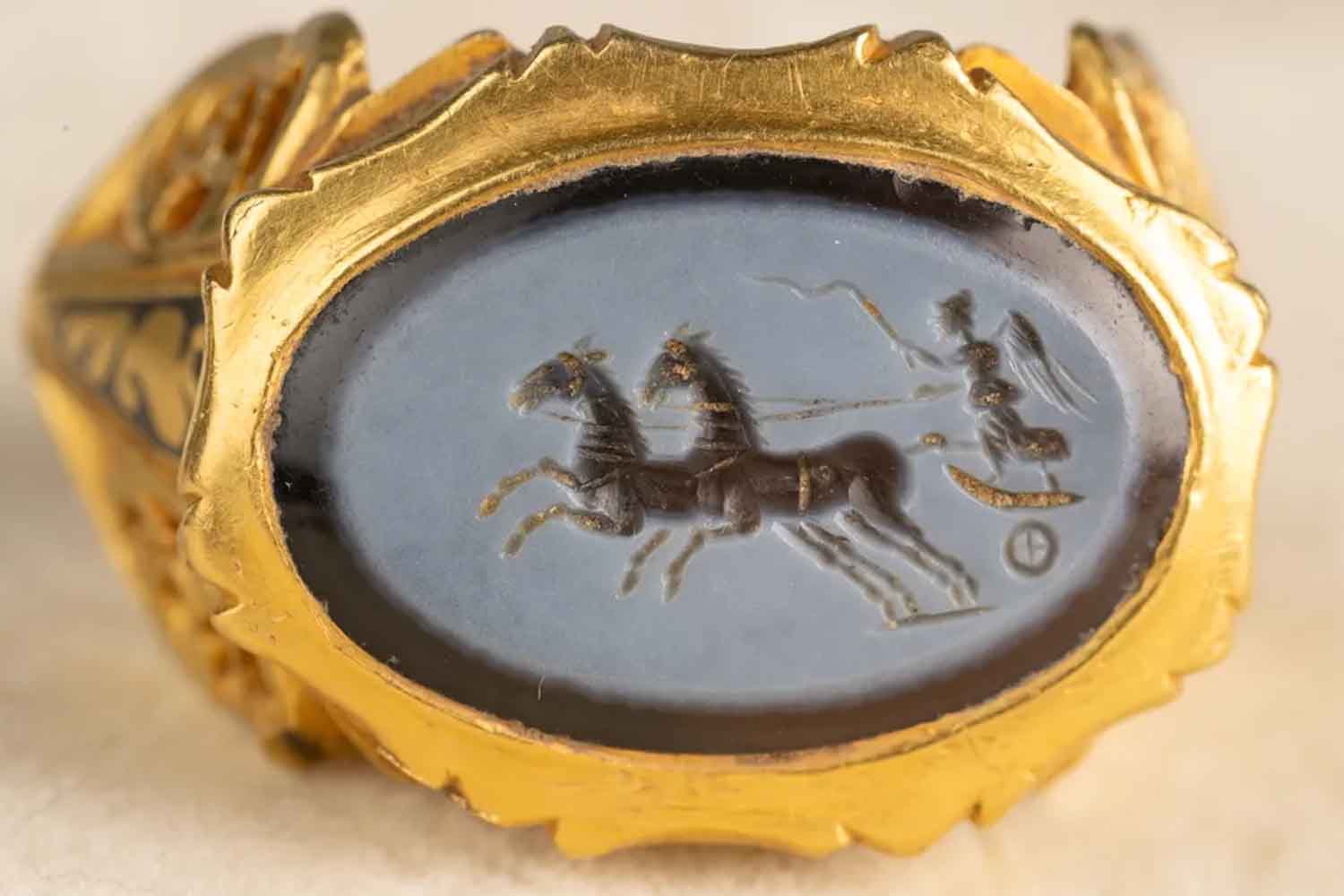
The English land, every now and then, returns Rome without making too much noise. A field near Ilminster, in Somerset, an area of south-west England which today seems very far from the imperial marbles, has brought out an apparently tiny object: a Roman ring in goldwhich remained buried for approximately 1,700 years along with a group of coins, lead and ceramics.
It was found in 2018 by Kevin Minto, a searcher with a metal detector, during a search authorized by the owner of the land. At first the signal seemed to promise a coin, perhaps a pin. Then a clearer shape emerged from the earth, too heavy to be a simple field surprise. The jewel today is known as The Minster Ring and was acquired by South West Heritage Trustthe body that also runs the Museum of Somerset.
The detail that stops archaeologists is the weight: 48 grams. For a Roman ring it is a lot. Nearly a pound of gold concentrated in a handheld object, with an elaborate setting and an engraved gem. We are far from the idea of the modest, worn find that emerged by chance as a sliver of everyday life. Here we are talking about a luxury jewel, probably belonging to a rich person, used to moving in an environment where prestige could also be seen on the fingers.
The goddess on the chariot
At the center of the ring is a nicolo gemstone, a variety of onyx layered with dark blue and light gray tones. It is engraved on the stone the goddess VictoriaRoman personification of triumph, depicted with wings while driving a chariot pulled by two horses. He holds the reins in one hand, the whip in the other. The scene is small, compressed into the space of a stone, yet it says a lot.
Victoria was a powerful image in the Roman world. It appeared on coins, in reliefs, in personal objects, especially when it served to remember success, authority, military power. In a province like Britain, on the northern edge of the Empire, wearing a similar symbol on your finger meant moving within a very precise language. The wealth alone already spoke. The engraved goddess added the rest.
The interesting thing is that the ring holds two different registers together. The gem is refined, but the scene remains almost dry. Gold, on the other hand, weighs and can be seen. This contrast makes the piece even more particular: a carefully engraved stone inside a setting that seems to want to take up space. The result is an object that is not very compatible with distracted everyday use. It is easier to imagine it on important occasions, perhaps ceremonial, perhaps linked to a public, military or administrative position. The owner’s name has been lost. His status, however, remained tied to gold.
A poorly hidden treasure
The ring was connected to a treasure with 297 Roman coins. This detail changes history. A ring fallen into the ground can tell of a loss, a bad day, a distracted gesture. A ring that ended up underground together with hundreds of coins tells another scene: someone hid precious objects thinking of recovering them.
Dating leads around the 297 ADimmediately after complicated years for Roman Britain. Between 286 and 296 the island went through a phase of strong political instability. Carausius, a Roman commander, took control of Britain and built a power separate from Rome; after him came Alletto, then the imperial reconquest. A sequence of coups, changes of command, military tensions. Enough to convince a rich person to take gold and coins and stick them in the ground, waiting for calmer times.
That return, evidently, never came. And this is the most concrete point of the story: the find does not only tell of Roman luxury in England, it also tells of fear. Someone had enough to lose and enough urgency to hide it. Ancient history often passes like this, from a practical gesture that then becomes archaeology. A hole, some hastily covered object, an owner who disappears from the scene. Seventeen centuries later, a metal detector arrives.
Rome far from Rome
For us Italians the word “Roman” immediately takes us elsewhere: forums, aqueducts, consular roads, villas, spas, mosaics. In England the discussion has a different temperature. Britain was a distant, conquered, militarized province, crisscrossed by now Romanized cities, trade, garrisons and local families. It was not the center of the Empire, but neither was it a silent periphery.
A ring like this serves precisely to dirty the too simple image of the distant province. Luxury objects, precious materials, imperial symbols and people capable of affording them circulated in Roman Somerset. It remains to be seen whether the jewel was produced in Britain or imported from the continent. The answer would tell you more about the level of local craftsmanship, trade routes and how rich life was for the elite in this part of the Empire.
The South West Heritage Trust collected £78,010 to acquire the ring and the treasure, thanks to the support of museum funds, institutions and local donors. Following conservation work, the Ilminster Ring will enter the Roman collections of the Museum of Somerset, Taunton. First it will also pass through primary schools in the area, where an object the size of a finger will be able to tell children a story of empires, wealth, fear and loose earth.
