
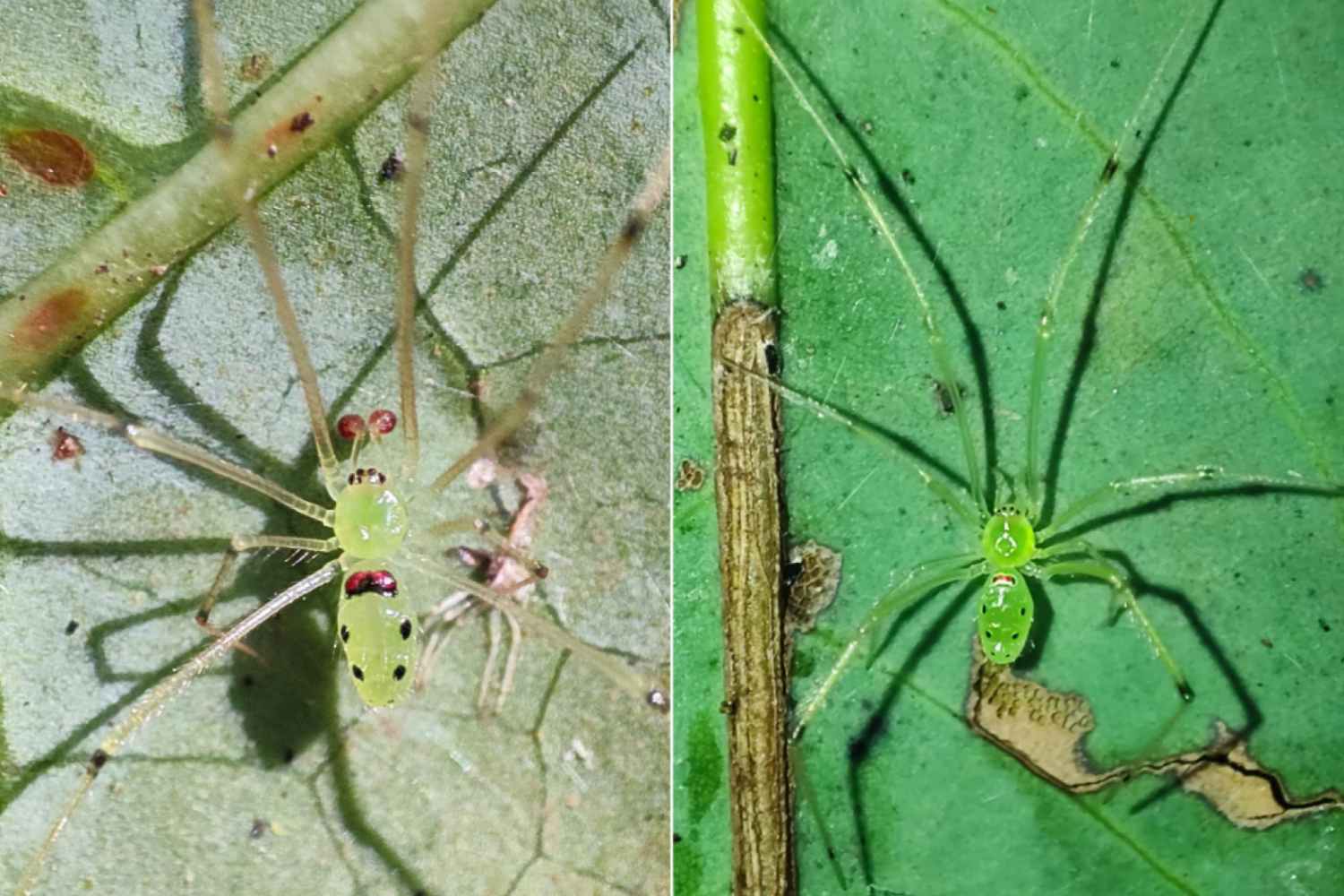
Among the heights of the Indian state of Uttarakhand, above 2,000 meters above sea level, researchers have identified a new species of arachnid destined to cause discussion in the scientific community. This is the Theridion himalayana, a small spider characterized by a curious red spot on the abdomen that resembles a smiley face.
The discovery occurred almost by chance during a study dedicated to ants in the mountain forests of the Himalayas. Scholars from the Forest Research Institute and the Regional Museum of Natural History began collecting and photographing some unusual specimens, without imagining they were faced with a species never described before.
A chance meeting that changed research
It was the expert eye of the researchers that made the difference. Observing images of a small spider hidden under a leaf, scientist Devi Priyadarshini recognized a striking resemblance to the famous “smiling spider” of Hawaii, the Theridion grallator.
From that moment a more in-depth analysis began which led to the collection of samples in various locations, including Makku, Tala and Mandal. The result was unexpected: 32 chromatic variations of the same species, with different patterns on the abdomen, a sign of strong polymorphism.
DNA confirms a new evolutionary line
To verify the authenticity of the discovery, scientists compared the DNA of the new spider with that of its Hawaiian “cousin”. Genetic analyzes revealed a difference of about 8.5%, enough to confirm a separate lineage that developed in Asia. This data strengthens the hypothesis that similar forms may have evolved independently in regions very distant from each other, a phenomenon that opens up new questions about global biodiversity and the evolutionary paths of arachnids.
A smile that remains a mystery
Despite the discovery, the meaning of the characteristic smile-shaped spot still remains unknown. Scholars hypothesize that it may serve to confuse predators or facilitate forms of communication between individuals of the same species, but there are no certainties yet. The new spider often lives on plants of the Hedychium genus, the same ones associated with other similar populations in completely different geographical contexts. A detail that fuels further questions about its evolution.
You might also be interested in:
