
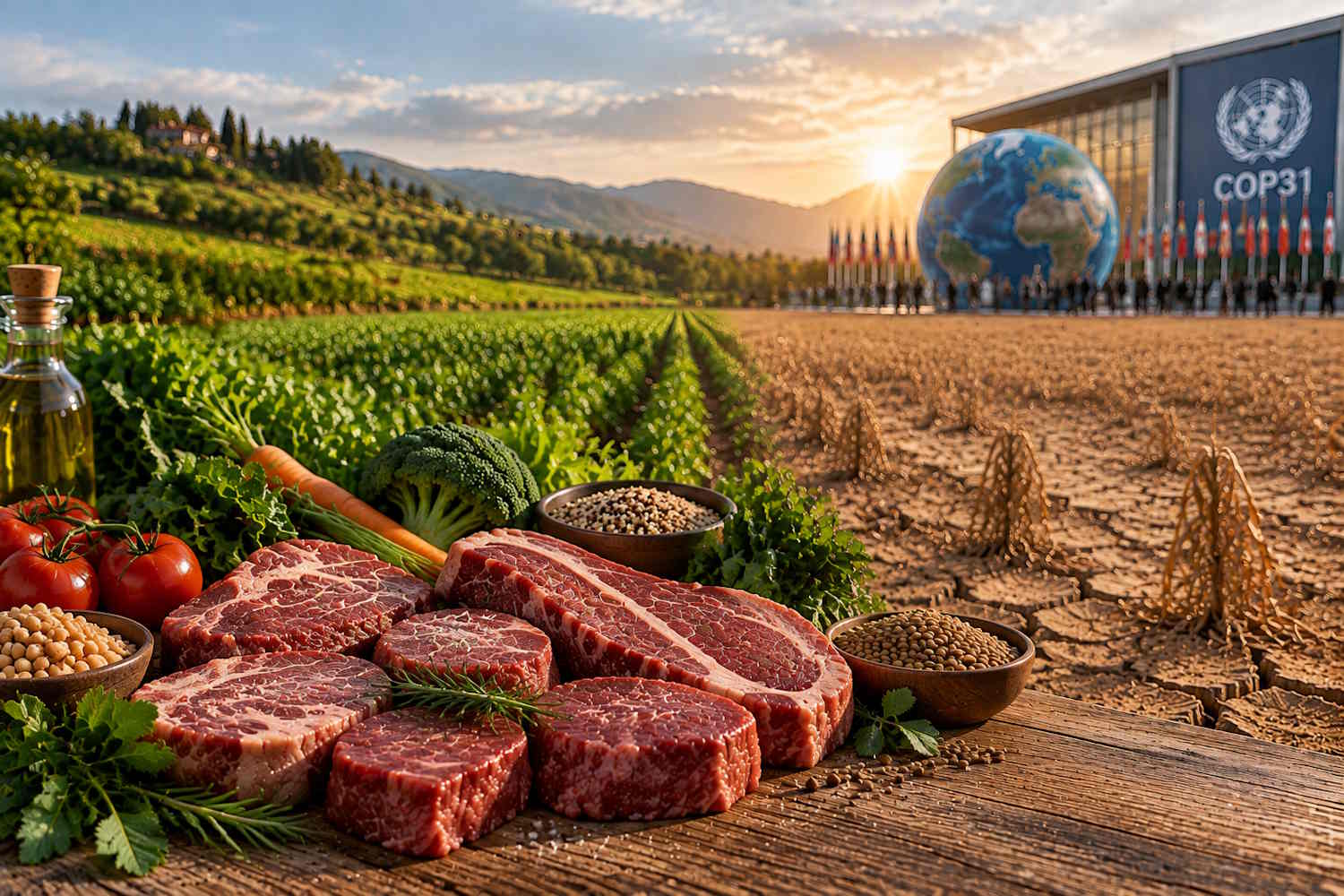
We have practically arrived at COP31 – the 31st Conference of the Parties to be held from 9 to 20 November in Antalya, Turkey – finally a word will be spoken that for years has remained on the margins of the great table of the climate crisis: food. Or rather: the way we produce and consume food. Including meat.
That’s right: while we talked about cars, power plants, coal, oil and gas, we forgot that even what ends up on our plates every day continues to tell a story made up of emissions, land consumption, loss of biodiversity and pressure on ecosystems.
Now something seems to be moving. Among the themes of the next COP, a Declaration dedicated to the transition towards sustainable, diversified and low-emission food systems has been proposed. The document, promoted by a coalition of organizations and open to the accession of UN member states, will have to be discussed and approved at the conference. But the fact that the topic has already arrived on the table of climate negotiations represents a political step that is anything but secondary.
For the first time, meat consumption enters the global climate discussion
The text of the declaration explicitly talks about the need to promote sustainable food practices, reduce excessive consumption of high-emission foods and promote food systems with a greater presence of plant-based protein sources.
What does it mean? That after years in which the issue was often considered almost a “private” topic – the one we choose at the supermarket or at the restaurant – diet finally enters the language of international climate policy. And the reason is (was) there for all to see: the global food system accounts for about a third of anthropogenic greenhouse gas emissions. Meat production, particularly that of ruminants, is associated with significant emissions of methane, a very potent greenhouse gas in the short term.
It does not mean, as the proposal itself makes clear, asking for the total elimination of foods of animal origin. The document talks about a gradual and fair transition, taking into account the differences between countries and the role that farming can have for many rural communities.
Not just meat
Reading the priority points of the agenda, it is clear that COP31 will seek to address food as a complex system, where every element is connected: what we eat, how much water we use, how we grow, who produces our food and how well agricultural systems are able to resist extreme climate events.
In fact, the so-called food-water-climate nexus appears among the central themes of the conference: the idea is that droughts, floods and water crises are not separate emergencies, but parts of the same problem that puts pressure on global food production.
Here are the main points that can be read in the Food Safety section:
