
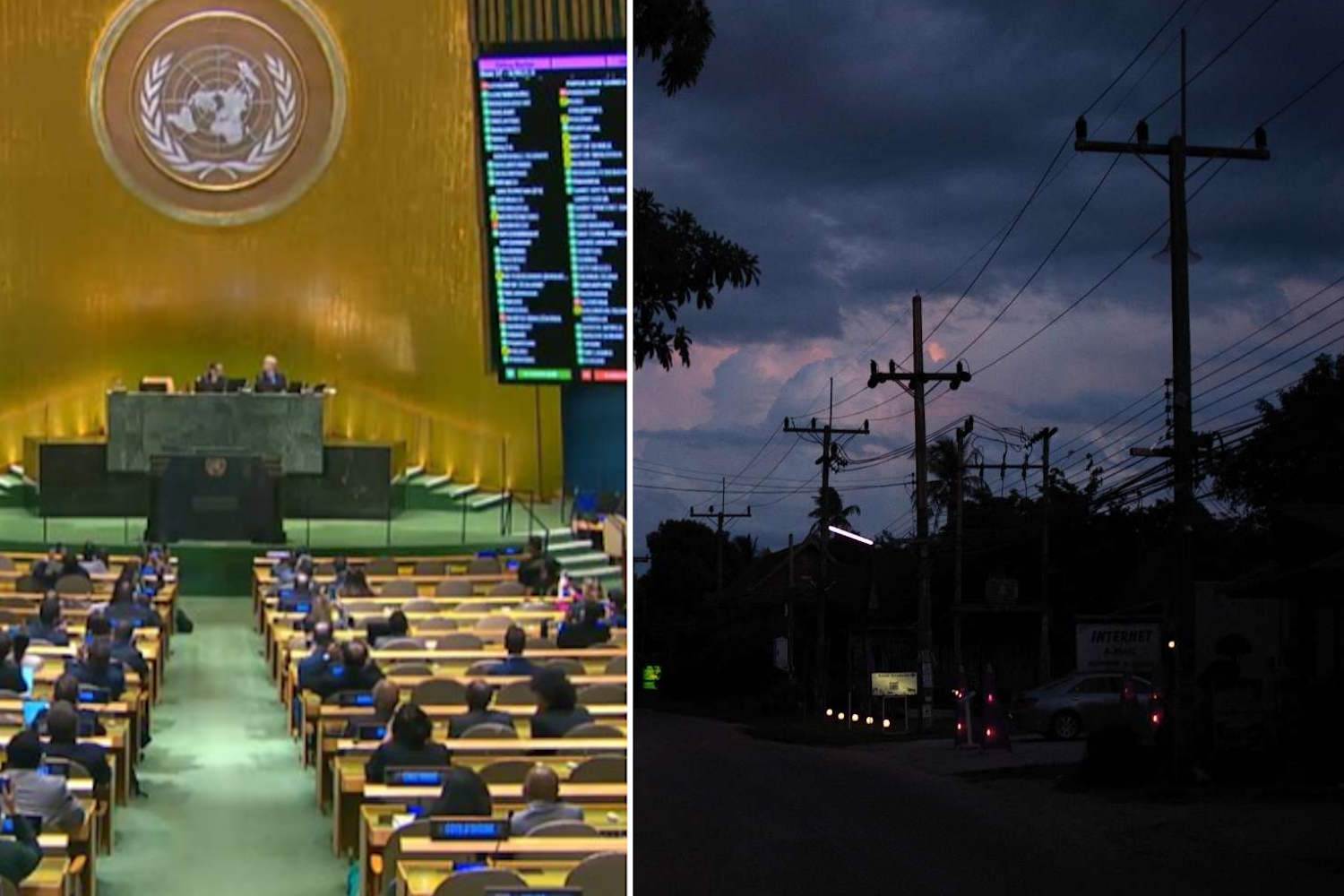
For over thirty years Italy had maintained the same position: asking for an end to the economic embargo imposed by the United States on Cuba. Now something has changed and during the vote at the United Nations General Assembly, our country chose to abstain, interrupting a long diplomatic tradition.
A decision that comes just as the Trump administration intensifies international pressure against the Cuban government, which is itself grappling with one of the most serious economic and social crises in recent decades.
Because Washington rejoices
The resolution calling for an end to the US embargo was still passed, but with significantly less support than in the past. The countries in favor went from 165 in 2025 to 130 in 2026, while those against rose to 17 and abstentions to 25.
And the latter include Italy, Germany, the Netherlands, Poland and several other European states.
#BREAKING
UN General Assembly ADOPTS resolution on the necessity of ending the economic, commercial and financial embargo imposed by the United States of America against Cuba
Result of the vote:
In favor: 130
Against: 17
Abstain: 25 pic.twitter.com/p4E3XqUpu6— UN News (@UN_News_Centre) October 28, 2026
This explains the Trump administration’s satisfaction: the United States did not win the vote, but managed to weaken the international consensus against the embargo.
The American ambassador to the UN, Mike Waltz, welcomed the change in position of several countries, underlining the results of Washington’s diplomatic activity.
The Italian abstention (Italy has always voted in favor of the UN resolution calling for the end of the US economic embargo against Cuba, starting from 1992) does not equate to formal support for the embargo, but still represents a significant political signal: for the States it means being able to count on a greater number of countries that do not openly take sides against their own policy towards Cuba.
The vote, in any case, does not directly modify the embargo, the lifting of which requires a decision by the US Congress.
Why did Italy abstain?
In an official note, the Foreign Ministry recognizes that the US embargo has negative economic and humanitarian consequences on the Cuban population. But he is quick to argue that the island’s crisis also depends on the responsibilities of the Havana government, on the lack of political and economic freedoms and on the inefficiencies of the production system.
Italy therefore calls for substantial reforms and the release of political prisoners, while confirming the continuation of humanitarian aid.
Substantial political, economic, social and judicial reforms by the Cuban authorities are urgently needed to alleviate the suffering of the Cuban people. The 176 economic and social measures adopted last June must be implemented quickly, it says.
A position that has attracted criticism from the opposition. Representatives of the Democratic Party accused the Meloni government of aligning itself with Trump, abandoning a diplomatic choice supported for decades by governments of different orientations.
What is the embargo against Cuba and who pays the consequences?
The economic, commercial and financial embargo imposed by the United States on Cuba dates back to the early 1960s, at the height of the Cold War. The restrictions limit economic and financial exchanges with the island and may also affect commercial relationships with companies and institutions in other countries.
Meanwhile, Cuba faces serious shortages of fuel, food and medicine, as well as frequent blackouts that also compromise essential services. The Cuban government blames a large part of the difficulties on US sanctions, while Washington insists on the responsibilities of the Havana authorities in managing the economy and repressing political freedoms.
Italy has chosen to no longer support a resolution that it had supported for over thirty years. For Washington it is a diplomatic success, but it is the Cuban citizens, struggling every day with the difficulty of obtaining fundamental goods and services, who pay the highest price.
