
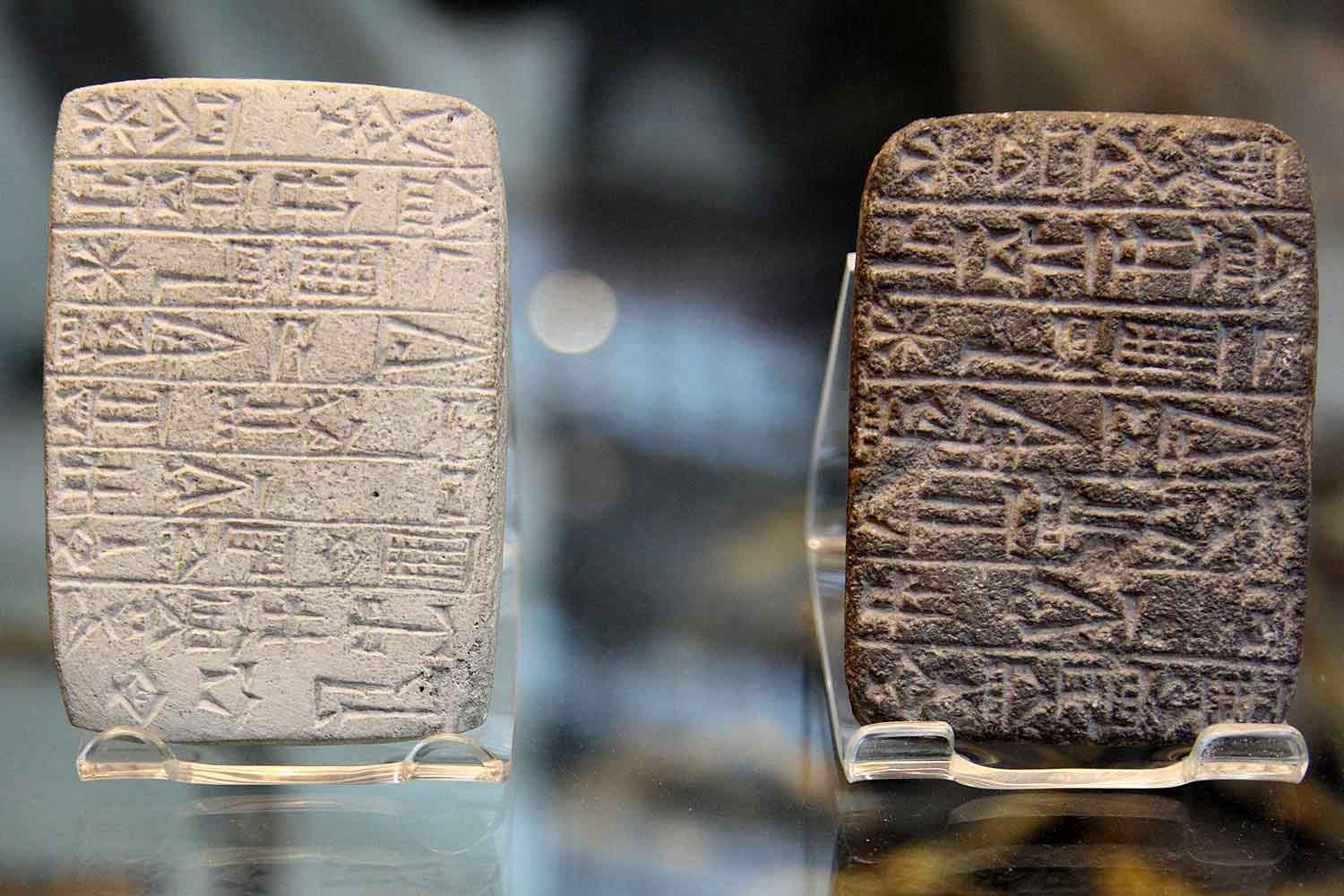
You write a sentence in English. TabletCraft brings it into Akkadian, converts the transliteration into cuneiform characters, and can even place them on top of a clay-colored digital tablet. The trip also works towards English. It is the latest step in a research that tries to make a huge archive more accessible: around half a million cuneiform tablets are preserved in collections around the world and a significant part still needs to be studied and translated.
A clarification is needed immediately, because five thousand years of history deserve at least to call things by their name. Cuneiform is a writing system, not a language: was used for several ancient Near Eastern languages. TabletCraft works onAkkadiana Semitic language documented for millennia in Mesopotamia. The system was developed by Zhaohui Wang of the University of Southern California, and the work was accepted at the ACL 2026 C3NLP workshop.
What’s new is the journey from English to Akkadian
Machine translation from Akkadian to English already existed. TabletCraft adds above all the way back: it receives an English text, produces an Akkadian transliteration, associates it with Unicode cuneiform signs and finally can render them graphically as a tablet. The model is based on ByT5 and has been trained in both directions since 58,126 aligned sentencestransformed into approximately 116 thousand training pairs. The converter includes 14,240 associations between transliterations and signs and, in the test carried out by the authors, covered 95.3% of the tokens.
On the Akkademia validation set, consisting of 2,812 mostly Neo-Assyrian examples, TabletCraft achieved a BLEU score of 49.1 in the Akkadian-English direction and 48.5 in the English-Akkadian path. Those numbers. BLEU compares the text produced by the model with a reference translation and the authors themselves warn that, especially in the direction towards Akkadian, it should only be considered an approximate measure of fidelity. A large-scale expert philological evaluation is yet to come.
There is also an older problem of artificial intelligence: the same Akkadian sentence can be written correctly in different ways, using syllabic signs or logograms. A machine can therefore deviate from the transcript chosen as a reference and receive a worse score despite having produced a plausible solution. On the contrary, it can generate an apparently convincing sentence that an Assyriologist would judge to be wrong. The automatic measuring tape alone does not dissolve the tablet.
The authors are also quite explicit about another boundary: Akkadian produced from English is approximate and machine generated. It cannot be treated as an authentic ancient text nor used as a historical source. The training corpus is also very rich in Neo-Assyrian royal inscriptions from the first millennium BC; the system moves better between formulas, titles and constructions similar to those already seen, while different registers, such as Paleo-Assyrian commercial letters, remain more difficult.
The first AI that translated cuneiform dates back to 2023
Perhaps the most spectacular part of the story, that is, the automatic translation of cuneiform characters into English, is a few years old. In 2023 Gai Gutherz, Shai Gordin and colleagues published on PNAS Nexus a study on machine translation of Akkadian. Their system worked both on transliterations in the Latin alphabet and directly on cuneiform characters encoded in Unicode. He obtained 37.47 and 36.52 BLEU4 points respectively.
The corpus included 8,056 tablets and 56,160 segments used for transliteration-to-English translation training. Here too the material was strongly biased towards the Neo-Assyrian period: 7,327 tablets belonged to that chronological group. Performance varied greatly depending on the genre of the text and its length; recurring formulas and short passages were generally easier to manage.
And the machine could make mistakes with considerable certainty. In one of the examples analyzed by the researchers, the text indicated that the king descended to the House of God on the twenty-first day. The model lost the denial and quietly let the ruler down. A word gone, meaning reversed. The authors used precisely such cases to explain why even an apparently successful translation must pass under the eyes of an expert.
There are still a few steps missing from the photograph of the tablet to the translation
The most immediate dream would be to photograph a tablet, wait a few seconds and receive the translated text. The necessary pieces are starting to appear, for now they remain spread across different systems.
In June 2026, a group from the Ludwig-Maximilians-Universität in Munich presented an automatic cuneiform sign recognition system applied to images from the Electronic Babylonian Library. The model was made work on 87,668 fragments and it produced almost 2.9 million sign detections. The annotated dataset used to develop it included 124,504 signs, more than double the previous version. However, it is a preprint and the researchers themselves report difficulties related to erosions, cracks, text arrangement and absence of linguistic information in the recognition process.
Sumerian is also entering this digital workshop. The project in 2024 SumTablets collected Unicode representations and transliterations of 91,606 Sumerian tabletsfor almost seven million glyphs. The model tested by the authors achieved an average chrF of 97.55 in transliteration, a result designed primarily to allow specialists to quickly check automatic proposals instead of transcribing each sign from scratch.
The direction, therefore, is quite recognizable: computer vision to identify the wedges on the photograph, linguistic models to reconstruct and transliterate the signs, automatic translation to obtain a first version in a modern language. A single system capable of taking any damaged tablet and independently returning a reliable translation does not yet exist. TabletCraft itself lists cuneiform OCR and Sumerian support among future works and is presented as an assistant to be corrected, not as a replacement for the Assyriologist.
Half a million tablets will hardly start talking all at once. Some of the most repetitive jobs, however, can become much faster: recognizing thousands of signs, proposing a transliteration, preparing a first translation to check. After four millennia, even shortening the queue in front of the Assyriologists’ desk is already a decent technological leap.
