
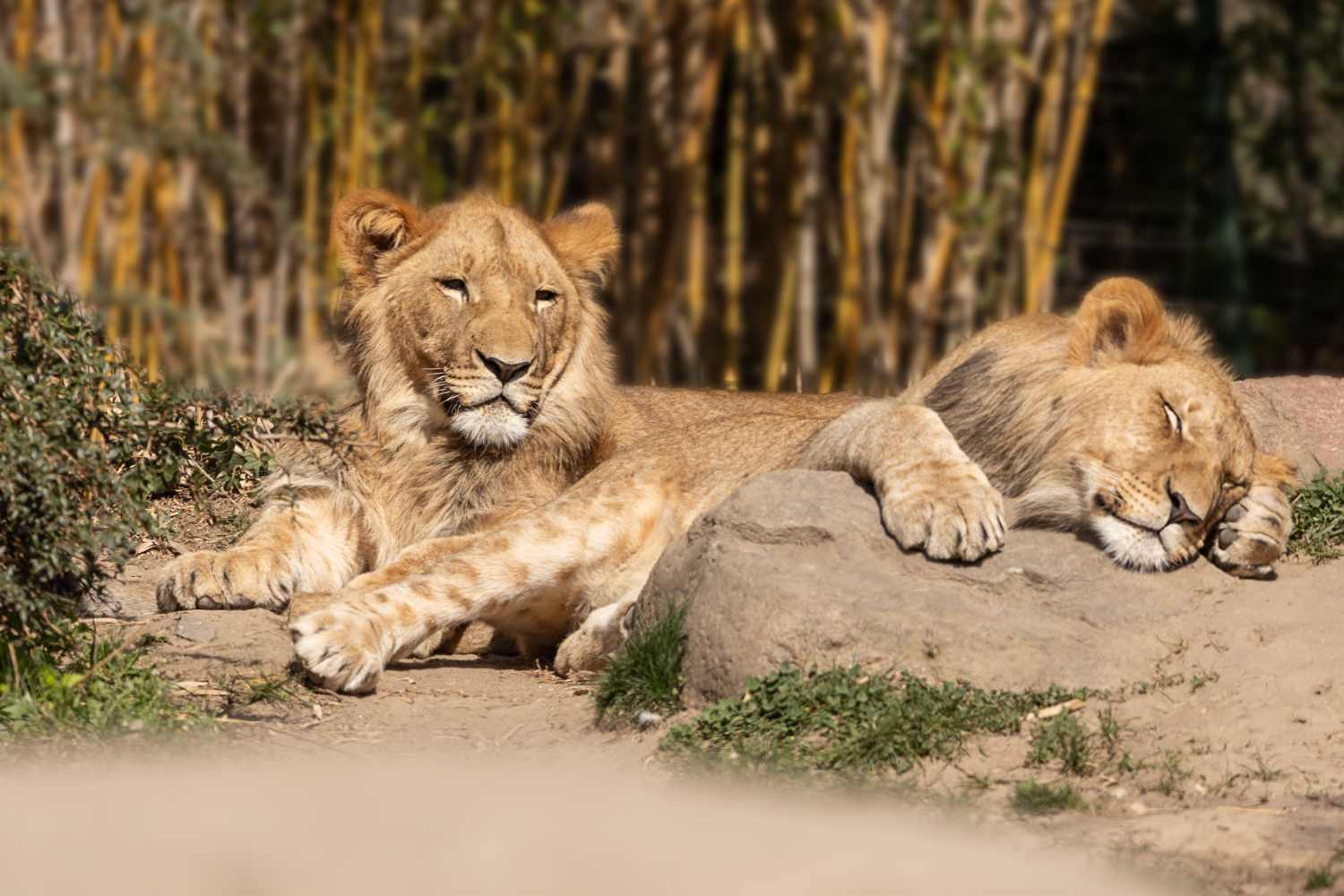
Tension remains very high at Tama Zoological Park, in the western suburbs of Tokyo, where veterinary staff are fighting to save three lions from death in dramatic conditions. These are two males and a female who, overwhelmed by an unprecedented wave of heat, could no longer even stand up.
To try to stabilize them, the facility’s workers urgently transferred them to an internal enclosure equipped with portable air conditioners, administering intravenous fluids. The entire feline exhibition area was sealed to protect the other specimens of the colony, originally composed of 16 individuals, affected by sudden lethargy and serious losses of consciousness.
The tragedy of Mugi, Ichigo and Ruena and the nightmare of humidity
This desperate intervention comes after dramatic days: between 28 July and 2 August three lionesses lost their lives. The victims are the young Mugi, just 3 years old, Ichigo, 11, and the older Ruena, 15 years old. The autopsies conducted on their bodies confirmed the clinical picture due to the heat, revealing severe and systemic dehydration culminating in multiple organ failure due to heat stroke. Although lions are evolutionarily accustomed to the high temperatures of the African continent, the Japanese summer presents a lethal combination of heat and very high humidity, a condition that prevents the body’s correct thermoregulation.
A record-breaking summer and measures in parks around the world
The meteorological context that is putting the country to the test has reached extreme peaks: the Japanese Meteorological Agency (Jma) has detected temperatures above 40 degrees in 34 different locations, breaking every historical record from 1946 to today. A global climate emergency that imposes new strategies in the world’s wildlife parks: from the Budapest zoo, where elephants are cooled with water jets and orangutans use dedicated showers, to the Prague zoo, which distributes tons of ice to give relief to polar bears. Images that on social media may seem “tender”, but which are not at all.
The bitter reality of captivity in the face of climate emergencies
In fact, what happened in Tokyo inevitably opens up a painful reflection on the opportunity of maintaining wild species confined in geographical contexts so distant from their original ecosystems. An animal enclosed between fences and concrete loses any possibility of independently seeking a favorable microclimate to protect itself. Forced to live a life in captivity, often treated as attractions to be shown to the public or exhibited on social channels, these felines find themselves completely vulnerable to climatic upheavals. A chain of deaths that shows all the limits of artificial detention in the face of a changing planet.
