
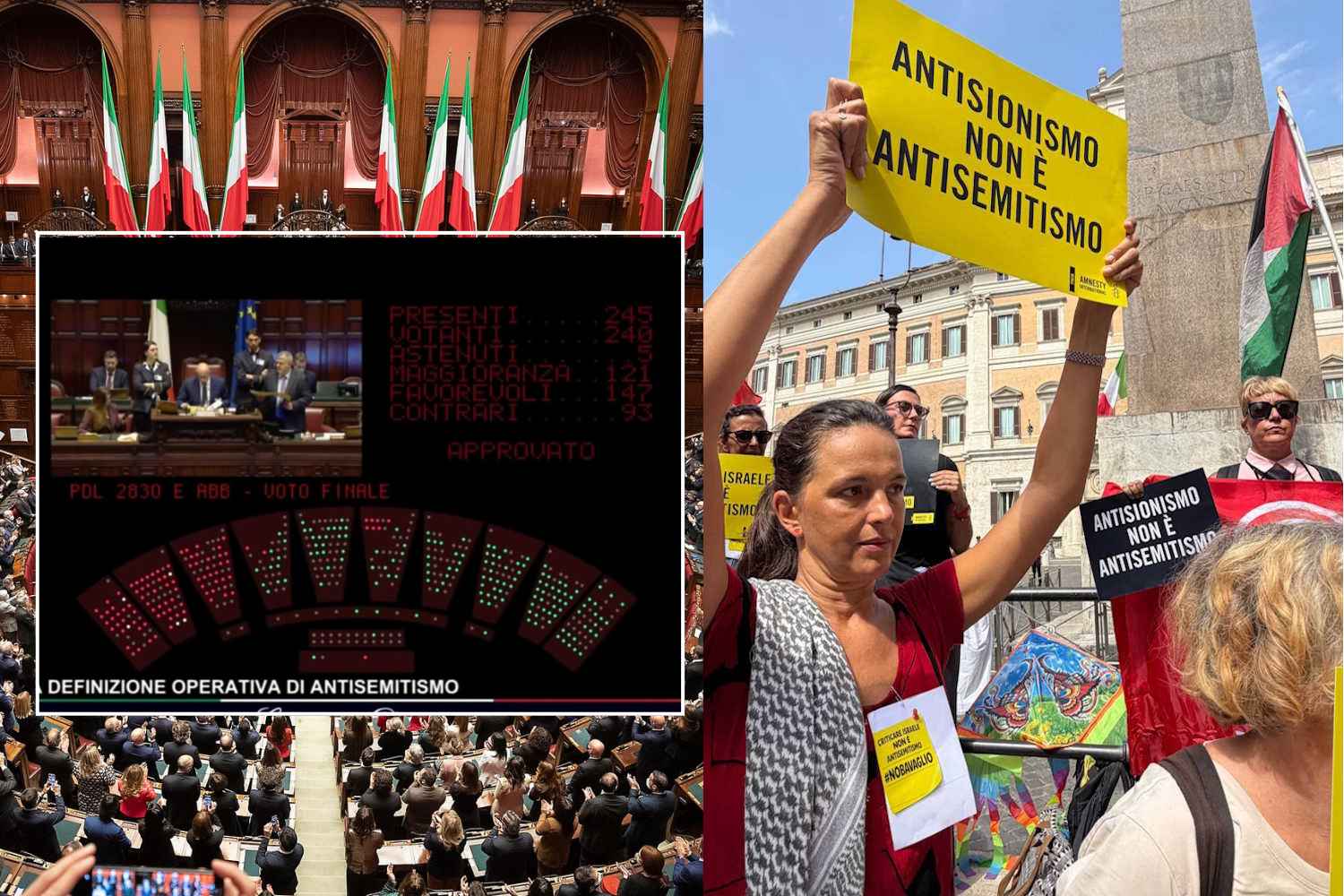
It had already been approved by the Senate last March, not without lively discussions. Then, a few weeks ago, Liliana Segre attempted to mend the rift, asking the parties for a unanimous vote and even being open to modifying the text. An intervention that had not extinguished the controversy, on the contrary: while over one hundred jurists and academics contested the law, accusing it of putting freedom of expression at risk, Parliament continued to be divided. Until the final vote on November 17th.
With it, in fact, the bill against anti-Semitism became law (Measures to combat anti-Semitism and for the adoption of the operational definition of anti-Semitism). The Chamber gave the green light with 147 votes in favour, 93 against and 5 abstentions.
But what does this law which was created to combat hatred and discrimination against Jewish people and which has instead sparked so much controversy really provide? To understand this, one precise point should not be lost sight of: the boundary between anti-Semitism and the right to criticize the policies of the State of Israel.
The provision, composed of five articles, in fact adopts the definition of anti-Semitism developed in 2016 by the International Holocaust Remembrance Alliance (IHRA), accompanied by a series of examples which, according to various human rights organisations, risk overlapping manifestations of anti-Jewish hatred and legitimate political positions.
The IHRA definition of antisemitism
At the center of the disputes is the definition of the IHRA, the International Holocaust Remembrance Alliance, drawn up in 2016, according to which:
Anti-Semitism is a certain perception of Jews that can be expressed as hatred of Jews. Verbal and physical displays of anti-Semitism are directed toward Jews or non-Jews and/or their property, Jewish community institutions, and buildings used for worship.
According to the IHRA, therefore, anti-Semitism is a certain perception of Jewish people that can translate into hatred towards them, with verbal expressions or actions directed against people, property, institutions and places of worship.
If, therefore, the definition, taken alone, clarifies that anti-Semitism concerns hostility and hatred towards Jewish people, it is however some of the 11 examples that accompany it that cause discussion.
Among these:
The problem, according to critics, is that examples of this type could lend themselves to very broad interpretations, even involving political positions, historical judgments or forms of protest that do not necessarily express hatred towards Jews.
The IHRA itself specifies that criticizing Israel like any other country does not constitute anti-Semitism. But where does legitimate criticism end and anti-Semitic prejudice begin? It is around this border, and above all the possible consequences of the adoption of the definition in Italian law, that the political conflict has centered.
And it must also be said that the IHRA developed this definition in 2016 as a non-legally binding operational tool. Its original function was to provide a common reference for recognizing and monitoring anti-Semitism. Now, with the provision approved in Italy on 17 November, however, the definition and related examples expressly enter the national legislative framework.
It is above all this passage that worries Amnesty International and some of the opposition: the fear that examples conceived as orientation tools will be applied too rigidly in areas such as schools, universities, communications and public events. That is, the risk is that denouncing human rights violations committed by the Israeli government, challenging its political choices or supporting Palestinian claims could be interpreted, in certain circumstances, as a manifestation of anti-Semitism.
The text of the law expressly calls for respect for freedom of political criticism, expression and assembly. But, according to critics, this guarantee would not be sufficient to avoid restrictive interpretations.
What does the law against anti-Semitism provide: the 5 articles
The law does not introduce new crimes or new criminal sanctions, but would strengthen the tools for preventing, monitoring and combating anti-Semitic discrimination. In detail, here is what the five articles establish:
What Liliana Segre had asked for
At the end of September, Liliana Segre, senator for life and Holocaust survivor, had invited political forces to overcome divisions, hoping for unanimous approval. The senator also said she was open to a modification of the text that would explicitly clarify a principle: criticizing the State of Israel, like any other state, does not automatically mean being anti-Semitic.
We talked about it here: What the anti-Semitism bill provides for and why it doesn’t convince everyone despite Liliana Segre’s appeal
A clarification that did not make it into the final version of the law. In the Chamber, in fact, all the opposition amendments were rejected.
The majority parties voted in favor, together with Action and Italia Viva. Against the Democratic Party, the 5 Star Movement and the Green and Left Alliance. Five deputies from the reformist area of the Democratic Party instead chose to abstain, distancing themselves from the official position of the party.
A rift that tells how difficult it has become, even within the same political party, to find a balance between the need to fight anti-Semitism and that of defending freedom of expression.
Amnesty International: “A dark day for freedom of expression“
The reaction of Amnesty International was very harsh, which through Erika Guevara Rosas, senior director of campaigns and research, defined the approval of the law as “a dark day for freedom of expressionAnd”.
According to the organization, the definition adopted risks confusing anti-Semitism with legitimate criticism of Israel, encouraging censorship and self-censorship, especially in schools, universities and on social media. And, while not introducing new crimes, the law
it could be used to punish legitimate criticism of Israeli government policies and target demonstrations of solidarity with the Palestinian population
Amnesty also recalls that all the amendments were rejected, including the one that proposed adopting the Jerusalem Declaration on anti-Semitism, considered less exposed to restrictive interpretations.
It is necessary to strengthen measures to prevent and combat racism and discrimination, but this new law is not the answer, concludes Guevara Rosas, reiterating that the fight against anti-Semitism and the protection of freedom of expression must proceed together.
The Union of Italian Jewish Communities (UCEI) has a completely different opinion.
President Livia Ottolenghi welcomed the approval, arguing that the provision strengthens the democratic tools of defense against anti-Jewish hatred without compromising the right to criticize. Emanuele Fiano, president of the Left for Israel Two Peoples Two States, also harshly contested the vote against by much of the centre-left, recalling that the law does not introduce new crimes or sanctions.
One thing should be beyond question: anti-Semitism is a form of hatred and discrimination that must be firmly opposed, even more so in a historical moment in which episodes of threats, aggression and hostility towards Jewish communities continue to occur. But precisely because it is a fundamental battle, the tools chosen to address it must be proportionate and respectful of everyone’s rights. Criticizing the decisions of a government is not the same as expressing hatred towards a people. Likewise, attributing responsibility for the choices of the State of Israel to Jewish people indiscriminately means fueling an anti-Semitic prejudice.
It is an essential distinction, which should not become a political battleground. The law was approved. It remains to be seen how it will be applied concretely, especially in educational environments, institutions and public debate.
