
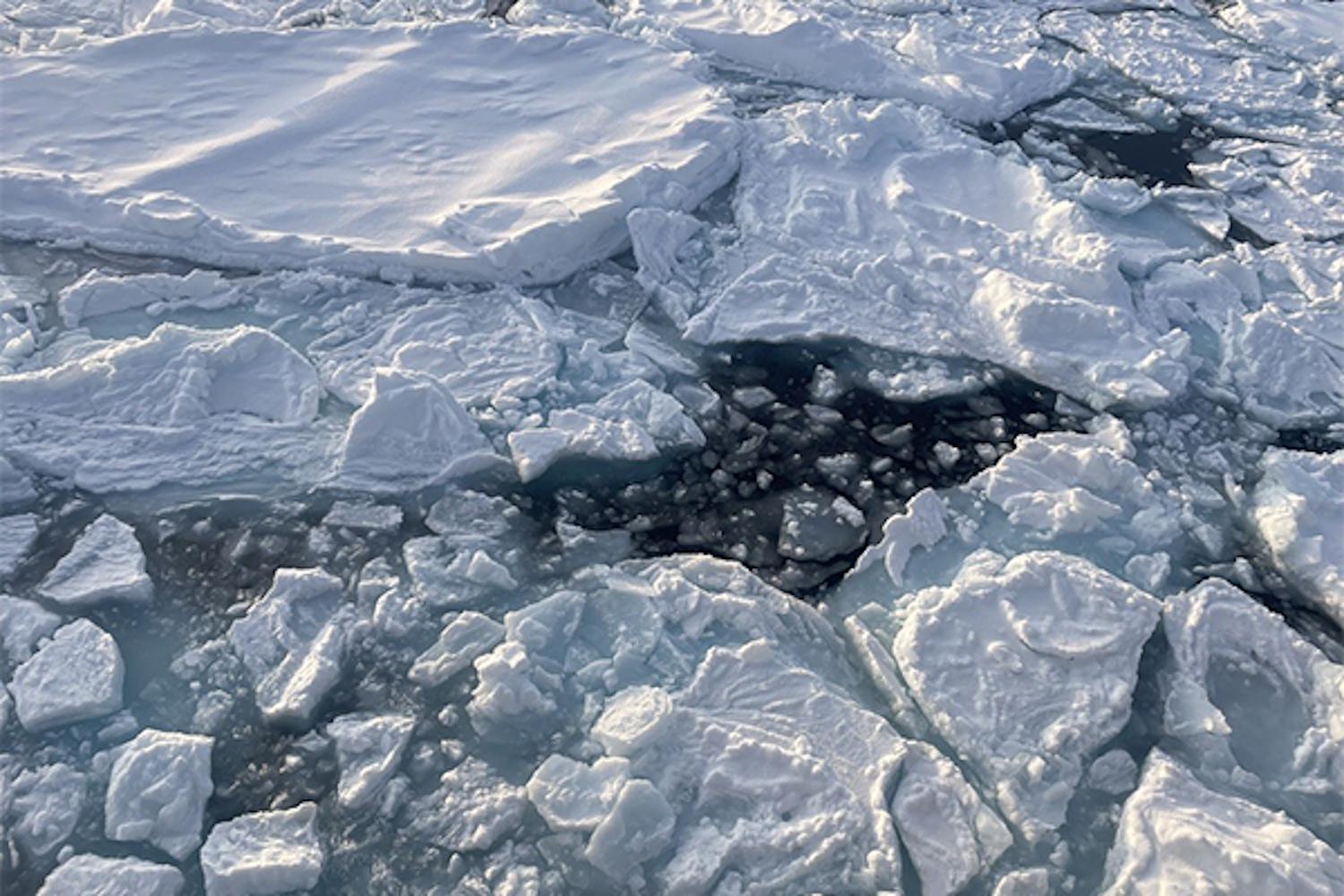
For a few years it had seemed that Arctic sea ice had slowed its march towards disappearance. A small respite and almost a positive anomaly in an increasingly worrying climate picture. But that pause seems to be over.
According to a new scientific study, in fact, the slowdown observed in the last twenty years in the loss of Arctic ice did not represent a reversal of trend, but only a temporary slowdown within a much longer and inexorable decline.
And the most recent data is far from reassuring: between 2024 and 2025, Arctic sea ice extent decreased by 5.8%, the largest annual winter decline on record.
The Arctic ice “pause” was only temporary
The previous study, published last summer, highlighted a surprising phenomenon: between 2005 and 2024, no statistically significant decline in Arctic sea ice extent was detected. An unexpected result, considering that in the same period global temperatures continued to increase due to the climate crisis.
According to scientists, this apparent stability was explained by some natural variations in ocean currents, capable of temporarily limiting the melting of ice and partially offsetting the effect of global warming. But that situation was not destined to last and researchers had already hypothesized that it was just a “postponement” and that the decline could resume in the next five to ten years at a rate even double the historical average.
The new analysis shows, in fact, that the resumption of fusion has come sooner than expected.
Arctic ice continues to shrink
Using the latest satellite observations of ice cover, the research team concluded that the slowdown recorded between 2005 and 2024 was “temporary and unsupportedAccording to Duo Chan, lead author of the study from the University of Southampton, what seemed like a pause in the early 2020s appears today as a simple oscillation within a process of reduction that continues.
What looked like a slowdown in the early 2020s now appears as a temporary decrease in speed within a long-term decline, the researcher said.
The numbers tell of a profound transformation: since 1979, the year in which satellite measurements began, the surface of Arctic sea ice in the month of September – when it reaches its annual minimum – has halved.
@University of Southampton – School of Ocean and Earth Science
Arctic ice loss isn’t just about the North Pole, but the consequences may extend far beyond that region.
In fact, winter sea ice functions as a sort of “natural insulator”: it separates the relatively warm Arctic Ocean from the much colder atmosphere. As ice declines, more heat and moisture from the ocean is transferred to the atmosphere, altering climate balances.
According to Dr. Alessandro Silvano, co-author of the study, the sharp decline recorded in 2025 is an unusual event, but physically compatible with an increasingly warm Arctic.
These changes may affect atmospheric pressure systems, storm development and large-scale atmospheric circulation, with possible effects on weather conditions further south as well.
A new sign of the climate crisis
For the authors of the study, the message is clear: short periods of apparent stabilization should not suggest that the crisis has slowed down.
Temporary recoveries may hide the direction of Arctic sea ice change over the long term. The low winter extents recorded in 2025 and 2026 clearly show that Arctic ice loss has not stopped: it continues in a warming climate, Chan concludes.
In short, the Arctic is not going backwards. What seemed like a truce was only a short breath before a new acceleration. And the melting ice at the North Pole is still one of the clearest signs of a changing planet.
