
Tonight’s game isn’t just a side game. At 9pm today, Wednesday 15 July, the planet’s spotlight will turn on the second semi-final of the 2026 World Cup: Argentina and England will face each other on the green lawn. At stake is the armored pass to the World Cup final, but sixty years of political tensions, real wars and sporting issues that have never been completely resolved also descend on the pitch.
It has been 24 years since the two national teams met in the final phase of a World Cup (the last precedent was in the 2002 group stage). Today history repeats itself with even higher stakes and a generational duel that will see Lionel Messi’s last dance pitted against the English battleship led by Harry Kane and Jude Bellingham.
View this post on Instagram
Rattín’s expulsion and the theft of the century in 1966
The football grudge between these two nations began in the 1966 World Cup at Wembley. During the quarter-finals, German referee Rudolf Kreitlein sent off Argentine captain Antonio Rattín in the 35th minute of the first half. In an era in which yellow and red cards have not yet been invented, a total linguistic babel is generated: Antonio Rattín does not understand the decision, protests for over eight minutes, tramples on the red carpet intended for the royal family and crumples a British corner flag.
England won 1-0 thanks to a goal from Geoff Hurst, but for Argentina that match officially became “the robo del siglo” (the theft of the century). From that chaos, the English referee Ken Aston had the intuition to introduce colored cards to make the sanctions universally understandable.
The drama of 1982 and the Falklands-Malvinas War
In 1982 the conflict moved dramatically outside the playing fields. The Argentine dictator, General Leopoldo Galtieri, decides to invade the archipelago of the Falkland Islands (which the Argentines claim as the Malvinas Islands) in an attempt to reawaken internal nationalism. British Prime Minister Margaret Thatcher’s response was immediate and military.
The conflict lasted 74 days and cost the lives of 649 Argentine soldiers and 258 British soldiers, profoundly impacting the collective memory of South America. The Argentine defeat accelerates the fall of Leopoldo Galtieri’s military regime, but leaves an open wound that immediately spills over into sport. In Argentina the territorial claim becomes a constitutional and identity dogma, still visible today in the naming of the Estadio Malvinas Argentinas in Mendoza.
Mexico 1986: Maradona’s revenge and the Mano de Dios
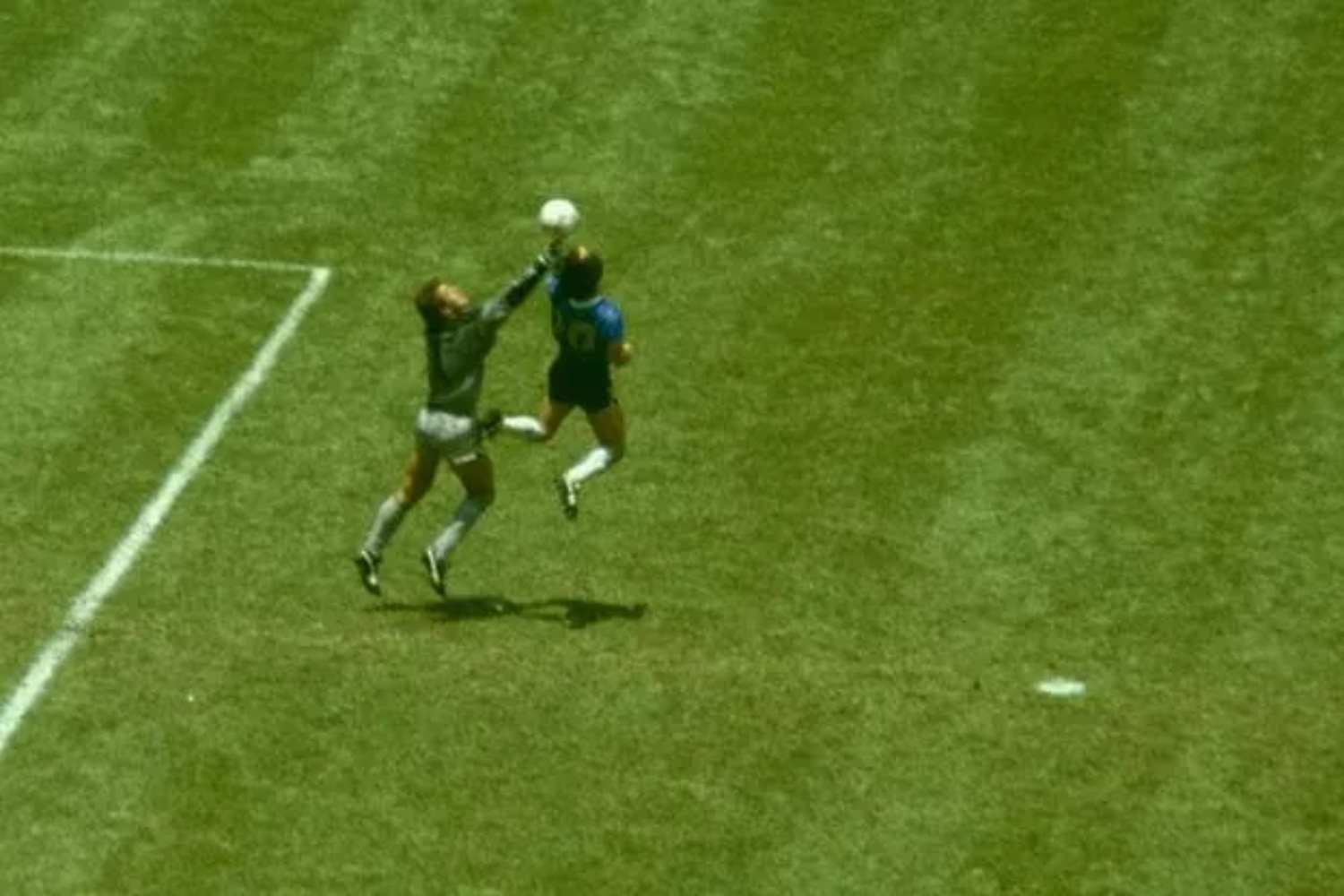
Four years after the war, on 22 June 1986, the two national teams faced each other in the quarter-finals at the Azteca Stadium in Mexico City, a match that will remain in the annals. It is the match that transforms geopolitics into a sporting myth thanks to Diego Armando Maradona. In the sixth minute of the second half, on a ball kicked by the English defender Steve Hodge, the Argentine champion beat the goalkeeper Peter Shilton (twenty centimeters taller than him) by hitting the ball with his hand.
The Tunisian referee Ali Bin Nasser does not notice the touch and validates the goal which Diego Armando Maradona will rename as signed by the “Hand of God“. Just four minutes later, the same Argentine number ten made the football gods forgive him by discarding five opponents in eleven seconds and depositing the goal of the century. The match ended 2-1 despite Gary Lineker’s late goal, projecting the Albiceleste towards the world title.
The Beckham-Simeone duel and Messi’s present
The saga continues to be written in the following decades with new protagonists. In the round of 16 of France 1998, a reaction by David Beckham to a foul by Diego Simeone cost the Englishman a direct red card; the match will end on penalties with David Batty’s decisive error eliminating England. Four years later, in the Korea-Japan 2002 group stage, it was David Beckham himself who achieved revenge by converting the penalty kick to make it 1-0 which condemned Argentina to early elimination. Today, the challenge is renewed in the second semi-final of the World Cup with Messi and his teammates called to straighten out a historic balance which sees the British with a slight advantage with six victories against the four Argentines.
