

Having a smartphone at the age of 12 could be associated with a greater risk of developing some symptoms related to eating disorders in the following two years.
This is what emerges from a new study published in JAMA Network Open and conducted on almost 9 thousand US teenagers, which analyzed not so much how much time kids spend in front of the screen, but another often overlooked element: the age at which they start having a personal device.
The results show that among those who already owned a smartphone at 12 years old, at 14 years of age, behaviors such as binge eating were more frequentrigid weight control and a tendency to link one’s self-esteem to physical fitness.
The study, it should be noted, does not prove that the telephone causes these problems. But it suggests that early and continuous access to social media, filtered images, content on the body and unrealistic aesthetic models may represent a factor not to be underestimated in a very delicate phase of development.
The study
The researchers, led by Jason Nagata from the University of California at San Francisco, analyzed the data fromAdolescent Brain Cognitive Development Studyone of the largest longitudinal studies of brain development and child health in the United States.
8,957 adolescents were taken into consideration. At 12 years old, 6,225 of them, or 69.5%, already owned a personal smartphone. The researchers then observed the presence of several signs associated with eating disorders at both 12 and 14 years of age: binge eating, compensatory behaviors to avoid gaining weight, fear of gaining weight and a tendency to make one’s personal worth depend on body weight.
@JAMA Network Open
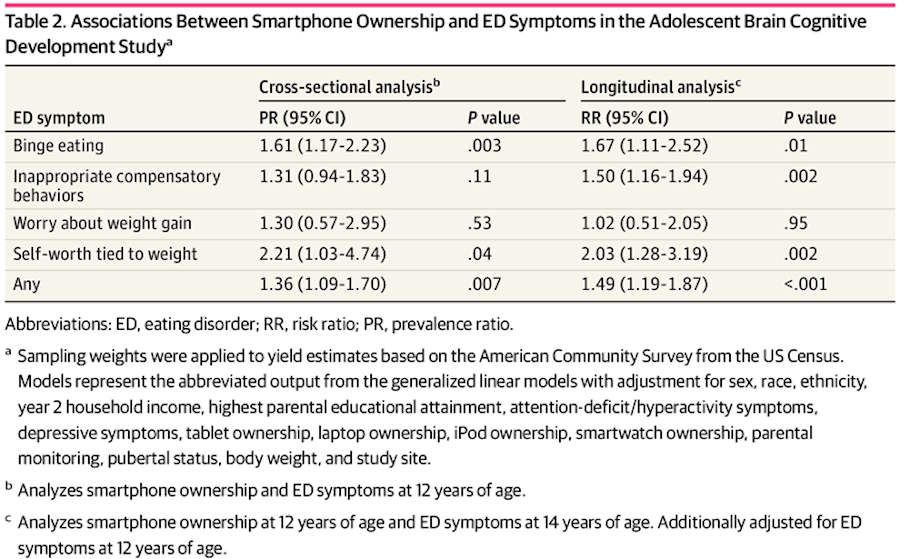
Two years later, among children who already had a smartphone at 12, almost one in four had reported at least one symptom of this type.
Longitudinal analysis shows that smartphone ownership at 12 years of age was associated with a 49% greater risk of presenting at least one symptom related to eating disorders at 14 years of age compared to their peers who did not own one at that age. The differences become even more evident when observing individual behaviors: the investigations showed that children who owned a smartphone at 12 years old had an approximately double risk of linking their self-esteem to body weight, a 67% greater risk of reporting episodes of binge eating and a 50% greater risk of implementing compensatory behaviors to control weight.
@JAMA Network Open
Why does this happen? Above all, a smartphone means continuous access to a digital environment in which images, body models and weight-related messages can become ubiquitous.
Having a smartphone means being able to literally carry a world of content focused on physical appearance in your pocket, Nagata says.
And it is precisely during pre-adolescence that this can become particularly delicate. Between the ages of 11 and 14 the body changes rapidly, puberty arrives and comparison with others inevitably increases. Before the advent of smartphones, that comparison took place above all with schoolmates, friends or people encountered in everyday life.
Today it can happen hundreds of times a day with bodies selected, edited, filtered and constructed to be shown. Which can mean that as I lie I develop dissatisfaction and low self-esteem.
In any case, the authors of the study point out that the results show an association, not definitive proof of cause and effect, since many other variables could come into play, such as family characteristics, socioeconomic conditions, pubertal development, pre-existing mental health and relationship with one’s body.
And in Italy? At 12 years old, almost everyone has a smartphone
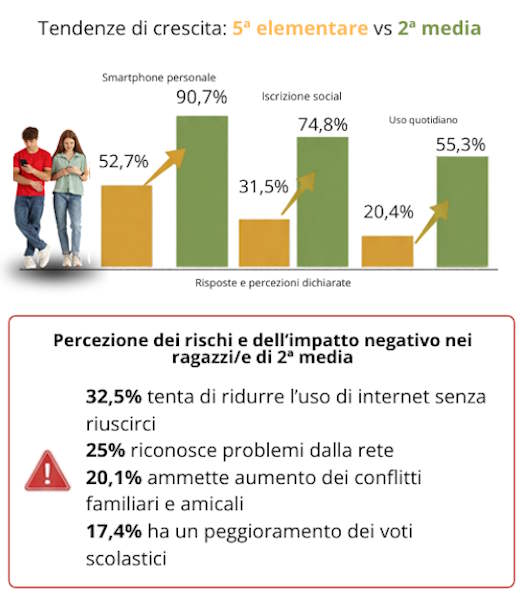
According to the results of the Children’s Worlds survey released by INAPP in September 2026 and based on a sample of 4,750 children and young people between the ages of 7 and 14, 52.7% already in fifth grade own a personal mobile phone. In the sixth grade the share rises to 87%. In the seventh grade it even reaches 90.7%. In practice, around the age of 12 only one in ten children still does not own their own smartphone.
And along with the telephone inevitably comes social media. Again according to INAPP, in seventh grade 74.8% of children are registered with at least one social platform. 55.3% use it every day or almost every day.
@INAPP
Here it is worth making a clarification: 74.8% indicates social media subscribers, not those who use them daily. However, very high frequency use concerns just over half of twelve-year-olds.
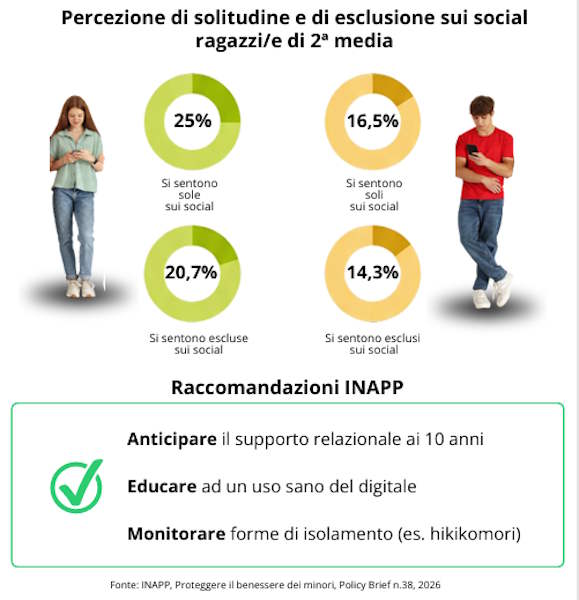
Furthermore, among seventh grade students, 32.5% say they have tried to reduce the time spent online without success and one in four recognizes that the Internet creates problems for them. 20.1% report conflicts with family or friends related to the use of the internet, while 17.4% associate the use of digital tools with a worsening of academic performance.
@INAPP
Numbers that say something that is now difficult to ignore: entry into the digital world occurs very early and coincides with an extremely vulnerable phase of life.
