
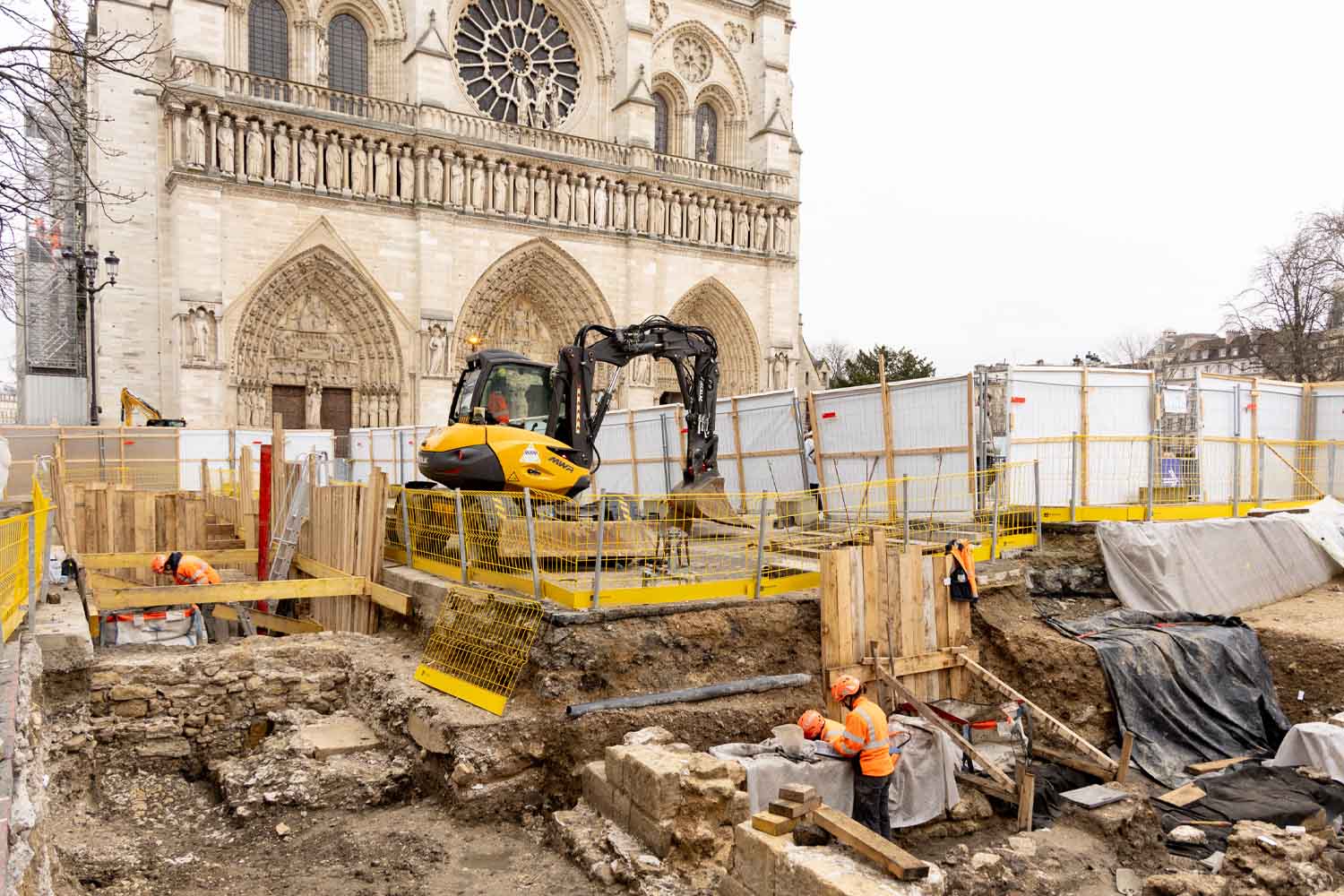
The Paris square in front of Notre Dame today it has a less than solemn noise: wooden planks, barriers, helmets, earth being raised in thin layers. A few steps away there are tourists queuing to look at the cathedral resurrected after the 2019 fire; under their feet, however, archaeologists are following the opposite path, descending into a much older Paris, that of Roman Lutetiaof the medieval neighborhoods, of the houses leaning against the square before that place became a world postcard.
The cathedral reopened at the end of 2024, and now the city wants to transform the large mineral esplanade in front of the facade into a cooler, shaded and greener space. Before planting trees, however, in Paris we dig. Because in such an old city even a flowerbed can rest on seventeen centuries of history.
A hole under the square
The excavations in front of Notre Dame they are part of a preventive archeology intervention linked to the redevelopment of the abords, that is, the set of spaces around the cathedral. The prescription comes from the Regional Directorate of Cultural Affairs of the Île-de-France, the state body that protects heritage in the Paris region. The archaeological site measures approximately 30 meters long and it goes up to 4 meters deep; eight months of work will be used by the city’s archaeologists to read the soil piece by piece, following the scientific direction of Camille Colonna.
The result is already surpassing the normal curiosity of an urban construction site. The French media have defined it as the “excavation of the century”, a somewhat broad formula, of course, but this time at least it rests on something solid: one of the most symbolic points in Europe offers scholars a rare window, almost never available with this breadth, onto an area where the city has been built, demolished and rewritten for centuries. Lucie Altenburg, restorer of the Paris archaeological unit, described the work as a concrete opportunity to change knowledge of the history of Paris. Said without velvet: under Notre-Dame pieces of the city are emerging that no one could see while the square remained closed under the asphalt and under the daily passage of millions of people.
Coins, houses and latrines
Among the finds already discovered there are hundreds of objects, including one 4th century coin with the face of the emperor Constantine, recovered as a small blackened disk and then recognized through analysis. In archeology a coin is worth more than its metal: it can help to date a layer, to establish a period, to give a chronological basis to everything that surrounds it. Alongside this find, fragments of medieval pottery have emerged with reddish signs painted on the inside, yet to be deciphered, and entire containers recovered from old domestic latrines. It sounds less than noble, I know. But latrines, also used as landfills, are often mines for archaeologists: organic material and softer soil can preserve fragile objects better than a clean room can.
Here the charm lies precisely in the low, domestic, everyday material. Jugs, cups, animal bones, fragments of plates, traces of housing structures, cellars, remains of medieval houses. At the time of the construction of Notre-Dame, which began in the 12th century, the square was occupied by houses, crossed by a road, with buildings to the north and south. The excavations are bringing back into view the foundations and cellars of those houses, erased from the urban surface and left underneath. Further down, grain pits from the Merovingian and Carolingian periods appear, between the 6th and 10th centuries; even lower, a dense Roman neighborhood, dating back to between the 4th and 5th centuries. Households, kitchen scraps, lost objects, broken things. History, when it stops being a statue, looks very much like a kitchen after lunch.
There Roman Lutetiathe ancient name of Paris, had its main center on the left bank of the Seine, in the area of today’s Latin Quarter. With the crisis of the Roman Empire, a part of the population concentrated on the Île de la Cité, easier to defend, reusing stones and materials from previous buildings. This also emerged on the construction site: a Roman threshold, probably belonging to a larger building, repurposed as road paving. It’s a beautiful detail because it takes away that tidy museum patina from the story. The ancient city recycled, moved, overturned, reused. Paris, before becoming Paris, was already very good at dealing with what it had at hand.
Before the cathedral
The current excavations are part of a broader framework of archaeological investigations linked to Notre-Dame. After the 2019 fire, research conducted in the area of the cathedral had already shown very ancient levels: under the Soufflot cave, in the heart of the building, floors of a residence from the beginning of the 1st century had been found, at around 3.50 meters deep; Remains connected to homes and artisan activities of the Late Empire had also emerged under the square.
This continuity changes the view on the cathedral. Notre-Dame remains Notre-Dame, with its facade, the towers, the windows, the emotional weight of the fire seen live by the whole world. Yet the ground under the square tells something rougher: before the monument there was a dense, concrete, inhabited city. People cooking, throwing broken objects, storing grains, walking on stones already used by someone else. The great Gothic architecture comes later. First there are hands, floors, thresholds, dishes, waste. First there are lives without photographic posing.
The square will change its face
The practical reason for all this work remains the transformation of the square. The project includes a square conceived as a sort of urban clearing, with trees, shade, a very thin blade of water 5 millimeters high to cool the stone on the hottest days and a large amount of vegetation around the cathedral. In total they will be planted 160 new trees and the site will earn approx 1,800 square meters more green. The former underground car park will become a new reception space, with access to the archaeological crypt, services and a climate shelter for visitors and Parisians. Most of the new structure is expected to be completed by 2028.
The paradox is almost perfect: to prepare a square more suitable for the scorching summers of the present, Paris is opening a passage into its deepest past. Trees and water above, Roman coins and medieval latrines below. From the outside it just looks like a construction site in front of a famous cathedral. Inside, however, the city is doing what ancient cities always do when someone dares to touch the ground: giving something back, even when no one asked for it.
