
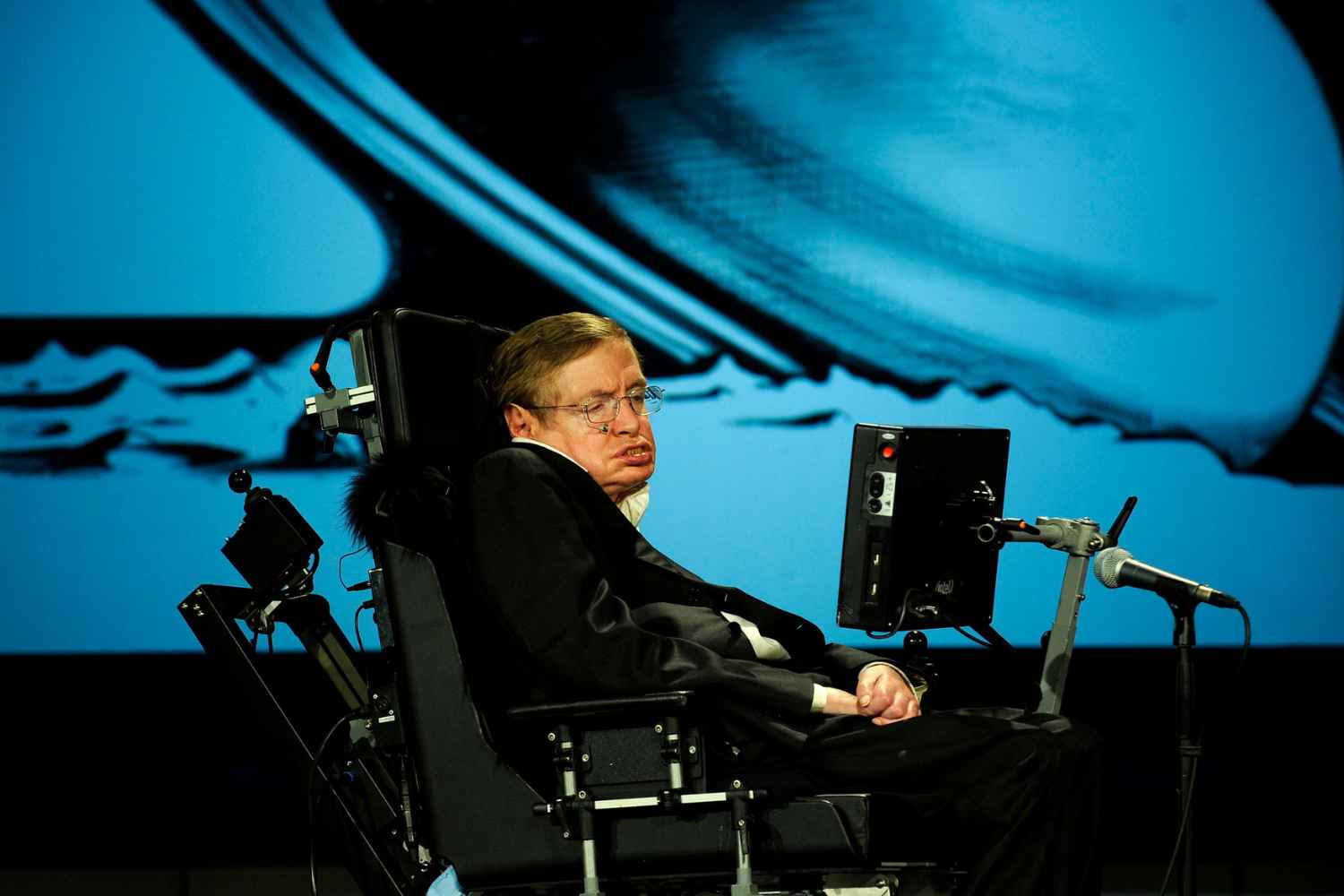
He loved the stars and space and encouraged us to go beyond the visible. Suffered from ALS since he was very young, Stephen Hawking he leaves us at the age of 76 and imprisons each of us to the wonderful world of science and knowledge, of visions of an unexplored cosmos and an intelligence out of the ordinary. Scientist and astrophysicist, brilliant like few others, so much so that his IQ was equal to those of Albert Einstein (among other things born on March 14th) and Isaac Newton. But who was Stephen Hawking? And what do we know about him today?
A physicist with a visionary mind, scientist and precursor of modern cosmology, Hawking in his life combined a boundless intellect and a mischievous sense of humor that made him an icon of the academic world and popular culture. In addition to his great scientific contribution, today there is also an asteroid that bears his name, 7672 Hawking, to remember him.
Ironically, Stephen Hawking was born on 8 January 1942, the same day on which Galileo Galilei died three hundred years earlier (8 January 1642), while the date of his death, 14 March 2018, overlaps with the day of Einstein’s birth, 14 March 1879. Not only that, 14 March is also celebrated as Pi Day.
Biography
Stephen William Hawking was born in Oxford in 1942. After high school, he graduated from the University of Oxford in 1962 as a mathematician and physicist.
In ’63, while ice skating, young Stephen slipped and had difficulty getting up. He was immediately diagnosed with a degenerative neuromuscular disease, ALS (amyotrophic lateral sclerosis). The doctors assumed that the disease would lead to his death in a couple of years, but it is the story we know. Of course, Stephen’s life was never the same after that, but his physical limitations never interrupted his intellectual activity.
Already in October 1962 he began his doctoral studies at Trinity Hall, Cambridge. He asked to work with Fred Hoyle, but the famous astronomer had too many suitors and the request was denied; many years later, Hawking himself would see the bright side: if he had been accepted, he would probably have been forced to defend Hoyle’s steady-state theory, discredited after the discovery of the cosmic background radiation in 1965.
While studying for his doctorate, he married Jane Wayline (1965), with whom he had three children. After almost 25 years, in 1990 the couple separated and the scientist went to live with Elaine Mason, one of the nurses who took care of him and with whom he married five years later; this second relationship lasted until 2007.
After obtaining a doctorate in theoretical physics (1966), his passion for studying the origin of the universe led him to focus on the field of general relativity, in particular on the physics of black holes, described for the first time by Robert Oppenheimer in ’39. In 1974 Stephen was appointed a fellow of the Royal Society and, three years later, professor of gravitational physics at Cambridge, where he was awarded the Lucasian chair of mathematics (1980), which had already been led by figures such as Isaac Newton and, more recently, Paul Dirac.
Between successes and intellectual recognition, however, his illness progresses to the point of immobilizing him. A tracheotomy in 1985 then forced him to communicate only through a synthesizer connected to his chair, but even this did not demoralize him: he wrote seven more books and continued to publish articles and hold conferences.
Despite his physical disabilities and the progressive limitations imposed by degenerative disease, Stephen Hawking is probably the most famous physicist since Einstein. A great fighter, throughout his life he managed to overcome the immensity of the impediments posed by the disease, undoubtedly becoming an example of resistance against the misfortune of fate.
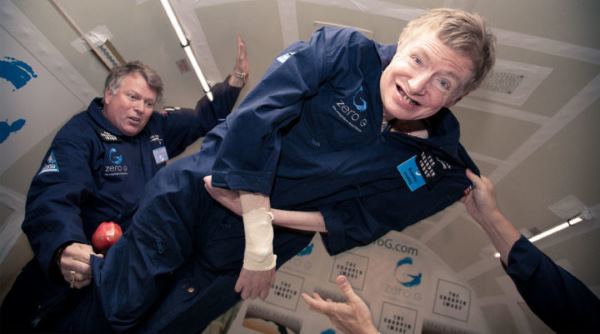
Stephen Hawking, 10+1 things you don’t know
Source
Stephen Hawking, 15 quotes
Look at the stars instead of your feet, be curious. No matter how difficult life may seem, you can always do something
The greatest enemy of knowledge is not ignorance, it is the illusion of knowledge
Life would be tragic if it wasn’t fun
I believe that life on Earth is at increasing risk of being wiped out by catastrophe, global warming, nuclear war, a genetically modified virus or other dangers
You can exit a black hole, even into another universe. If you feel like you’re in a black hole, don’t give up. There is a way out
I think of the brain as a computer, which will stop working when its components fail. There is no heaven or afterlife for broken computers. It’s a fairy tale for people who are afraid of the dark
God may exist, but science can explain the Universe without the need for a creator
I’ve noticed that even people who claim that everything has already been written and that we can’t do anything to change things look before crossing the street
If aliens came to visit us one day, I think the outcome would be similar to what happened when Christopher Columbus landed in America, not a very good outcome for the Indians
People who brag about their IQ are losers
People won’t have time for you if you’re always angry or complaining all the time
One of the fundamental rules of the Universe is that nothing is perfect: perfection simply does not exist… without imperfection, neither you nor I would exist
To limit our attention to earthly matters would be to limit the human spirit
Nothing is better than reading and gaining more and more knowledge
The universe does not behave according to our pre-conceived ideas, but it continues to surprise us
