
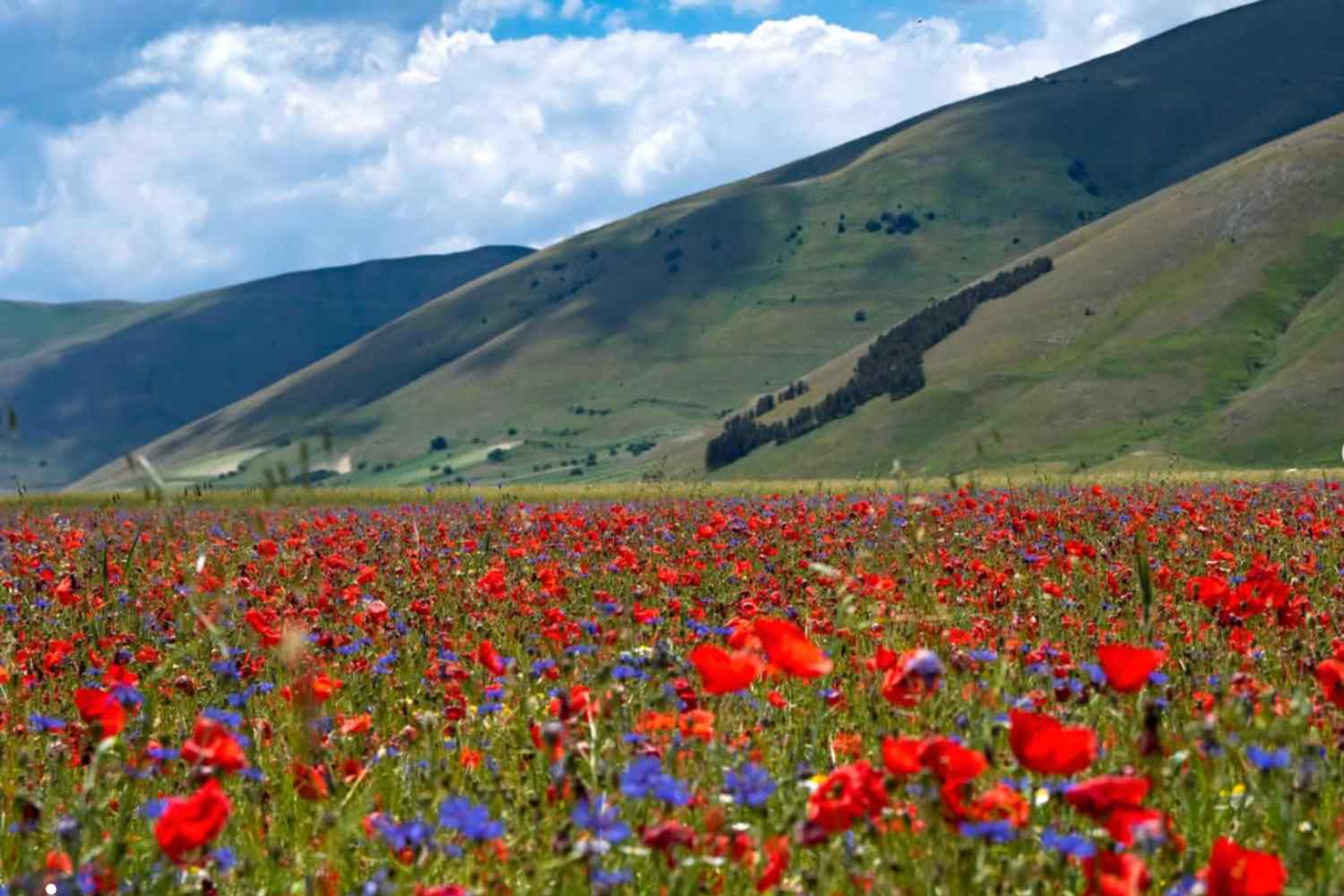
A different flowering than usual
Every summer the Pian Grande of Castelluccio di Norcia, in the heart of the Sibillini Mountains National Park, transforms into one of the most famous natural spectacles in Italy. Thousands of visitors reach the plateau between Umbria and Marche to admire the mosaic of colors created by the spontaneous flowering and cultivation of lentils: the red of the poppies, the yellow of the wild mustard, the blue of the cornflowers, the white and light blue of the lentil flowers.
This year, however, the landscape looks very different. The red of the poppies dominates almost exclusively, while many other floral species have been hit hard by the high temperatures and drought that have characterized the last few weeks.
Record drought and “burnt” flowers
Gianni Coccia, councilor of the Municipality of Norcia and historic farmer of the Castelluccio lentil cooperative, explains the situation. After a rainy spring until the second half of May, the area was hit by a phase of intense heat and lack of rainfall.
«This is probably the driest year I can remember. The flowers were practically burned”, he told ANSA.
The high temperatures, which on some days reached 30 degrees even at altitude, have compromised the development of many floral essences, significantly reducing the chromatic variety that makes Castelluccio’s flowering famous.
Because poppies resist better
Extreme weather conditions do not affect all plants equally. During periods of drought, in fact, flowers are among the most vulnerable parts of plants because they lose water through transpiration and can be rapidly damaged when water reserves decrease.
Poppies, on the other hand, show a greater ability to adapt to dry soils thanks to a root system that is more efficient in absorbing water. This characteristic has allowed them to survive better than other species present on the plateau, becoming the almost exclusive protagonists of the 2026 flowering.
View this post on Instagram
Castelluccio lentils are also at risk
The effects of drought do not only affect wild flowers. Even the famous Castelluccio lentil, a symbolic product of the territory, is affected by climatic anomalies.
This cultivation grows in very particular conditions: Pian Grande in fact occupies the bottom of an ancient dried up lake, characterized by soils rich in phosphorus and poor in potassium. For centuries the lentil production cycle has been favored by harsh winters and regular rainfall.
Today, however, these balances are changing. The increase in average temperatures, the reduction of frost days and increasingly long periods without rain are profoundly changing the environmental conditions of the plateau.
View this post on Instagram
Climate change changes the face of the plateau
The flowering of 2026 represents one of the most evident effects of the climate transformations taking place in the mountain areas of the Apennines. Scientific studies have shown that heat waves can irreversibly damage flowers and compromise the productivity of agricultural crops.
Lentils, in particular, are very sensitive to thermal variations: their optimal development occurs between 18 and 30 degrees. Higher temperatures for prolonged periods can cause drastic drops in production, as demonstrated by various international research.
The testimony of farmers
Gianni Coccia, councilor of the Municipality of Norcia, farmer and member of the Castelluccio lentil cooperative, describes the gravity of the situation.
It rained practically until May 20-25, then came an exceptional drought. This is probably the driest year I can remember. The flowers are practically burned,
he explained to ANSA. According to Coccia, the weather conditions of recent weeks have prevented the different floral essences from developing regularly, compromising a natural spectacle that attracts thousands of visitors from all over Italy every year.
Disappointment among visitors
Despite the large influx of tourists, photographers and hikers recorded over the last weekend, many visitors found a panorama different from the one immortalized in the photographs that have made Castelluccio famous throughout the world. As highlighted by ANSA, the traditional multicolored carpet has given way to a much more muted palette, where the red of the poppies dominates while many of the other species that normally characterize flowering are almost absent.
A new face for flowering 2026
The flowering of Castelluccio never has a fixed date and varies every year depending on the weather conditions and lentil sowing,
Coccia recalled again. This year, however, the climate has profoundly changed the face of one of Italy’s best-known natural spectacles, making it clear how extreme events can impact mountain ecosystems and local agricultural production.
A signal not to be ignored
The flowering of Castelluccio remains a spectacle capable of attracting thousands of people, but the face of the plateau in 2026 also offers concrete evidence of the effects of climate change on mountain ecosystems and traditional agricultural production. A phenomenon that not only concerns the future of the famous Umbrian lentil, but also the conservation of one of the most iconic landscapes of the Italian Apennines.
