
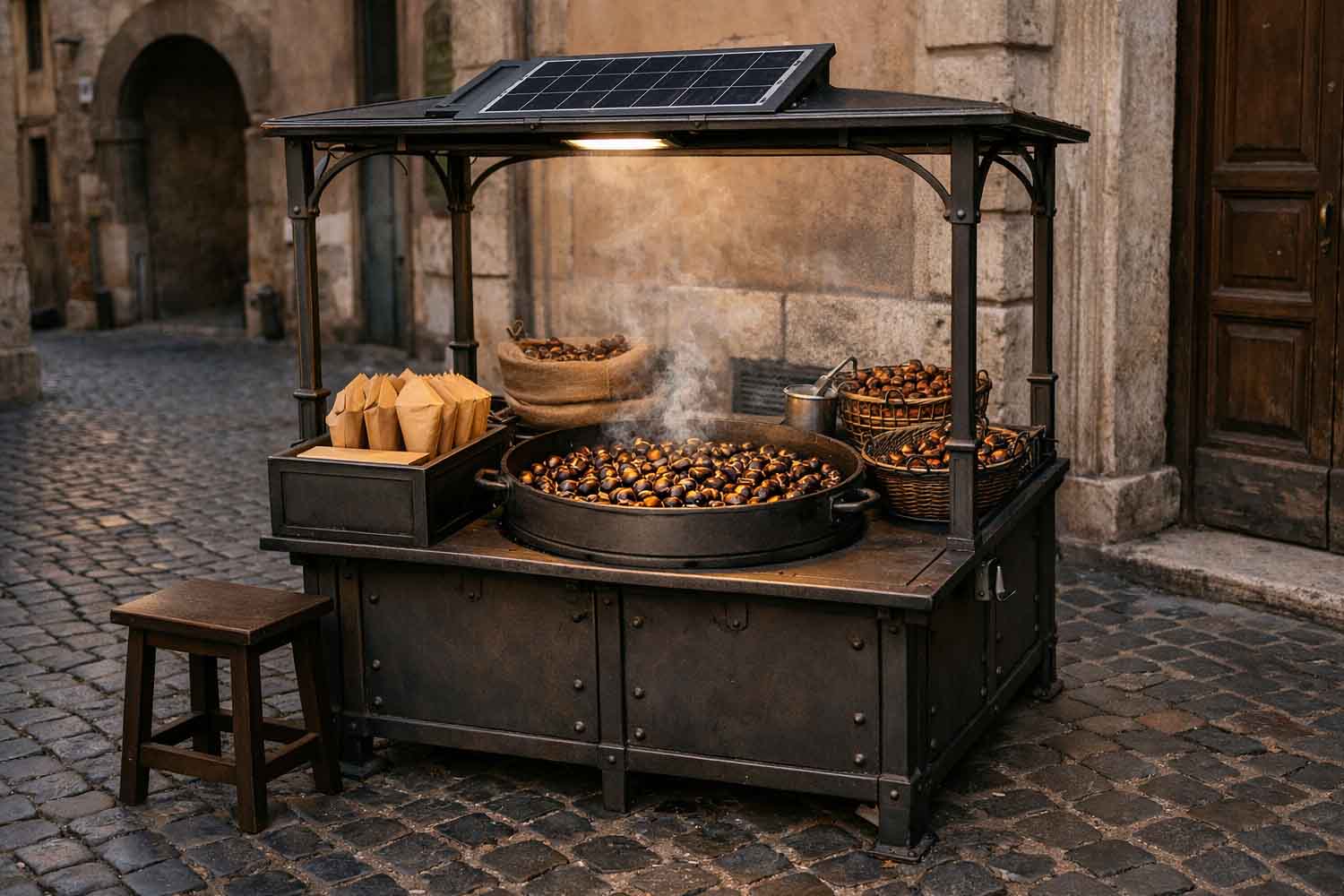
In Rome, winter continues to have the same smell. Warm chestnuts, straw paper, hands warming up on the street. What changes is not the ritual, but the way in which it occupies public space. This is established by Resolution no. 34 of 18 December 2025 of the Rome I Center Municipality, which approves the new municipal plan for commerce in public areas and puts in black and white what the chestnut roasters of the historic center will have to be, and where they will be able to stay.
The plan affects dozens of locations, including seasonal winter ones. Inside there is also the chapter regarding roasted chestnuts, treated not as untouchable folklore but as a commercial activity that occupies public space and, therefore, must respect precise rules.
New rules for the desks
The Plan establishes a typical bench which cannot exceed one square meter in total. Only the elements necessary for the activity must be placed within this space.
The bench is made up of:
The structure must be made of dark-colored wrought iron. The installation of umbrellas and any connection to the electricity grid is prohibited. Power is guaranteed by a small photovoltaic panel positioned above the hob, sufficient to provide energy and a minimum amount of lighting to the station.
Where chestnut roasters can stay and why some areas remain excluded
The Plan promptly identifies compatible and ineligible stations. The assessments take into account historical-landscape constraints, road safety and urban decorum. Some particularly protected areas, such as squares and streets of great monumental value, remain excluded from the possibility of hosting seasonal stalls.
In other cases, the Municipality has foreseen movements of a few meters compared to the historical locations, identifying points deemed technically suitable. This approach allows the presence of chestnut roasters to be maintained without interfering with areas subject to stringent constraints.
Tradition remains, context changes
The Plan does not intervene on the origin of the chestnuts, which will continue to arrive from the territories traditionally linked to this product. The change mainly concerns the organization of the public space and the appearance of the stations.
For citizens it means finding more tidy and homogeneous stalls; for operators, having clear and definitive rules after years of temporary solutions. The sale of roasted chestnuts remains a typical presence of the Roman winter, but inserted into a more defined regulatory framework.
You might also be interested in:
