
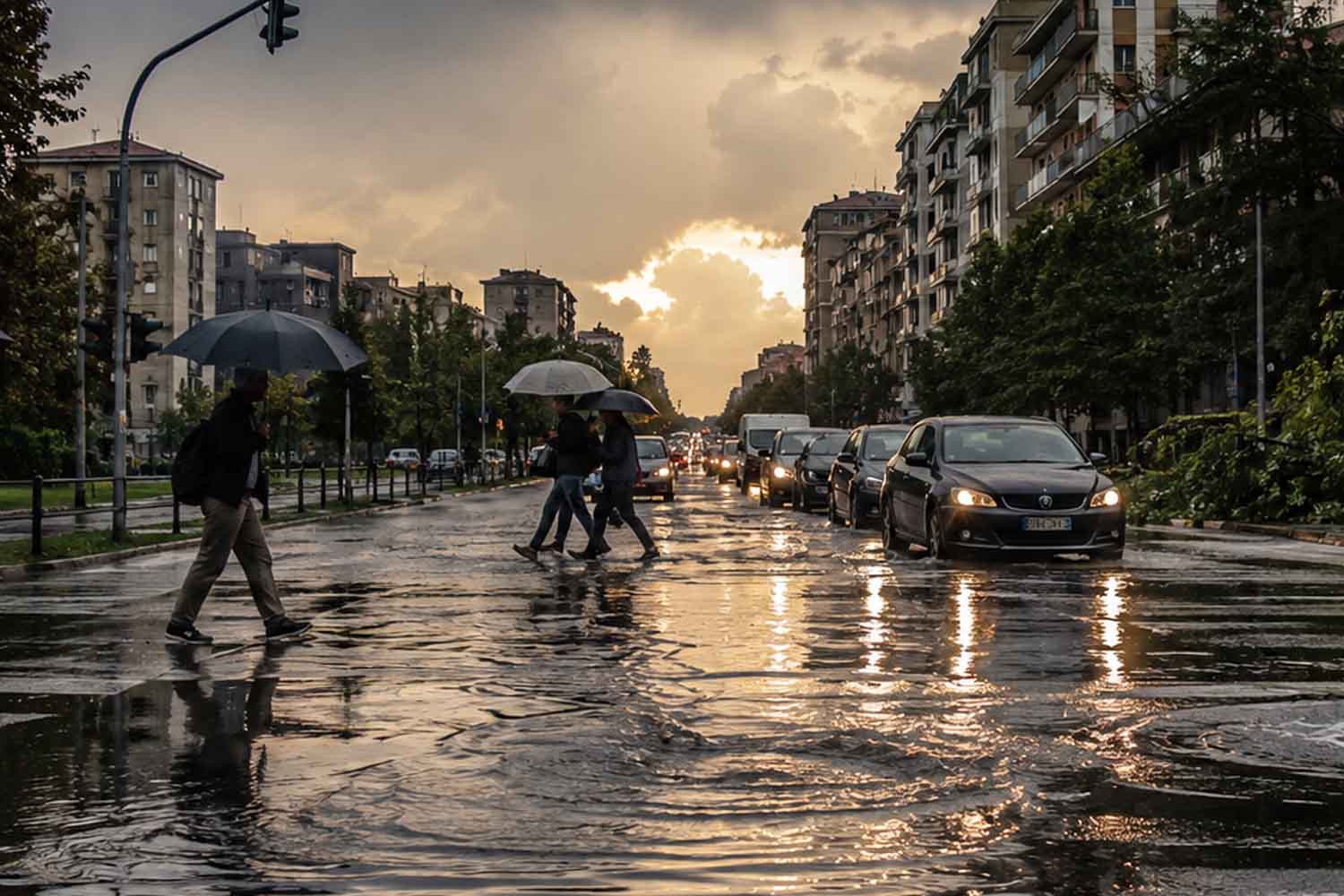
There are evenings when a city seems unable to cool down anymore. The asphalt continues to release heat even after sunset, the walls remain warm, open windows are of little use and sleep comes poorly. Then maybe, a few weeks later, a few hours of rain are enough to transform a road into a brown torrent, an underpass into a trap, a station into an improvised swimming pool. Urban climate change in Italy now has much less to do with abstract images of distant glaciers and much more to do with the body of cities.
The data from the 2026 Istat annual report tell exactly this: an increase in temperatures, a growth in extreme events and cities that are finding it increasingly difficult to absorb the blow. In the 21 Italian regional capitals, between 1971 and 2023, both the average annual temperature and the frequency of thermal anomalies and intense rainfall increase. Since 1997, annual temperature anomalies have always been positive, with the sole exception of 2005 and 2010. In 2022 and 2023, the highest annual average value of the entire historical series was reached: approximately 16.6°C.
The heat remains stuck between the buildings
The most concrete part, however, comes when we look at the so-called “tropical nights”. They are those in which the minimum temperature does not fall below 20°C. Translated into real life: nights in which the body doesn’t really recover, houses overheat, sleep is broken and air conditioners stay on until dawn.
Between 2006 and 2023, in the cities observed by Istat, there are an average of 114 summer days and 49 tropical nights per year, with anomalies of +13 and +11 respectively compared to the reference climate values. In 2023 the situation gets even worse: almost all regional capitals show increases above the average threshold, with +28 summer days and +22 tropical nights.
It’s the kind of change that slowly alters the way you experience a city. Older people cope worse with the constant heat, those who work outdoors accumulate physical stress, those who live in small and poorly insulated apartments enter the summer already tired. And the problem gets even tougher in dense urban areas, where concrete, traffic and impervious surfaces retain heat like a battery.
Here the urban greenery stops being furniture from municipal renderings and returns to being physical infrastructure. Shade, evaporation, lower temperatures, water absorption. In 2024, urban green areas in the capital municipalities exceed 590 km², equal to 3% of the municipal territory and 33.7 square meters per inhabitant. However, when only the areas actually usable by citizens are considered, the average availability drops to 15.9 square meters per inhabitant.
That difference matters a lot. Because it is one thing to have “statistical” greenery, it is another to have real trees along the streets where people wait for buses, cross squares or walk at three in the afternoon in July.
Milan, Genoa and Rome at the top
The hardest data concerns extreme weather events. Between 2000 and 2024, Istat records 86 flood and inundation events in the regional capitals and 188 events in the 69 cities considered by the urban environmental survey. Milan, Genoa and Rome are the cities with the highest number of overall episodes: 45 events in total. About a fifth is associated with rainfall lasting more than 24 hours.
The problem, here too, is very material. Italian cities were built largely for a climate different from the current one. Asphalted surfaces, buried streams, very dense neighbourhoods, waterproofed soil, drainage networks designed decades ago. When more violent and concentrated rainfall arrives, the water simply has no place.
And in fact, Istat reports that the period 2020-2023 is characterized by consecutive negative anomalies in annual rainfall, with 2022 among the driest years of the entire historical series. Less overall rainfall, therefore, but more imbalances: long dry periods alternating with intense episodes. It is one of the most difficult paradoxes to communicate, because in the common imagination “hotter” is still automatically associated with “more sun”. Urban reality is much more like a broken pendulum.
Italian cities consume and concentrate everything
Then there is another element that makes urban areas central to the climate crisis: concentration. The 109 Italian capital municipalities host approximately 29% of the resident population, generate 40.5% of the added value of industry and services, collect approximately 32% of urban waste, concentrate almost 40% of tourist arrivals and approximately a quarter of the country’s final energy consumption.
In short, Italian cities are simultaneously part of the problem and the place where the effects become more immediate. Heat, traffic, energy, soil sealing and population density accumulate here. Here a tropical night weighs more. Here a violent storm blocks transport, schools, work, emergency rooms and entire neighborhoods.
In the meantime something is moving. Urban forestation now involves 68 provincial capitals, more than double compared to the 32 in 2013, reaching almost 16 million square metres. Compared to 2023, the increase is 6.2%; compared to 2013 it reaches 35%.
However, the climate pace remains faster than the administrative pace. Young trees take years to create real shade. Neighborhoods built without green spaces remain vulnerable for decades. And many Italian cities continue to chase emergencies that no longer seem like emergencies. They seem routine.
“Tropical nights” sound almost exotic when put that way. Then you try to sleep at midnight with 31 degrees between concrete and buildings, you hear the air conditioner motor running for hours and you understand that that technical definition already concerns the daily lives of millions of people. The climate now lives downstairs.
You might also be interested in:
