
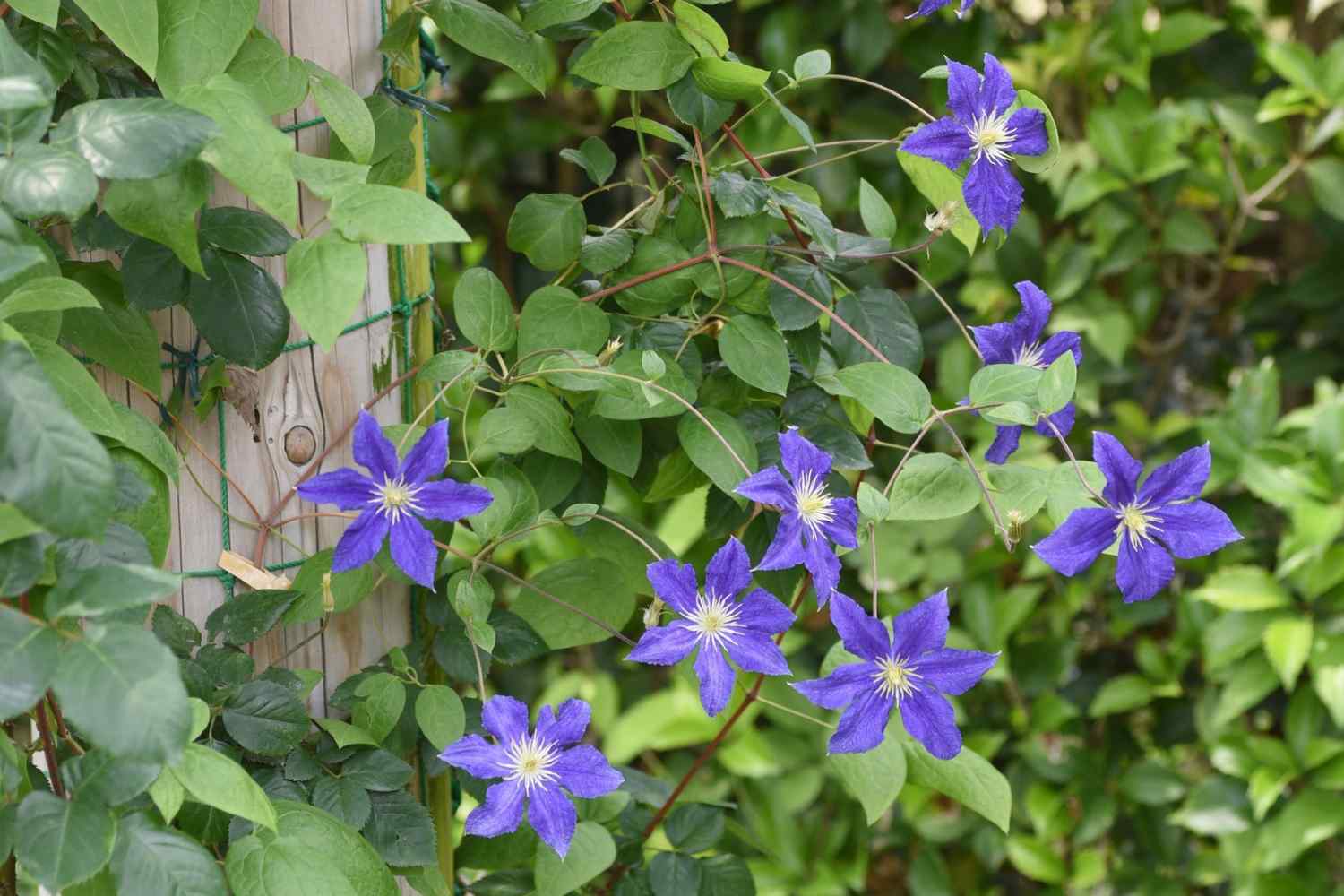
Clematis is known as the “queen of vines”. During the flowering period this plant produces splendid pink-purple star-shaped flowers. Find out how and when to plant clematis and, above all, how to care for it for a garden full of colour.
Clematis: what is it
There are more than 300 species and hundreds of clematis hybrids. Most are woody, deciduous vines, while others are shrubby. Some species bloom in spring, and others in mid to late summer.
The blooms are spectacular because the plant offers showy flowers in the shape of saucers, bells and tubes in cold shades of purple or pink, but there are species in shades of blue, white, magenta, yellow and even two-tone. Additionally, many varieties of clematis are fragrant, but the most fragrant species is the tender one C. armandii. This plant attracts various pollinating insects.
Clematis grow well on a trellis, pole, or fixed structure to climb, as without these structures the vine will sprawl across the ground.
Clematis: what are the varieties
The clematis family includes many varieties. Below you will find the most common ones to grow:
How to grow clematis
Clematis thrives in full sun, so much so that it needs at least 6 hours of light a day for good flowering. However, sensitive roots cannot handle the heat; therefore, the advice is to keep plant roots moist and cool with mulch, low-growing plants and ground cover. Furthermore, the soil must be well draining with a neutral PH.
When and how to plant clematis
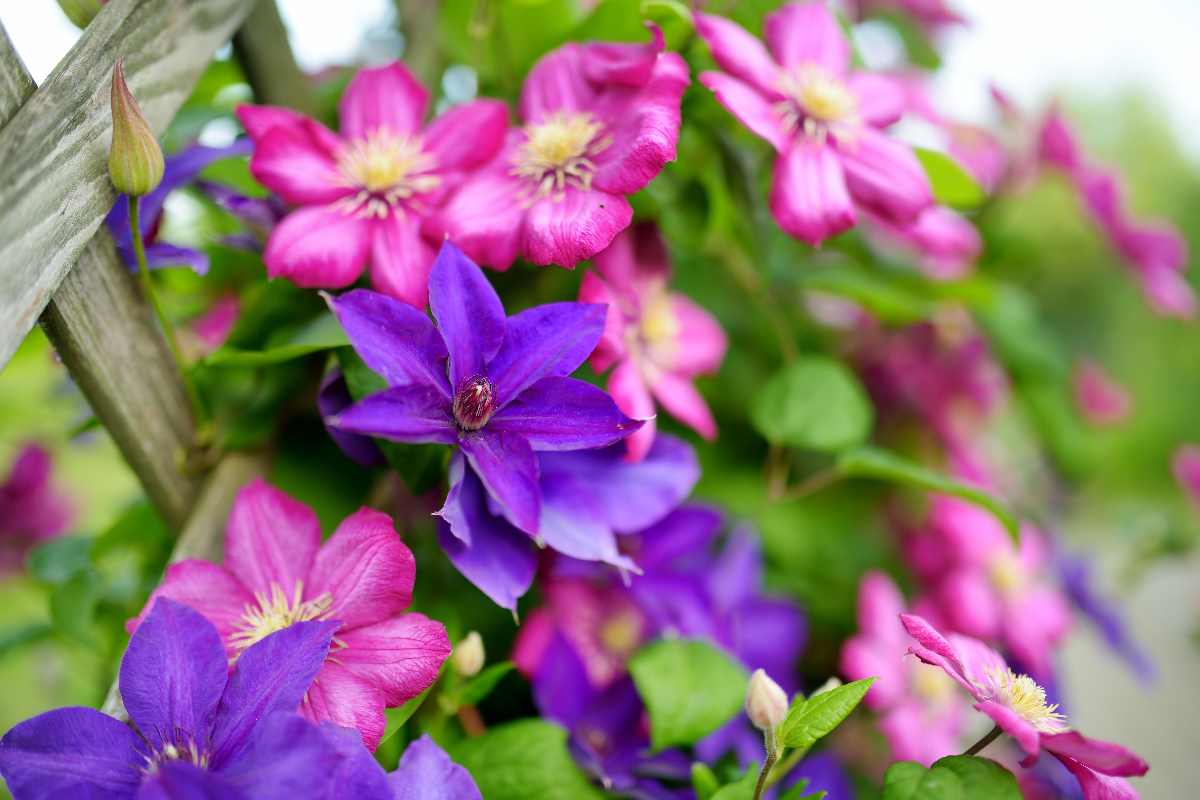
The advice is to plant it during the cool spring. Here’s how to proceed to grow clematis in the garden:
- Dig a planting hole about 2 to 3 times the width of the root ball and a few inches deeper
- the crown (the part of the plant where the stem and roots meet) should be about 10 centimeters below the soil surface. This will encourage branching and stem development underground
- at this point, fill with soil, water generously and mulch to keep the roots cool and keep weeds to a minimum
- position the climbing structure to allow the plant to grow.
Keep the soil moist during the first year, watering weekly, and don’t let the soil dry out. In colder regions, it is best to add additional mulch around the plant in late fall to protect the roots. Once the plant is in the ground, do not disturb or move it.
Each spring, spread compost around the plant (away from the stems) and, importantly, prune any dead wood, cutting new growth above it. On older plants, remove any stems that are 4 years old or older.
If you wish you can also plant it in a pot, but this must be large enough to allow the plant to grow. We advise you to opt for pots approximately 50 cm deep in which to insert a 5/10 cm layer of expanded clay balls and soil mixed with manure.
Also in this case, place the plant in a bright and sunny place, and proceed with watering only when the soil is dry but not excessively dry.
Prune clematis
Pruning clematis is important to encourage flowering. There are 3 different types of clematis and you need to figure out which type you have before pruning it. The woody-stemmed types, for example, such as the Clematis montanathey flower early on the previous year’s stems.
Clematis belong to one of three groups, based on flower size and bloom time.
Parasites and diseases
The most serious disease is commonly called clematis wilt. It is a stem and leaf rot disease caused by a fungus. It mainly affects large-flowered clematis hybrids.
Additionally, clematis is also susceptible to powdery mildew, rust, fungal leaf spot, and viruses; while, as regards parasites, pay attention to aphids, vine weevils, scale insects, snails and mites.
Clematis propagation
Clematis can be multiplied in two main ways: by cutting or by seed. Propagation by cuttings is the quickest and most reliable method, and is recommended above all to preserve the characteristics of the mother variety. Semi-woody cuttings are taken between May and July, choosing healthy stems with at least two nodes. Cut just below a node, remove the lower leaves and immerse the base in powdered rooting hormone before inserting the cutting into a moist mixture of peat and sand in equal parts. Covered with a plastic bag to maintain humidity, the cutting should be kept in a bright place but not in full sun. Roots generally form within four to six weeks.
Propagation by seed is slower and mainly suitable for botanical species, since hybrids do not faithfully transmit their characteristics to seedlings. The seeds should be collected in autumn and sown in trays between January and March, after a cold stratification period of four to six weeks in the refrigerator. Germination can take from a few weeks to several months, so it’s best to arm yourself with patience. The young shoots should be transplanted into individual pots when they are robust enough and brought into the open ground only in the following spring.
Fertilization
Proper fertilization makes the difference between a stunted clematis and a lush plant full of flowers. In spring, when new shoots begin to appear, it is the ideal time to administer a slow-release granular fertilizer rich in potassium, which stimulates flowering and strengthens the tissues. It is distributed around the base of the plant, away from the stems, and is incorporated lightly into the soil.
During the growing season, from April to July, it can be integrated with a liquid fertilizer for flowering plants to be administered every two-three weeks, diluted in the irrigation water. From August onwards it is best to suspend nitrogen fertilization so as not to stimulate late growth which could be damaged by the cold. In autumn, however, a supply of mature compost distributed around the plant slowly nourishes the soil during the winter and prepares the clematis for the following spring.
Common problems and solutions
One of the most frequent problems is so-called sudden wilting, in which the stems collapse and turn yellow for no apparent reason. This is almost always a fungal infection that affects the base of the stem. In this case it is necessary to immediately remove and dispose of the affected parts without placing them in the compost, and treat the plant with a specific fungicide. Clematis often manages to grow back from the root, especially if at the time of planting the crown was buried 10 centimeters deep.
Leaves with white, dusty spots indicate the presence of powdery mildew, a fungus favored by heat and poor air circulation. You can intervene with treatments based on sodium bicarbonate or with specific fungicides, improving ventilation around the plant. If the leaves yellow widely without obvious spots, the problem is often overwatering or poorly draining soil, conditions that suffocate the roots. In this case it is sufficient to reduce watering and check that the water does not stagnate.
The presence of aphids on young buds can be managed with a strong jet of water or with soft soap-based treatments. Finally, snails are formidable enemies, especially in spring when the shoots are tender: traps with beer or anti-snail granules positioned around the base are the most effective remedies.
Frequently asked questions
The most common question concerns failure to flower. If the clematis grows lush but does not produce flowers, the causes can be various: pruning carried out at the wrong time, which eliminates the flower buds already formed; an excess of nitrogen fertilizer, which favors the leaves to the detriment of the flowers; or simply a too shady position. Clematis needs at least six hours of direct sun a day to flower profusely.
Another frequently asked question concerns the possibility of growing it in the shade. The answer is partially yes: some varieties, such as C. alpina and C. montana, tolerate partial shade better than large-flowered hybrids, but no clematis thrives in deep shade. A position with filtered light in the morning and direct sun in the afternoon represents the ideal compromise.
Many also wonder how fast the plant grows. Under optimal conditions, an adult clematis can grow a meter or more each year, but growth is slower in the first two years because the plant focuses its energy on root development. It is therefore normal that in the first year it seems almost still: it simply means that it is working underground.
You might be interested in:
