
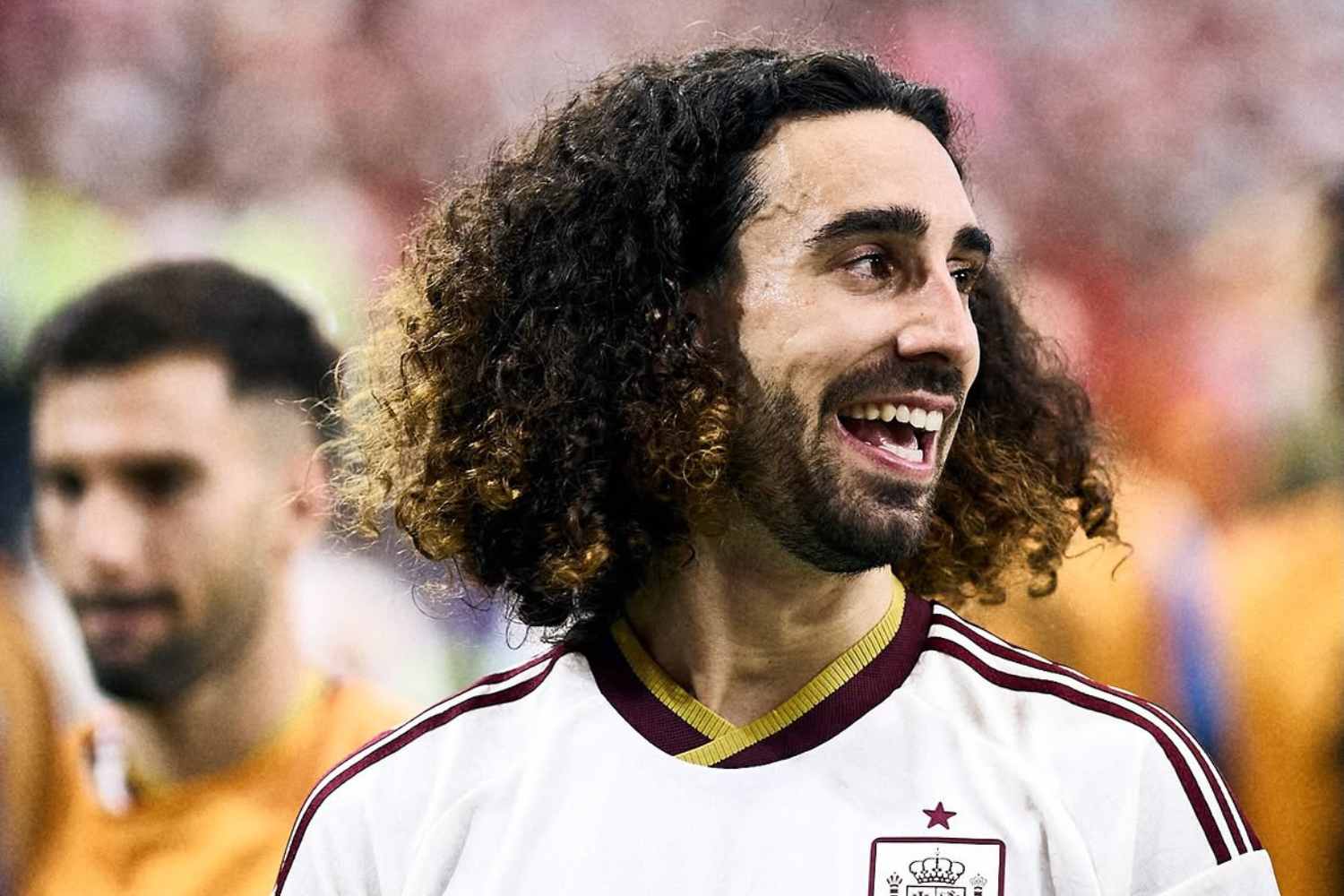
In the stands of the provincial pitches, during the youth years, a mother struggles to distinguish her son between identical shirts and all the same hair. It happens to Patricia Saseta, mother of Marc Cucurella, and the solution she finds is to let his hair grow: so, between chatting with the other mothers in the stands, she can spot him straight away. Cucurella himself said it in an interview with La Voz de Galicia dated July 2024:
My mother let our hair grow so long (she also talks about her brother) because when she accompanied us to matches she would get distracted and could recognize us by our hair. We played in the youth team and since then I have never abandoned them. It wasn’t that bad, eh eh eh.”
From that moment on, he never cut his hair again. It has become a brand as recognizable as its defensive diagonals, first with the shirt of Eibar, then Getafe, Brighton, Chelsea and finally Spain, with which he became European champion in 2024 and world champion in 2026.
The viral version
On Instagram, however, in recent days another version has been circulating, much more touching, in which Cucurella would keep his hair long so that his little son Mateo, suffering from autism, can recognize him on the pitch during matches. The additional detail, that of the child peering at his father from the stands, has made the rounds on social media, thanks to a quote placed in quotation marks and attributed to the footballer.
@cucurella3 / instagram
What fact-checking really says
However, Cucurella never uttered that sentence. This was verified by Infoveritas, a Spanish newspaper that joins the European Fact-Checking Standards Network: a cross-research on the player’s statements does not return any confirmation in reliable journalistic sources, while the only interview in which Cucurella addresses the topic, precisely that of 2024, explicitly talks about his mother.
Two true stories, merged into one false one
There remains a grain of truth, and it is probably there that the hoax took root, because Cucurella actually spoke, on several occasions, about the diagnosis of autism of his eldest son, Mateo, and the difficulties that the family went through in understanding his needs. Two authentic stories, in short, merged into a third which is not so.
