
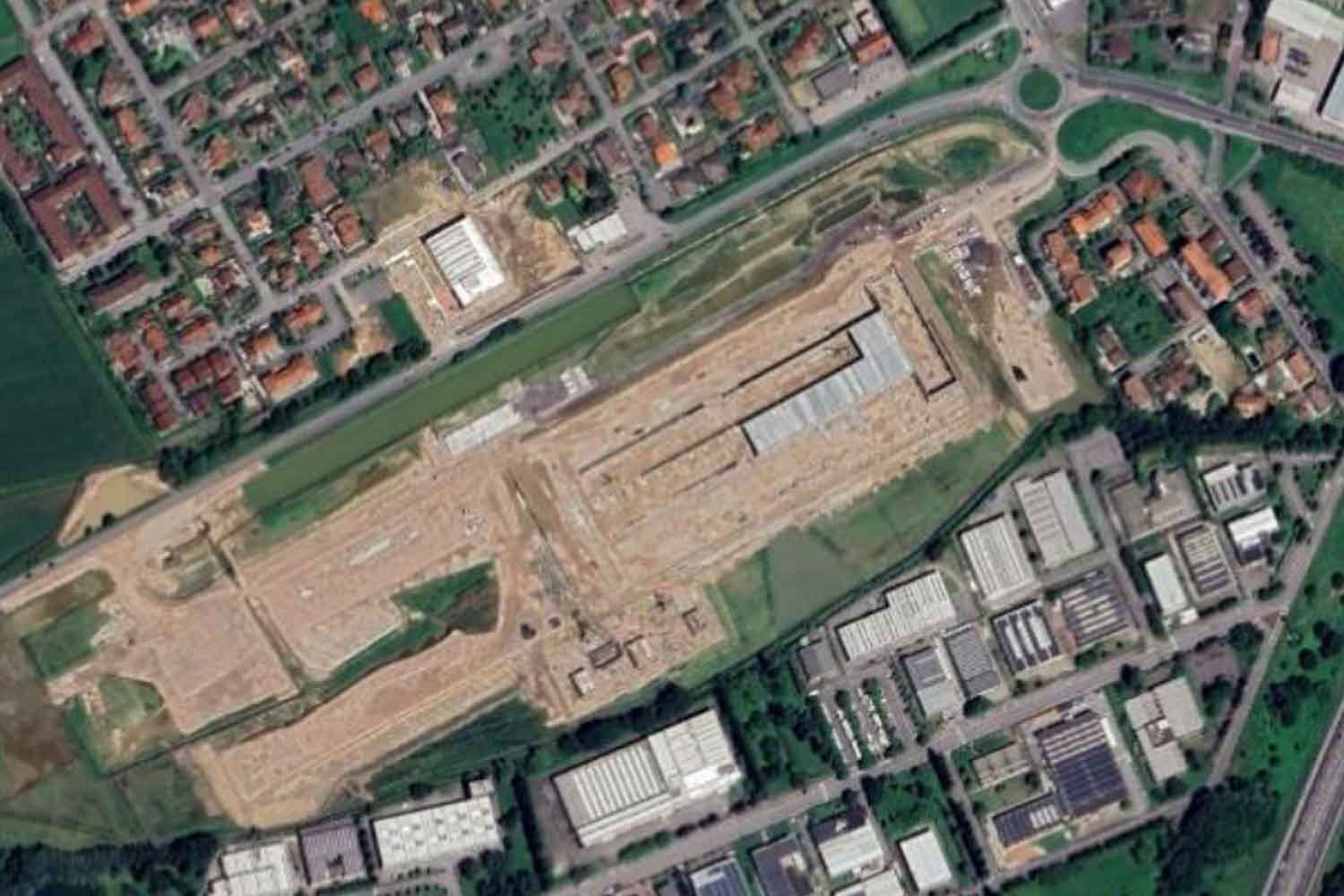
In Noviglio, on the outskirts of Milan, an area of approximately 14 hectares has become a construction site for a data center. The satellite images from 2023 and 2024 published by ISPRA show the transformation: first the fields, then a large surface area occupied by works. The cloud may be a cloud, but several square meters of land are needed to host it.
And Noviglio is just one of the Italian cases. According to the latest ISPRA data, in 2025 the main data centers caused the consumption of 13 hectares of previously agricultural or natural land. In 2024 there were 37. A decrease, of course, which however does not necessarily mean fewer projects arriving. On the other hand, with the growth of artificial intelligence and digital services, finding space for servers is becoming an increasingly concrete necessity.
©ISPRA
To understand what we are talking about, let’s imagine a huge building full of computers working day and night. It is there that much of the information necessary to use the internet, applications, platforms and artificial intelligence is stored and processed. Every time we save a photo to the cloud or query a chatbot, there are machines working somewhere.
Machines that consume electricity, produce heat and need systems to cool. And, above all, space. Lots of space. So, as we continue to imagine an increasingly digital future, part of that future is also making its way into the countryside. With all due respect to the immateriality of the web.
In Italy, data centers occupy new land, but not all of them consume land
Michele Munafò, ISPRA manager and responsible for national territory monitoring, explained in a speech that probably more than half of the large Italian data centers are built on surfaces already occupied by buildings or other artificial coverings. In these cases, therefore, new agricultural or natural land is not necessarily taken away. Recovering an old abandoned industrial area, for example, is very different from building on a cultivated field.
Munafò also highlighted a rather important difficulty: in Italy there is still a complete list of all data centers. ISPRA is able to identify, above all, the larger plants, through the projects subjected to environmental assessment and other available information. Therefore, the 13 hectares in 2025 represent the land consumption detected through this monitoring. To know what the impact of the new projects will be, we will have to wait until they are actually implemented.
And the problem comes in a country where we are already losing a lot of ground. According to the ISPRA report on land consumption for 2026, in 2025 alone over 102 square kilometers of Italian territory were transformed into artificial surfaces. It means more than 3 square meters per second, including new buildings, roads, squares and other works. All this while the land recovered through restoration interventions remains much less numerous.
Data centers represent a very small part of this total, let’s be clear. But they add to a long list of activities that continue to ask for new spaces, especially in the more developed areas of the country. And once you have built a large building on fertile land, going back is not at all easy.
In Lombardy, building on fields costs more. But it can still be done
Lombardy, the main Italian data center hub, has decided to intervene with a dedicated law. Regional law number 11 of 3 June 2026 aims to encourage the recovery of old industrial areas, trying to discourage the construction of new data centers on agricultural land. As? By making those who decide to occupy them pay more. In the cases provided for by the law, if a data center is built on agricultural land rather than in areas considered priority, the construction contribution increases by 100%. In certain areas protected by regional legislation, the increase reaches 200%.
Simply put, construction costs can double or triple. Attention: we are talking about the sums due to build, not the overall cost of the system. The additional money is allocated to interventions to compensate for environmental effects and improve the area. The idea is to make it cheaper to renovate an old building, rather than covering new concrete fields. So far, everything is quite understandable.
However, there is an interesting detail: paying more does not mean being banned from building. If the land can be used according to planning regulations and all necessary authorizations are obtained, the data center can still be built. The operator pays the increased contribution and the project can move forward.
In practice, the Region tries to discourage the consumption of agricultural land by reaching into the wallets of those who build. A choice that could direct some investments towards areas already built up, but which leaves open the possibility of continuing to occupy the fields. And environmental compensation, however useful, does not automatically restore the land to the characteristics it had before the works.
From the US to the UK, data centers are looking for space outside of cities
The issue also concerns other countries, where the race for digital infrastructures is already creating land management problems. In the United States, for example, northern Virginia is home to one of the largest concentrations of data centers in the world. According to an official survey published in December 2024, between 2013 and 2021 these structures accounted for approximately 20-30% of the acreage developed in two counties, Loudoun and Prince William. An important share, which however concerns two territories particularly affected by the sector and not the whole of Virginia. The study also specifies that a part of those surfaces could have been used for other constructions, such as homes and warehouses.
In the United Kingdom, however, on 10 June 2026 the Government authorized a new data center in the Slough area, within the so-called Green Belt, a green belt where construction is subject to particular limitations to prevent cities from continuing to expand without control. The project also affects previously used surfaces, so it would be incorrect to consider it entirely a loss of agricultural land. However, it demonstrates how difficult it has become to find a balance between new technological needs and the protection of open spaces.
Moreover, already in July 2026 the British Government had admitted in a parliamentary response that it was still working to understand how much agricultural land had been requested by the data centers. When asked about the total area already lost, he did not provide a figure. A problem that, evidently, runs faster than the ability to measure it.
Build on the fields or recover what already exists
In Italy, the growth of data centers is destined to compete with a territory already affected by roads, warehouses, shopping centers, logistics hubs and new infrastructures. To host the servers, precise conditions are naturally needed: sufficient electrical connections, digital connections and adequate structures. It’s not enough to choose an abandoned warehouse and fill it with computers. Yet, recovering abandoned industrial areas can be a concrete way to reduce the consumption of new land, when the characteristics of the site allow it.
The Lombard law tries to push investments in this direction, increasing the costs for those who choose agricultural land. It will be up to the authorizations and projects actually carried out to show how much this measure will have an impact.
Because servers can also process millions of pieces of information per second, but to restore a field covered in concrete to its original fertility, just pressing a button is not enough. And not even pay triple the charges.
