
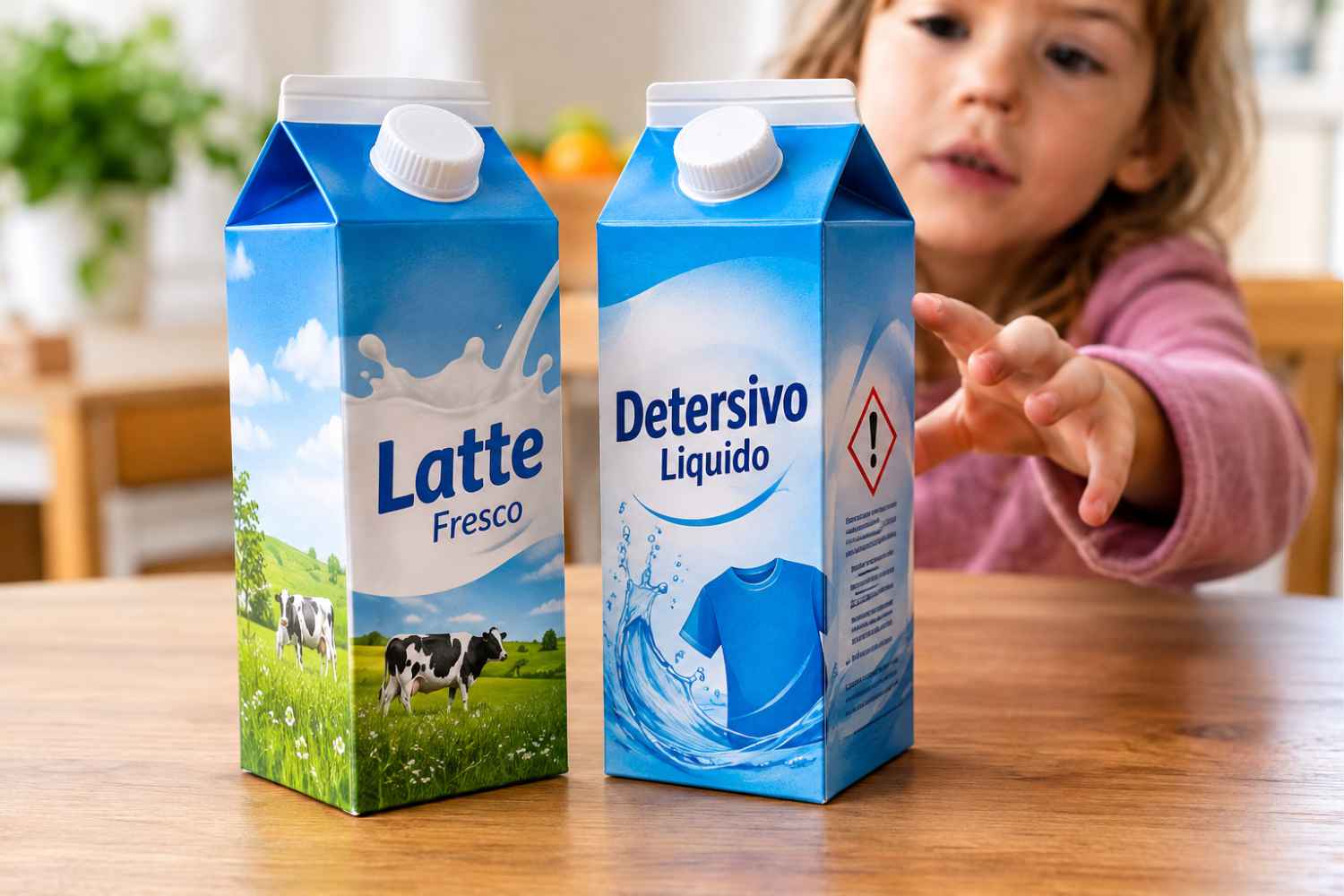
A carton that appears to contain milk or fruit juice, but is actually detergent. This is anything but a harmless resemblance, especially if there are children in the house. Precisely from an event of this type a ruling by the Court of Justice of the European Union was born, which clarified when the packaging of chemical products can be considered misleading and therefore not compliant with European rules.
The ruling, dated 5 November 2026, concerns a specific issue: the packaging of substances and mixtures classified as dangerous and sold to the public.
The story originates in Sweden and involves the company Orkla Care, which marketed liquid laundry detergents in colored cardboard packages, with an elongated shape and a closure with a screw cap. An aspect that was a little too reminiscent of the common containers used for milk, fruit juices and other drinks.
After reports from consumers, the Swedish Chemicals Authority banned the sale of nine products packaged in that way. According to the authorities, in fact, the similarity with food packaging could mislead and attract the curiosity of children, with possible consequences for their safety.
However, the company had contested the provision and the matter had come before the Swedish judges. To clarify how to interpret the European rules, the latter turned to the EU Court of Justice, asking it to establish which elements to consider to evaluate the similarity between a package of a dangerous chemical product and one intended for food.
What the EU Court of Justice ruled
The Court clarified that, to evaluate whether packaging can be confused with that of a food, it is not necessary to focus on a single detail, but to consider its overall impression. Various elements must therefore be examined: the shape, size, volume, design, colours, labels, materials used, consistency and even the smell. Even the combination of several features can help make a package similar to that of a food product.
The evaluation must be carried out on a case-by-case basis, also taking into account the habits and products known to consumers in the country where the packaging is marketed. It is therefore not necessary for the packaging to be considered misleading throughout the European Union, it is sufficient to evaluate the national market concerned.
Another important aspect concerns additional security measures. In the case examined, there was also discussion of a label applied to the cap and intended to be removed upon first use. For the Court, a measure of this type is not sufficient to exclude the risk of confusion if, once removed, the packaging returns to having an appearance similar to that of a food container. The characteristics that distinguish the packaging must therefore be evaluated considering the entire life cycle of the package.
The ruling also clarifies who needs to be considered when assessing the likelihood of confusion. Not only the average consumer, but also children and vulnerable people who may come into contact with the product after its purchase.
It is a particularly relevant passage: a container that to an adult appears clearly intended for a detergent may not be as recognizable to a child. For this reason, the authorities must also consider the ability of these people to distinguish the packaging of a chemical product from that of a food.
The Court also clarified that it is not necessary to prove that someone has already mistaken the detergent for a drink or suffered an accident. For the packaging to be non-compliant it is sufficient that the risk of misleading is not negligible. There is therefore no need to wait for a concrete episode to occur to intervene.
Nor does the specific hazard category of the substance or mixture contained make any difference: according to the Court, neither the hazard class nor the specific risk associated with the product are decisive elements in determining whether the packaging complies with this provision.
This is not a new ban for all products
It is important not to misunderstand the scope of the pronunciation. The Court did not establish that from today all detergents, cosmetics or other non-food products must no longer have packaging that resembles that of food. The ruling concerns the interpretation of Article 35(2) of the CLP Regulation, which applies to packaging containing dangerous substances or mixtures intended for the public.
This provision already existed and establishes that such packaging must not have a shape or design that could attract the curiosity of children or mislead consumers. Furthermore, they must not have characteristics similar to those of packaging used for food, feed, medicines or cosmetics, when this similarity could be misleading.
The novelty, therefore, is not the introduction of a new law, but the clarification provided by the Court on the criteria to be used to apply a rule already in force. An interpretation that will have to be taken into consideration by national authorities in the checks and evaluation of individual products.
The dispute between Orkla Care and the Swedish authority will now have to be defined by the national judge, who will apply the criteria indicated by the Court to the specific case. The ruling, however, establishes an important principle for the entire European Union: when it comes to packaging of dangerous chemical products, the resemblance to food is not just an aesthetic or commercial issue, but can become a safety problem for consumers.
