
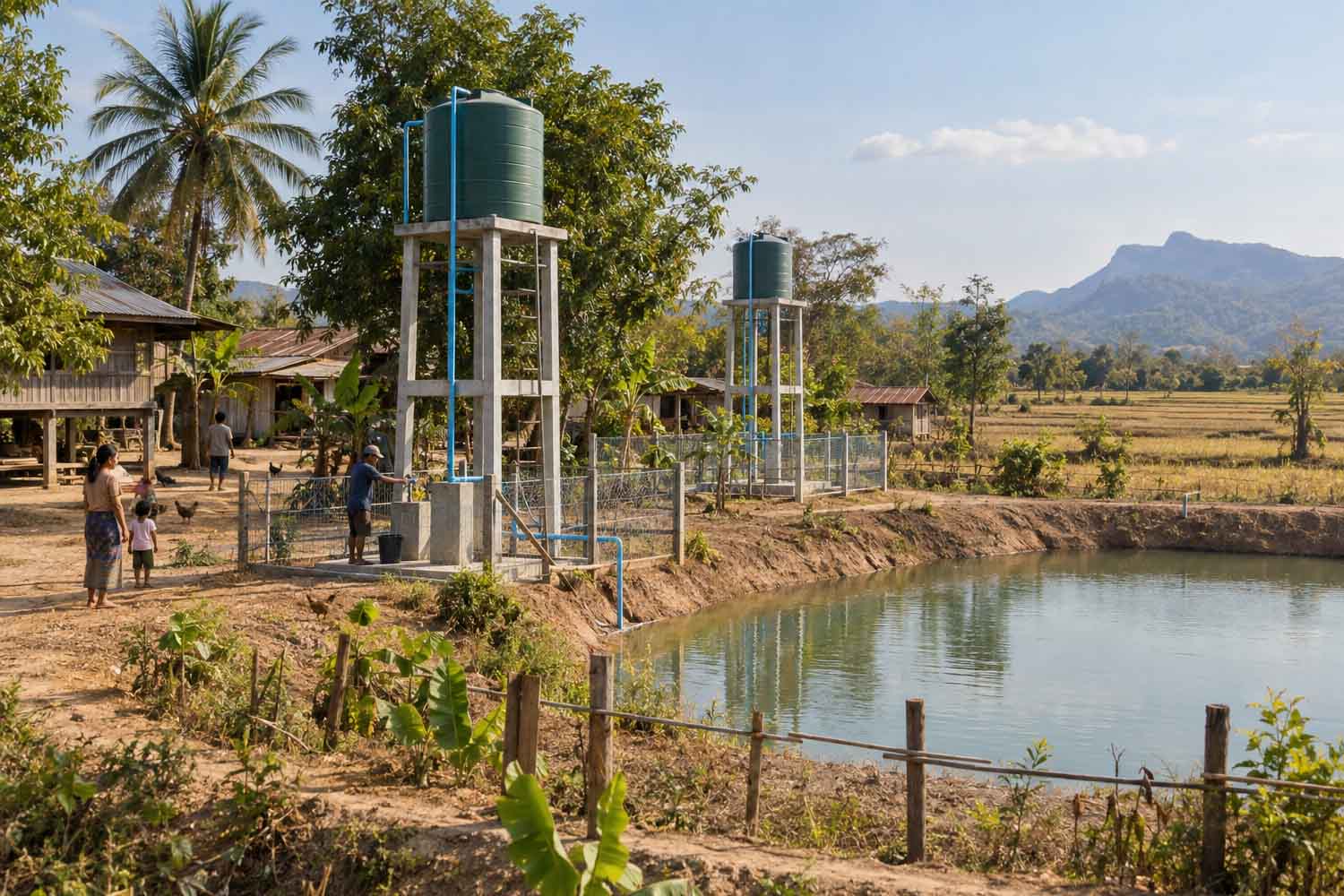
To understand how much a tap might be worth, just count the wells. In Pakouay, a small village in the province of Savannakhet, in southern Laos, there were eighteen. Fifteen no longer worked. For many of the 154 families who live here, seasonal streams, springs and surface aquifers remained: water that was there, then decreased, then they had to go and look for it elsewhere.
Now two new wells approximately 35 meters deep descend beneath the village. Above there are two 2,000 liter tanks; a little further on, where previously there were mostly fields, a basin appeared large enough to retain more than 18 million liters of rainwater.
The transformation is described in a study published in Journal of Climate Change and Pollution by researchers and technicians from Laos together with the Small Grants program of the Global Environment Facility-UNDP. The project also appears in the official database of the UNDP program, which indicates funding of $50,000.
It concerns 749 people. Few on a map. A little less few if the unit of measurement becomes a bucket of water that you no longer have to go and fill elsewhere.
When 15 liters must be enough for a day
Before the work, the authors estimated domestic consumption of between 10 and 15 liters of water per person per day. Drinking, cooking, washing and cleaning must be inside.
The figure becomes more understandable if we compare it to the references of the World Health Organization: even in humanitarian emergencies the WHO indicates as an initial objective at least 15 liters per day per person, to be increased as soon as possible. Pakouay is not a refugee camp and the comparison has obvious limits. Those numbers, however, give a measure of the margin on which many families lived.
Only 43 households were able to regularly purchase 20-litre commercial jerrycans. The others also depended on available sources around the village, including surface water and shallow aquifers, which are more vulnerable to seasonality and contamination. The problem then entered the fields.
This part of Laos lives largely on rice and family farming. In Pakouay, the yields reported by the study ranged between 1.1 and 2 tons per hectare, while seasonal drought, irregular rainfall and soil salinity made it difficult to produce food throughout the year. If there is no water in the house it is a problem. If he is missing from the field at the same time, it all starts to become the same problem.
They looked for water under their feet
Before drilling, the community participated in choosing the points in which to intervene together with researchers and local authorities. One well was built near the community hall, the other in the central residential area. The aquifer has already been intercepted between 9 and 10 metres, but the wells reach a depth of around 35 metres. They didn’t go any further, because the authors explain that drilling deeper would have increased the risk of encountering saline water, a problem already present in the area.
Submersible pumps bring water to two 2,000-litre overhead tanks. During testing, each well delivered approximately 300 liters per hour. An approximately 500 meter long pipeline also reaches land used by around fifty families. According to the study, this small network now allows people to have water from the tap even during the dry season. Then they dug the basin.
A 21 million liter hole in the ground
It measures approximately 60 by 120 meters and reaches a depth of between 2.5 and 3 metres. When filled it can contain between 18,000 and 21,600 cubic meters of water: up to 21.6 million litres. Water comes mainly from rain and runoff during the wet season. What previously would have continued to flow away from the territory can thus remain available for longer, especially for agriculture.
The extracted earth was not taken elsewhere: it was used to build the embankment. Bamboo and fruit trees have been planted on the banks to limit erosion. More than 2,500 young fish were placed inside, also adding a small food resource to the water deposit.
Wells and basins therefore perform two different jobs. The former draw on the aquifer and try to guarantee water in daily life. The second sets aside some of the abundance of the rainy months for when the landscape becomes dry again.
In places where rainfall is becoming more erratic, conserving water when it arrives can decide what happens months later. Even the World Bank, in its report on climate and development in Laos, indicates increasing storage capacity and improving irrigation among the interventions necessary to make the country’s agriculture more resistant to droughts and variations in rainfall.
The system is built, the long test begins now
The inhabitants of Pakouay did not simply receive two wells with keys attached. The project involved meetings, interviews, discussion groups and the creation of local bodies to manage water and take care of maintenance. A community fund has also been established to cover future costs.
A pump can break. A pipe can leak. A basin can fill with sediment. If the infrastructure remains without maintenance, within a few years those fifteen old out-of-use wells risk becoming more of a premonition than a memory.
Even on the result you have to stop where the data arrives. The study describes the design, implementation and first effects of the intervention, but does not yet have multi-year monitoring. We therefore do not know how the water table will change after several consecutive dry seasons, how much agricultural production will actually increase, or how well the entire system will work in five or ten years.
The authors also speak of an improvement in the safety of the water supply, while a long series of microbiological analyzes following the intervention does not appear in the published work. Having water available more continuously and knowing exactly what its quality is are two related but different issues.
However, something very physical remains in Pakouay: where fifteen out of eighteen wells were unusable, today there are two new ones, two tanks, half a kilometer of pipes and a basin that can hold over 18 million litres. The next dry seasons will tell how long the system will hold up. Meanwhile, the water now arrives even when the rain has already left.
