
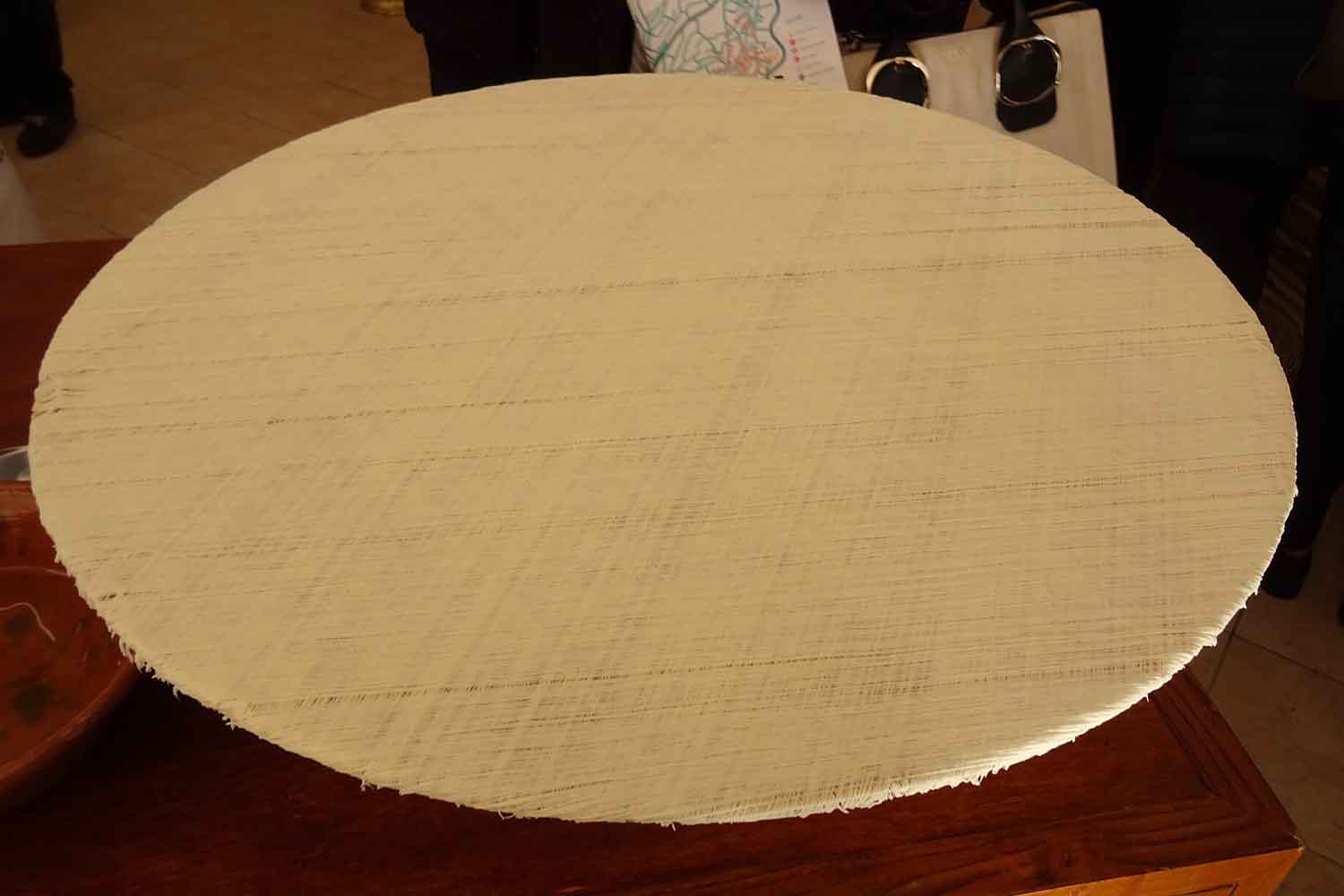
Take a piece of dough, pull it with both hands, join the ends. Then do it again. And again. After eight passes, those two threads have become 256 very thin filaments, to be spread one over the other to build a texture that almost looks more like a fabric than a plate of pasta. It all starts with three very normal ingredients: durum wheat semolina, water and salt.
It is su filindeu, literally known as the “threads of God”, one of the rarest and most difficult preparations of the Sardinian tradition. To make it so you don’t need some unobtainable ingredient collected during the full moon: you need hands that know how to understand when the dough is elastic enough, when it needs water and when it needs salt water instead. A written recipe alone is useful here up to a certain point.
The Sardinia Region still today describes preparation as knowledge preserved by a few women and handed down through practice. And this is perhaps the most interesting detail: while many traditional foods can be reproduced following quantities, temperatures and minutes, filindeu still depends a lot on the fingers of the person preparing it.
How do you get from a piece of pasta to 256 threads
The processing starts from a mixture of durum wheat semolina and water. The official sheet of traditional Sardinian products specifies that during kneading the pasta is also hydrated with a solution of water and salt, until it reaches the right consistency. To process three kilos it can take about an hour for this first phase alone.
Then begins the part that makes even rolling out an egg puff seem easy.
A portion is stretched between the hands and folded on itself. At each passage the number of threads doubles: two, four, eight, sixteen. After eight repetitions you reach 256 threads. They are then arranged in three crossed layers, traditionally on a circular support made with intertwined asphodel leaves, whose surface favors the passage of air and drying.
Once dry, that sort of edible web becomes stiff and can be broken. The traditional preparation requires it to be immersed in sheep broth and accompanied by fresh sheep’s milk cheese. Few ingredients, no shortcuts.
A pasta created for the pilgrims of San Francesco
Su filindeu is linked above all to Nuoro and to the feast of San Francesco di Lula. For centuries, on the nights that accompany the May and October celebrations, the faithful have reached the sanctuary at the foot of Monte Albo and are also refreshed with this hot soup.
The official Sardinian tourism portal says that the pilgrimage and the celebration have taken place for around five centuries and that the preparation of the “threads of God” is now an inseparable part of the ritual. The tradition also appears in the landscape told by Grazia Deledda, who described the pilgrimage to Lula in Elias Portolu.
There are very generous reconstructions regarding the precise age of the pasta. The regional documentation chooses a more prudent formula: the testimonies collected attest to filindeu at least before 1890. Enough to avoid having to invent a few more centuries to make it interesting.
The problem isn’t knowing the recipe, it’s being able to make it
View this post on Instagram
The fame of su filindeu grew precisely around its difficulty. Over time, professional chefs and pasta producers have tried to reproduce that very thin texture, discovering that seeing someone roll the dough and being able to do it are two different sports.
Paola Abraini, one of the artisans who contributed most to making this tradition known outside Sardinia, taught the technique beyond the family circle. It is an important step for a knowledge that, when it remains in the hands of very few people, simply risks disappearing with them.
And here is perhaps the most beautiful part of the story. The rarity of su filindeu does not depend on a secret recipe jealously locked in a drawer. The Sardinia Region publicly describes its ingredients and steps. The difficult part comes later: learning to recognize the dough by touch, pulling it without breaking it, stopping exactly when needed. The ingredients can be listed in three lines. To learn how to transform them into 256 threads, however, you need time, practice and lots of tests.
