
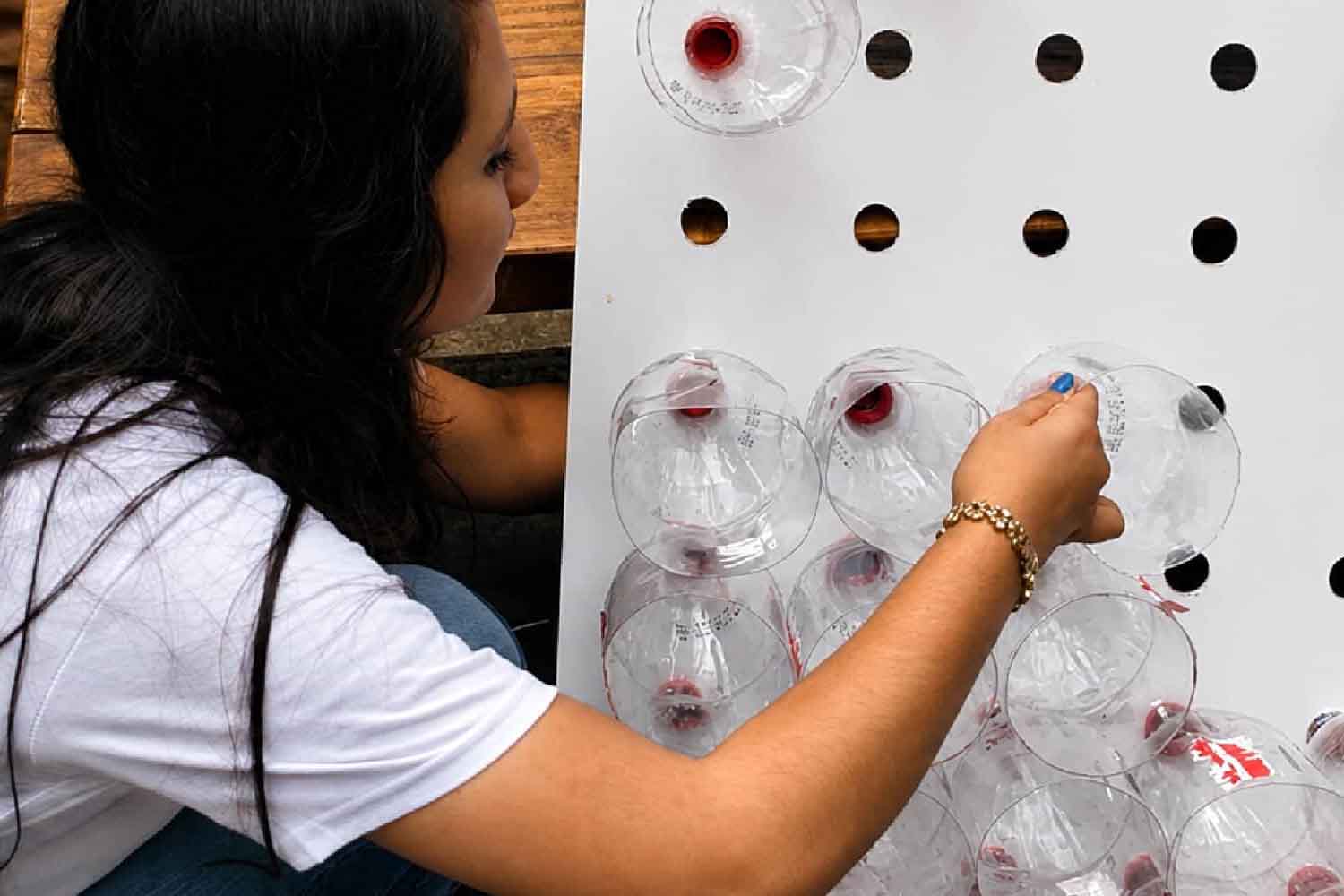
A wooden panel, neat rows of half bottles and the necks facing the inside of the house. THE’Eco Cooler it has no compressor, fans, cables or a remote control destined to disappear between the cushions: it was created to make homes affected by the heat a little more liveable by using recovered materials and a window.
The project was developed in Bangladesh in 2016 by the Gray Dhaka agency together with Grameen Intel Social Business. It was aimed above all at families who lived in rural houses built with corrugated sheet metal, a cheap and resistant material that under the sun can transform rooms into hot boxes.
The instructions were distributed free of charge. Plastic bottles are cut in half, inserted into a perforated board the size of the window and fixed with the wide part facing out. The air enters through the openings, passes through the narrowest necks and is directed into the room.
The result is a system low-techreplicable with few tools and almost free of costs. A decisive detail in the places where to buy and power an air conditioner remains out of reach for many families.
A panel built with what is there
The Eco Cooler is often described as an air conditioner capable of reducing the internal temperature up to 5°C. The figure comes from the campaign with which the project was presented and contributed significantly to its diffusion: five degrees obtained with bottles destined for waste are a story that practically tells itself.
Actual operation is simpler. The necks of the bottles narrow and direct the flow, creating small jets of air that can increase the sensation of coolness on the skin, especially when there is already a bit of wind outside. The same effect is felt by blowing with pursed lips: the air seems fresher because it arrives faster and favors the evaporation of sweat.
The panel can therefore contribute to the perceived ventilationwhile cooling the entire room remains much more difficult. To really lower the temperature it would be necessary to remove heat from the environment, as air conditioners do through a refrigeration circuit. The bottles, with all good will, do not hide a compressor.
The tests undermine the promise of 5 degrees
In 2024, a group of researchers subjected the Eco Cooler to a systematic test, described in the scientific journal npj Climate Action. The scholars constructed seven panel configurations and made 92 experiments in a climatic chamber, varying temperature, humidity and air speed to reproduce conditions similar to those of Bangladesh.
The maximum reduction measured was approx 0.2°Cobtained with a very weak air current. At higher speeds the benefit on temperature became almost imperceptible and some configurations hindered the passage of the wind compared to a window left free.
The data scales back the promise of 5 °C, without taking away the value of the project essential solution, accessible and built with what is available. The study was carried out in the laboratory and not inside the homes for which the device was designed; therefore, there remain possible differences linked to the shape of the houses, the position of the windows and the local winds.
Near the necks of the bottles, the jet can give a feeling of freshness on the skinwhile cooling the entire room is another matter. To really lower the temperature it would be necessary to remove heat from the environment, as air conditioners do through a refrigeration circuit. The bottles, with all good will, do not hide a compressor.
Passive cooling starts from the walls first
The Eco Cooler works best when placed within a broader strategy. Shading roofs and windows, using light or reflective surfaces, insulating roofing and creating openings on opposite sides of the house can reduce heat build-up and improve natural ventilation.
These are interventions also indicated by the World Health Organization and UN-Habitat to make buildings more resistant to heat waves, especially where air conditioning is too expensive, the electricity grid is unstable or homes rapidly retain heat.
Even the arrangement of the bottles can make a difference. A panel mounted in front of the only available opening risks reducing air exchange; installed where a current already exists and accompanied by an outlet on the opposite side can instead better guide the flow. Before the bottles comes the house, with its walls, shadows and the wind that manages to pass through it.
The Eco Cooler does not replace an air conditioner and the 5 °C advertised is not confirmed by tests. However, it retains the merit of being an open project, buildable with recovered materials and designed for a very concrete need. In homes where the heat enters through the metal sheets and every air current counts, even a small solution deserves to be talked about for what it can do. Without loading the bottles with a compressor that they don’t have.
