
For preparing tea and herbal teas, but also for quickly having hot water available in the kitchen, the electric kettle is a very convenient small appliance. But how much do you have to spend to buy one that works well? Not necessarily a lot, at least according to a new test by Altroconsumo, which demonstrates how good quality models can be purchased even for just over 30 euros.
The consumer association compared 10 electric kettles, evaluating their performance, practicality, robustness, consumption and some aspects related to safety. The result is interesting especially for those who are thinking of buying one: the high price is not always synonymous with quality and, in some cases, you risk spending much more without obtaining better performance.
Let’s find out which ones are worth buying.
The best electric kettles according to Altroconsumo
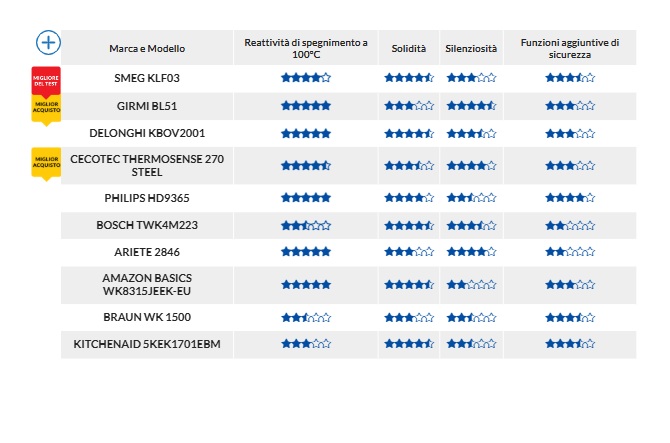
Winning the title of Best of the Test is the Smeg KLF03, which achieves an overall score of 66 out of 100. A good result, but accompanied by a decidedly demanding price, the model costs between 179 and 187 euros.
Behind it we find two much cheaper alternatives, which Altroconsumo reports as Best Buys. The first is Girmi BL51, with 65 points out of 100 and a price between 33 and 39 euros. Followed by Cecotec Thermosense 270 Steel, which obtains 63 points and is on sale at a price varying between 28 and 47 euros.
In other words, to buy a kettle that performs well in tests it is not necessary to invest a large sum. Indeed, there is a fact that makes it even more evident how the cost can be misleading: the most expensive model of the entire selection is not the one that offers the best results.
This is KitchenAid, sold for 199 euros, which even ends up in the lower part of the ranking with a poor overall rating. What penalizes it above all is the management of limescale, the filter is in fact unable to effectively retain the deposits and, after 20 boiling cycles, a considerable quantity of limestone has accumulated inside. It doesn’t convince in terms of practicality either, because it is heavy, has an unergonomic handle and is inconvenient to clean.
Below is the complete ranking of kettles.
@Altroconsumo
How much do electric kettles consume?
An interesting aspect of the test concerns energy consumption, especially considering that the kettle is often used several times during the same day.
The differences between the ten devices examined are rather limited. To bring one liter of water to the boil, starting from an initial temperature of around 15°C, between 0.104 and 0.118 kWh are needed. Considering an electricity tariff of 0.35 euros per kWh, a single boiler costs just between 3.6 and 4.1 cents.
According to Altroconsumo, the electric kettle is also a particularly efficient solution for heating a liter of water, when compared with using the microwave or a covered saucepan on an induction cooker. Compared to the latter, however, no major differences emerge when gas is used.
The times are also quite similar between the models: to heat a liter of water it takes from 3 minutes and 22 seconds to 3 minutes and 54 seconds. Bosch was the fastest, while Amazon Basics took the longest.
Pay attention to limescale and safety
In addition to speed and consumption, when choosing a kettle it is also important to consider maintenance. In fact, limescale tends to accumulate with use, especially in areas where the water is particularly rich in minerals. An efficient filter can help retain deposits, but it must also be easy to remove and clean.
Altroconsumo verified this aspect by subjecting the ten models to 20 boiling cycles, evaluating both the formation of limescale and the effectiveness of any filters.
No less important is safety, because these devices bring water to very high temperatures and can cause burns. All models have passed electrical safety checks, but the association also examined some additional protections: for example, the automatic switch-off at the end of boiling and the heating block when the kettle is turned on without water.
Precisely on these aspects some critical issues have emerged in the Bosch and Ariete models. Both can continue to work even with the lid open and, if turned on without water, the protection system intervenes with a certain delay: after 17 seconds in the case of Bosch and 22 seconds for Ariete. Overfilling can also cause quite large water leaks.
How to choose the kettle best suited to your needs
Before purchasing an electric kettle, it is worth asking yourself how often we will use it and, above all, for how many people. Capacity is one of the elements to consider, if you prepare several cups of tea or herbal tea at the same time at home, a model of at least one and a half liters may be useful. For those who live alone or use it mainly for one or two drinks, however, a smaller device may be sufficient.
Then there is a detail that can also make a difference in terms of waste: the minimum quantity of water that the kettle allows to heat. In fact, not all models work with the same filling level.
In the test, only Bosch and Philips allow you to heat around 250-260 ml of water, a quantity sufficient for a cup. The others require at least half a liter, while for some models, such as De’Longhi, it can reach up to a liter. If you often use the kettle for just one person, this feature deserves particular attention: being able to heat only the necessary water means avoiding consuming energy for an amount that will then not be used.
Temperature regulation can also be useful, especially for those who prepare green teas and other drinks that require less hot water than the 100°C of boiling. However, if the kettle is located in a kitchen open to the living room, it may also be worth considering the noise level.
Steel, glass or plastic: which material to choose?
Finally, there is the question of materials. Electric kettles are available in different versions, each with specific characteristics.
Steel is generally resistant to impacts and scratches, but it must be considered that the external surface can reach high temperatures during operation. Glass has the advantage of allowing you to easily control the water level and any limescale deposits, but it is more fragile than other materials. Plastic, on the other hand, generally makes the device lighter.
There is therefore no absolute best solution: the choice depends on your habits and the characteristics you consider most important. In any case, in addition to the aesthetic aspect and ease of cleaning, it is good to pay attention to the temperature of the surfaces you touch during use.
Finally, the Altroconsumo test reminds us that even when it comes to small household appliances it is not necessary to chase the most expensive brand or the most sophisticated design. If the goal is simply to have hot water in a few minutes, Girmi and Cecotec demonstrate that a good result can be achieved even by spending less than 40 euros.
