
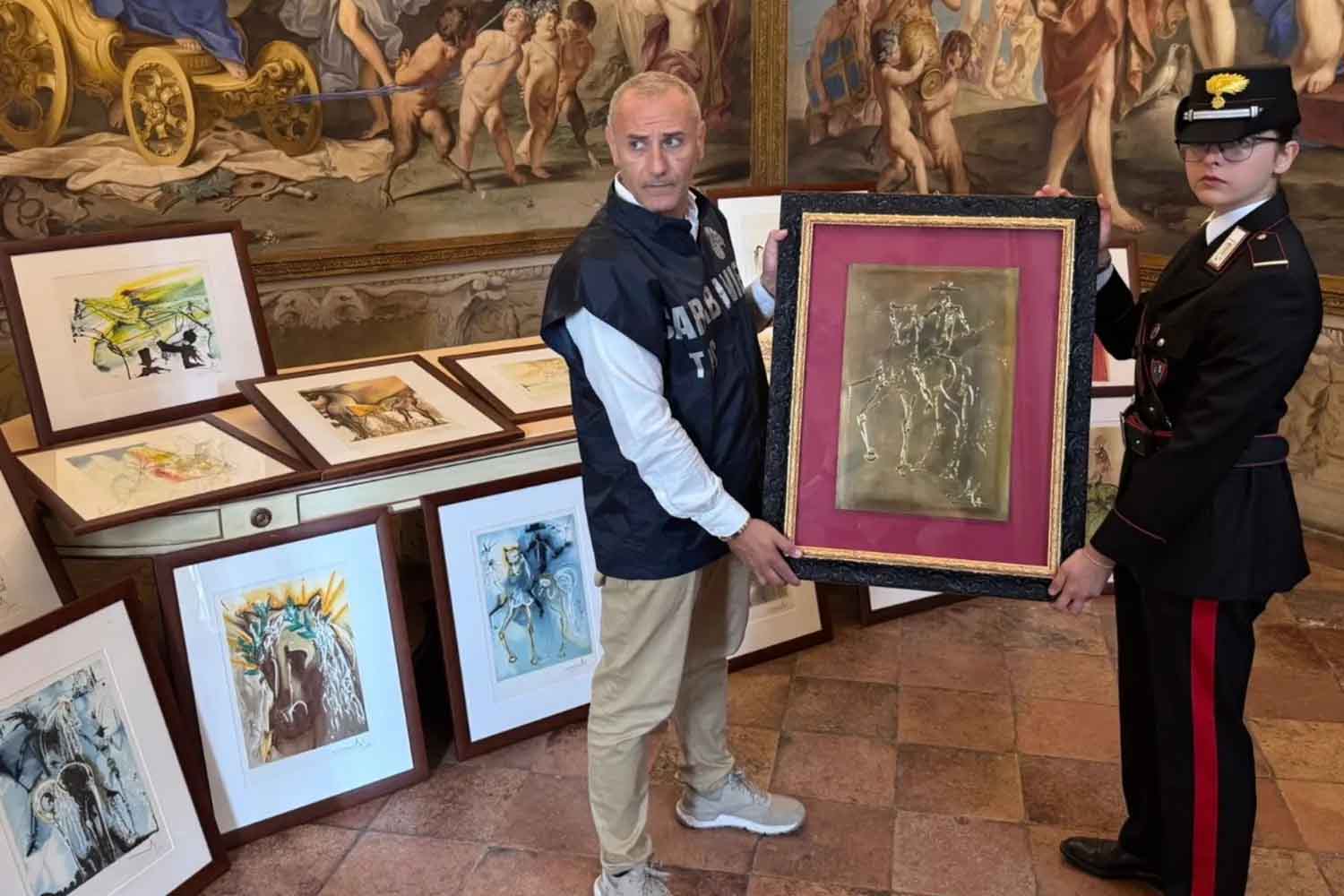
A waiting exhibition, one of the most loved artists in the world and, behind the scenes, a heavy suspicion: 21 works attributed to Salvador Dalí could be false. This was established by the Rome Prosecutor’s Office, which given a mandate to the carabinieri of the Cultural Heritage Protection Unit to seize them at the headquarters of the exhibition Dalí. Between art and mythset up at Palazzo Tarasconi, Parma.
The kidnapping took place in the early hours of the morning and concerns drawings, engravings, tapestries and various objects exposed as authentic, but now at the center of an investigation for falsification of works of art.
The doubts were born months ago in Rome
The same exhibition had been hosted last winter in Rome, at the Historical Museum of Infantry, where the TPC carabinieri had already noticed anomalies. The great paintings were missing, those who are expected from an exhibition on an artist of world caliber. In their place, only minor works: lithographs, drawings, some statue.
This triggered the checks. And from there the first contacts with the Fundació Gala – Salvador Dalí, the official body that manages the artistic inheritance and copyright of the Spanish painter started from there.
The foundation verdict was clear: those works are not authentic. No official documentation, no involvement in loans or selection. Thus the report came directly to the Public Prosecutor of Rome, which started the investigation and asked for the preventive seizure of the 21 works.
To organize the event is Navigare Srl, a company active for years in the art world. After the kidnapping, the company has released a press release in which it declares itself available to collaborate fully with the carabinieri.
We are ready to provide all the required documentation and each useful element to the investigation. Waiting for the conclusion of the procedure, we reserve every law of the law.
A defensive, but collaborative position, waiting for technical and scientific analyzes to confirm or deny the suspicions of falsification. At the moment, there are no suspects, and the same navigation is not formally accused of anything.
An increasingly widespread phenomenon
It is not the first time that false authors are discovered in Italy exposed in official exhibitions. Only in recent months, the carabinieri discovered a clandestine laboratory in Rome where Picasso and Rembrandt were products, then resold online.
Another investigation has dismantled a European network that reproduced Banksy, Warhol and Klimt works, distributed throughout Europe.
According to Diego Poglio, commander of the TPC nucleus who is following the Dalí case, the presence of counterfeit works is growing above all in the contemporary art sector:
Many organizers act in good faith, but the controls must always be rigorous. A signature or a certificate is not enough: the involvement of the official foundations and in -depth technical analyzes is needed before exposing any work.
And now?
The 21 suspicious works were removed and seized to be subjected to exams by experts and technicians in charge of the Prosecutor. Meanwhile, the exhibition remains open to the public, but obviously deprived of an important part of the exhibition itinerary.
The truth will emerge in the coming months, when the results of the analyzes will be available. In the meantime, the story raises important questions: how much can we trust what we see in museums? And who really controls the authenticity of what is shown to us as “official art”?
You may also be interested in:
