
Behind a salmon fillet or a package of fish bought at the supermarket there is a much more complex supply chain than we imagine. The idea that farmed fish can automatically be a more sustainable choice than traditional fishing clashes with a harsh reality where the environmental impact of farming, the management of antibiotics and the difficulty of knowing precisely where the product comes from come into play.
It is precisely this gray area of the seafood supply chain that the Coller FAIRR Seafood Index has tried to put under the lens, analyzing the strategies of the largest global companies in the sector.
This is the first global assessment tool dedicated to companies in the fishing and aquaculture sector, published by FAIRR Initiative. We are talking about a benchmark, that is, a comparison parameter that allows companies to be measured and compared on the basis of common criteria. In this case, 20 of the largest listed companies in the world operating in the seafood sector were analysed, assessing how prepared they are to face environmental, social and production chain risks.
It should be specified immediately that the index was created as a tool for investors and not as a ranking of products to buy or avoid. FAIRR specifies in fact that the score assigned to companies measures the maturity of the strategies implemented to address environmental and social risks and opportunities, it does not represent an absolute assessment of the sustainability of their activities.
The companies were evaluated on 16 different topics considered relevant for the future of the fishing sector: from pollution to greenhouse gas emissions, through the impact on marine ecosystems, food safety, the welfare of farmed animals, the management of antibiotics and the traceability of fish products. The analysis also took into consideration social aspects, such as the risk of forced labor and the protection of workers’ rights, as well as the ability of companies to develop forms of aquaculture considered more sustainable.
To develop the index, FAIRR analyzed publicly available information from companies, including sustainability reports, company policies, official communications and other data sources, evaluating not only declared commitments but also companies’ ability to translate them into concrete actions.
And the picture that emerges is anything but reassuring.
The companies analyzed
The report examined 20 large international groups listed on the stock exchange that operate in the seafood supply chain, from fishing to farming, from feed production to processing and distribution. The list includes some of the world’s leading salmon companies, including Norwegian salmon groups such as Mowi, Bakkafrost, SalMar, Grieg Seafood and Lerøy Seafood Group, Asian companies such as Thai Union Group, Nissui Corporation and Kyokuyo, as well as large Western players such as Sysco Corporation and Nomad Foods.
Among the companies analyzed there are also names that may be more familiar to Italian consumers. Mowi, for example, is present on the Italian market with salmon-based products and was the company with the highest overall score in the FAIRR index, with 57 points out of 100. A record which, however, does not equate to a promotion: even the group at the top of the ranking remains below the threshold of 60 points, i.e. sufficient.
Thai Union Group, active in the processed fish products supply chain, obtained an overall score of 35/100, while Nomad Foods, a European frozen food group also present in Italy, achieved 26/100.
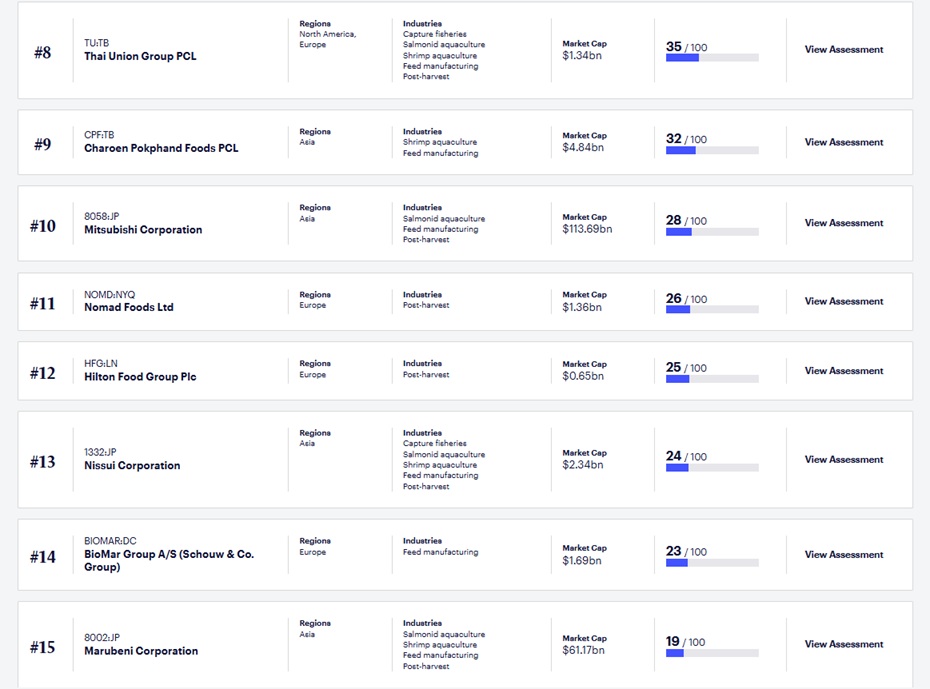
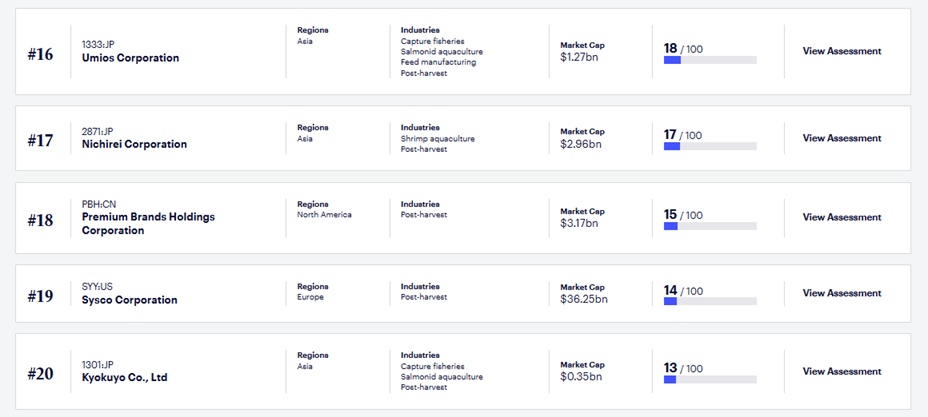
@FAIRR
The most critical point: pollution
Among the aspects analysed, the environmental one was one of the most problematic. Overall, the companies assessed achieved an average score of 25 out of 100 for environmental risk management, while social issues achieved a slightly higher average of 39 out of 100.
The issue of pollution weighs the most, representing the area with the lowest score of the entire index: just 19 points out of 100. This category includes various problems related to fishing activities, from discharges from salmon farms to waste produced by plants in the sea, up to the possible chemical contamination associated with fishing activities.
Another aspect considered by the index concerns the raw materials used in the aquaculture supply chain. FAIRR also assessed the sustainability of the ingredients used in feed for farmed fish, as well as the risks linked to deforestation and ecosystem conversion. These are important elements because feed production represents a significant part of the environmental impact associated with some fish farming systems.
Food safety, antibiotics and animal welfare
Food safety reached an average score of 43 out of 100. Other areas related to fish production performed worse: antibiotic management stopped at 27 out of 100, while animal welfare reached just 26 out of 100.
These aspects mainly concern the ability of companies to prevent and manage risks linked to farming methods, animal health and production quality.
The traceability of fish
Another area where the sector shows a lot of room for improvement is traceability. The companies analyzed scored on average 27 points out of 100 in their ability to follow the path of fish products along the supply chain.
This means that difficulties remain in guaranteeing complete and transparent information on fundamental aspects such as the origin of the fish, the species marketed and the production method, elements that are increasingly important to allow consumers to make informed choices.
Few strategies to develop a more sustainable fishing sector
Finally, among the lowest scores of the entire index is that relating to future opportunities: companies obtained on average just 11 points out of 100 in their ability to develop new, more sustainable production models.
According to the analysis, many companies continue to focus primarily on traditional models, such as existing fisheries and farming of popular species such as salmon and shrimp. However, alternatives such as non-fed aquaculture are still underdeveloped, i.e. the farming of species such as mussels, oysters and algae that do not require external feed because they obtain nutrients directly from the surrounding environment.
