
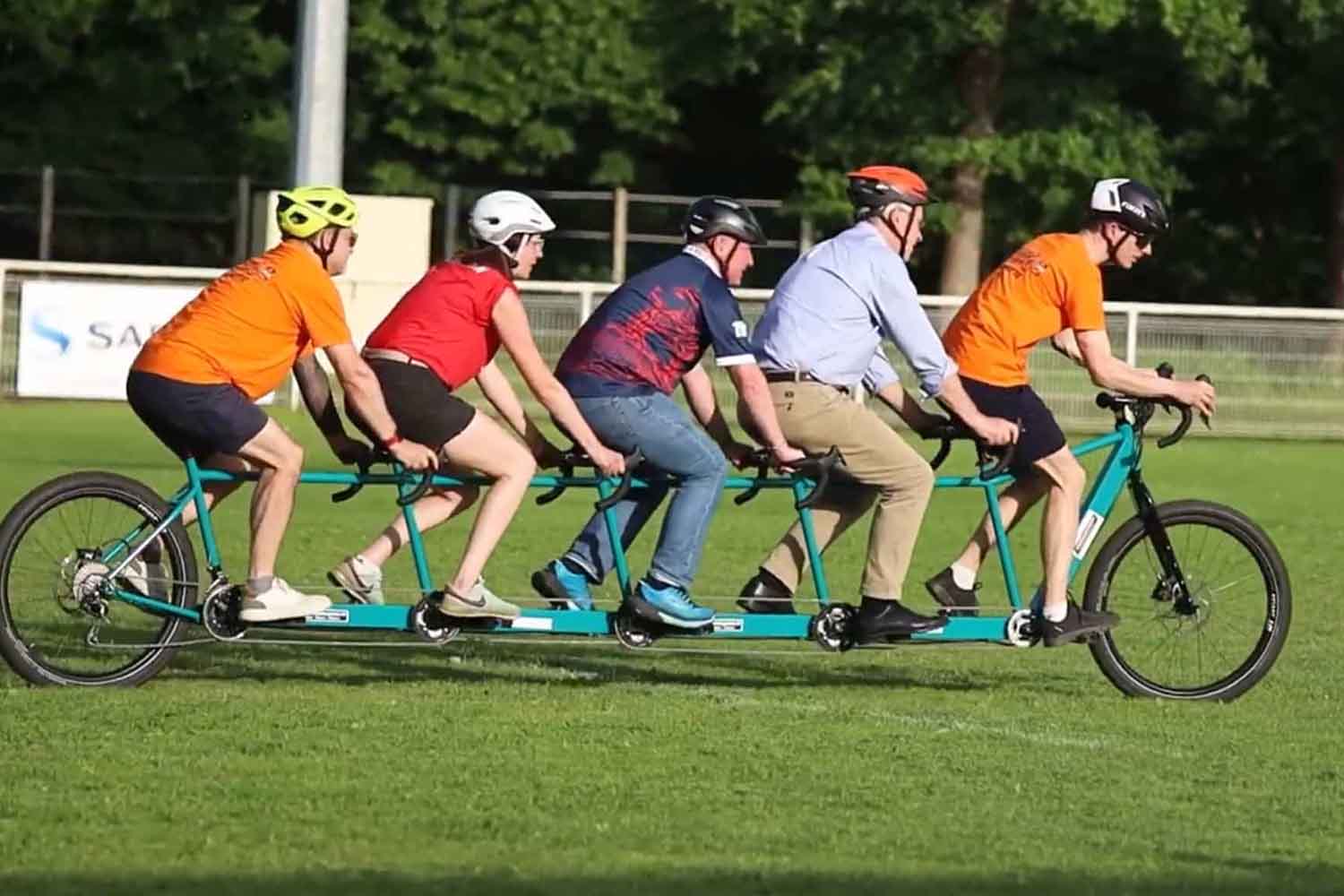
Five people on the same bicycle already seem like enough to imagine a comical scene: one starts off too fast, one falls behind, one is afraid of the curve, one thinks he knows everything and one, poor thing, is just trying to get to the end of the ride in one piece. Then you look better at the Quintuplette and understand that the idea, in that somewhat strange form, is much more concrete than that.
The five-seater bicycle was born in Compiègne, in northern France, from an idea by Aurélien Vauquelin, a visually impaired engineer, together with Olivier Liénard. The vehicle has five saddles, five handlebars and five pairs of pedals, all on the same frame. A kind of multiplied tandem, except that here the game immediately becomes more serious: to advance you need to find a common rhythm. If one pushes too much, everyone feels it. If one gets distracted, everyone feels it. If someone decides to do it on their own, the bicycle reminds them of it within a few metres.
Five bodies, one vehicle
© Mission Quintuplette
Building such a bike means solving quite practical problems: stability, weight, braking, comfort, transmission, safety. It’s not enough to lengthen a frame and add a few saddles, also because five people never pedal in the same way. They have different legs, different fear, different strength, different times. The Quintuplette must transform all this into a single movement, without continuous jerks and without making driving an act of faith.
The driving remains entrusted to the person in front, while the others contribute to the push. It is a simple mechanism to understand and much less simple to inhabit. Those who climb cannot simply make a presence, because each pedal stroke weighs on the general movement. At the same time, no one can claim to command alone, because the medium only works if everyone agrees to be within a kind of physical agreement.
In this sense the link with adapted cycling is evident. For blind or partially sighted people, the tandem has long been an important tool: it allows you to pedal with a guide, maintaining speed, movement, air in your face and the pleasure of the sport. The Quintuplette extends that principle to a small group. It does not place a person “in the center” as a symbol to be applauded. He puts five people on the same frame and asks everyone to do their part.
Confidence is in the pedals
The beautiful thing here is that inclusion doesn’t hang on words. It becomes a matter of legs, brakes, starts and curves taken well. Before leaving you need to get in, settle in, understand who is driving, listen to the directions, coordinate. It seems like little, but it is already a lot. Anyone who has ever tried even a tandem knows it: after thirty seconds everyone’s character comes out.
The Quintuplette was also created for sporting initiatives, association events, disability awareness days and group activities. It can become a useful tool for schools, associations, companies, municipalities, solidarity events. All contexts where we often talk about cooperation and then, at the first snag, everyone returns to their own corner with great dignity and zero desire to regulate themselves over others.
A bike that forces you to be together
The project also looks at public challenges and sporting events in the coming years, with the aim of bringing this bicycle out of local curiosity. And that’s where the five-seater bike gets interesting. Not because it’s perfect, brilliant or revolutionary. Because it takes a huge word like “inclusion” and lowers it to a very concrete gesture.
In times when even a walk can become a performance worth talking about, this bike does something almost antiquated: it forces five people to feel the rhythm of the others. If one moves badly, the problem comes immediately. If everyone finds the pace, the vehicle goes. And for once the metaphor isn’t even necessary. Just watch them pedal.
You might also be interested in:
