
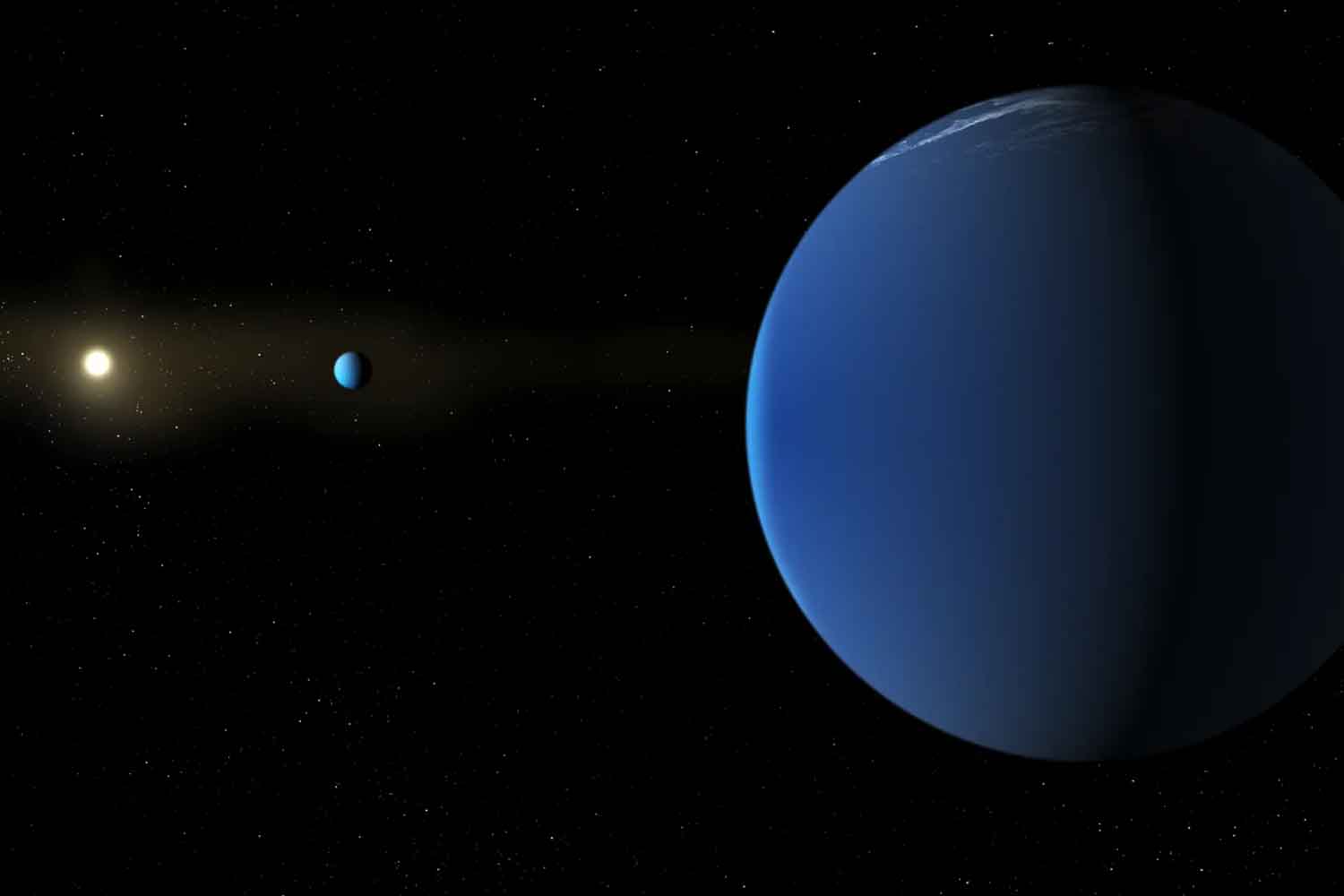
Two enormous, swollen, almost improbable planets are circling a very distant star with a lightness that throws instinct into a bit of a crisis. They are called TOI-791 b And TOI-791 chave dimensions comparable to those of Jupiter, yet their density is lower than that of cotton candy. Something that, when said like this, seems like a space amusement park gimmick, actually comes from a study published in Monthly Notices of the Royal Astronomical Society.
The system is located in the southern constellation of Flying Fishapproximately 1,110 light years from Earth. The star, TOI-791, is an F7 dwarf, therefore a hot star and similar to the Sun in some respects. These two gas giants orbit around her, which astronomers classify as the so-called super-puff planetsworlds with an extremely rarefied structure, with atmospheres so large that they appear very large compared to their real mass.
Big, swollen, very light
The comparison with Jupiter illustrates the elegant absurdity of the discovery well. The average density of Jupiter is approx 1.33 grams per cubic centimeter. TOI-791 b just arrives at 0.038 grams per cubic centimeterwhile TOI-791 c stops at 0.047. Translated in a less laboratory way: they are approx 28-35 times less dense than Jupiter and remain below the typical value of cotton candy, which is around 0.05 grams per cubic centimeter.
Even the mass tells a strange story. According to the NASATOI-791 b is almost the size of Jupiter, but contains just the 3% of its mass. TOI-791 c is even larger than Jupiter, with approximately 5.9% of its mass. It seems like the type of object that in astronomy forces us to revisit the models, because it occupies that awkward area where the formulas work, of course, but nature still decides to take a different turn.
The two planets are considered “brothers”: they would have formed from the same disk of gas and dust around the young star. They also have a rare orbital bond, called 5:3 resonance. It means that when the inner planet completes five revolutions around the star, the outer planet completes almost exactly three. This gravitational ballet leads them to pull each other, with small slips in the times of transits in front of the star.
The discovery started from the volunteers
The first trace came from the data of TESSNASA’s space telescope that searches for exoplanets by observing tiny dips in the brightness of stars. When a planet passes in front of its star, seen from our perspective, the light dims very slightly. That drop, if it returns regularly, may indicate the presence of a world in orbit.
The TOI-791 b and TOI-791 c candidates were identified thanks to the project volunteers Planet Hunters TESScitizen-scientists who sift through the data in search of signals that have escaped the algorithms or are too particular to be recognized immediately. Then came the long, patient, much less spectacular work: observations from telescopes distributed across different continents, calculations of dimensions, estimates of masses, analysis of variations in transit times.
Antarctica also enters this part of history. The telescope ASTEPAntarctic Search for Transiting ExoPlanets, installed at Concordia station, played a decisive role. During the Antarctic winter, the darkness lasts for months and allows continuous observations that are very difficult to obtain elsewhere. This is how astronomers managed to completely follow very long transits, exceeding 11 hoursthe longest ever observed completely from the ground.
Why these super-puff planets matter
THE super-puff planets they are still an open problem. One of the most discussed hypotheses involves enormous atmospheres rich in hydrogen and helium, accumulated when planets formed in the cold areas of the protoplanetary disk, far from the star, where the gas could cool and gather rapidly around a solid core. Another possibility, more complicated to verify, involves very large rings capable of distorting the perception of size. For a system with two such similar planets, however, the explanation must hold twice.
TOI-791 thus becomes a kind of cosmic testbed. The two planets are in the same system, have a formation relationship, interact gravitationally, and show measurable transits. All precious elements for understanding whether these worlds are truly swollen with atmosphere, whether they have followed a particular migration or whether there is some other mechanism that is still elusive.
The next step could come from the James Webb telescope. Observations from space could search the atmosphere for molecules containing carbon, nitrogen and oxygenuseful clues to reconstruct the chemistry of the two planets and, with a bit of luck, their history. In cases like this, every detail weighs: a spectral signature, a time change, a more precise light curve.
