
David DeMar was crawling across a rocky outcrop in Montana when he picked up a small reddish lump, about the size of half a golf ball. He turned it over, observed it with a lens and saw something emerge from the rock that no one had found there in over a century of research: a tiny fossil feather. It was 2016. The rock, it would turn out, was much less elegant than his discovery: it was fossilized dinosaur feces about 66 million years old.
And that feather was only what you could see from the outside. By micro-CT scanning the coprolite, the researchers found more feathers, bone fragments from an ancient aquatic bird and even tiny fish scales. A meal within a meal, stuck in the rock since the end of the Cretaceous: a bird had probably eaten a fish, then a dinosaur had eaten the bird. The results were published on Current Biology.
A feather stuck out of the fossilized poop
@Current Biology
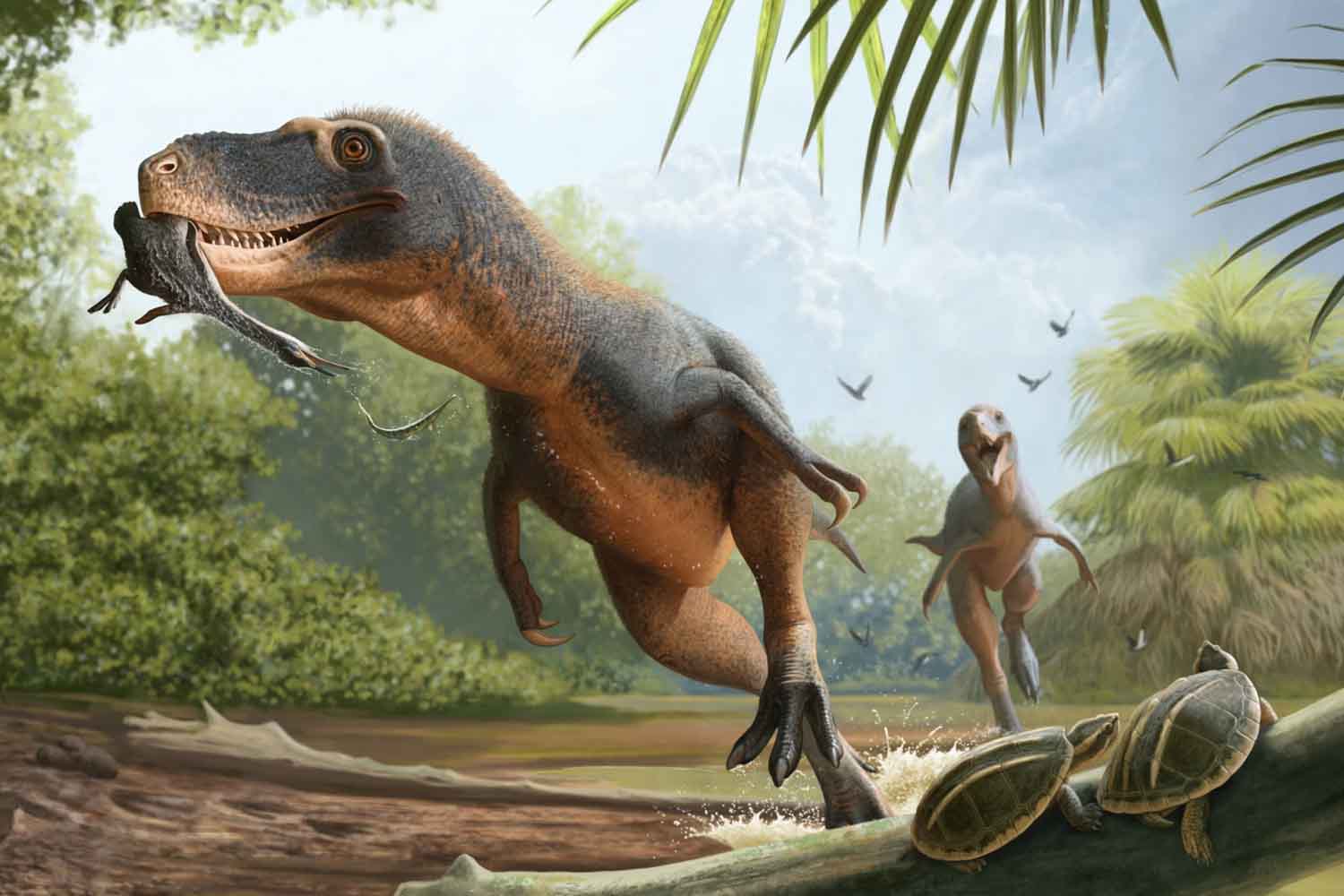
The fossil, cataloged as UWBM 103150comes from the most recent part of the Hell Creek formation, that expanse of rocks in Montana and nearby states that preserves the very last million years of the dinosaur era. The study identifies it as the coprolite of a medium-sized carnivorous theropod. Identifying with certainty who produced it is impossible; among the candidates indicated by the researchers there is a young man Tyrannosaurus rex And Nanotyrannus. So yes, it could be Tyrannosaurus poop. The conditional, after 66 million years, deserves its space.
To understand what it really contained, the team analyzed the mineral composition of the fossil and used computerized microtomography, accumulating thousands of X-ray images to reconstruct its interior in three dimensions. As the data was processed, feathers, bones and scales remained hidden in the fossilized mass.
The preservation of the main feather is exceptional. It has a rachis, i.e. the central axis, with an almost square section and a spongy internal part: a light and rigid structure that is very reminiscent of that of the feathers of modern birds. The beards are also particularly thick, a characteristic that reduces water penetration and which today we find in birds adapted to aquatic life. According to the authors, it probably is the best preserved feather ever recovered from Mesozoic rocks.
First the fish, then the bird, then the dinosaur
What gave a plausible owner to those feathers were above all the small bone fragments found nearby. They most likely belong to a hesperornitiforman extinct group of aquatic birds that lived during the Cretaceous. Many were unable to fly, had specialized teeth and legs to propel themselves underwater, with a lifestyle that in some ways resembled that of modern loons.
Until now their feathers had remained unknown. Those enclosed in the coprolite are therefore the first attributed to hesperornithiformes and they show a curious combination: some have very modern characteristics, suitable for repelling water; others, identified by micro-CT inside the fossil, retain more primitive morphologies, with a soft and filamentous appearance.
Then there are two tiny scales attributed to a fish from the group of garfish with hard, armored scales still present in North America today. The authors interpret them as the remains of the bird’s last meal: the fish would have been eaten by the hesperornithiform shortly before the latter ended up in the dinosaur’s stomach.
A coprolite that looked like little more than a pebble thus preserves at least three levels of the same food web: the fish, the bird that caught it and the large carnivore that caught the bird. A scene that occurred shortly before the great extinction at the end of the Cretaceous and has come down to us in the least noble way possible, but rather effective.
Those feathers perhaps tell why some birds disappeared
This is where the discovery becomes more interesting than a dinosaur’s dinner. Hesperornithiforms were relatively close relatives of the Neornithesthe group to which all living birds belong. Hesperornithiforms disappeared during the extinction 66 million years ago; the Neornithes instead managed to cross it.
One of the hypotheses proposed over time is that living in aquatic environments may have favored the survival of some birds after the asteroid impact. Hesperornithiforms complicate this explanation a lot: they were perfectly aquatic and died anyway.
The feathers encased in the coprolite suggest another lead. Alongside feathers already very similar to modern ones, these animals retained more primitive body feathers. Jingmai O’Connor and colleagues hypothesize that less efficient thermal insulation, together perhaps with differences in plumage moltmay have made some groups more vulnerable to the abrupt cooling following the asteroid impact.
It’s a possibility, not the definitive explanation for the survival of modern birds. The same study talks about a factor that could be having contributed to the selectivity of extinction: the fate of entire animal groups cannot be reconstructed from a single coprolite and a few feathers. However, the finding shows that Modern and primitive forms of plumage still practically coexisted on the eve of extinction.
And above all it opens up a rather unusual place to go and look for others. This feather was identified because the coprolite had broken in just the right place, allowing it to surface. Now the researchers propose to subject other fossilized excrement to micro-CT: feathers, hair and other tissues that time normally erases could have survived inside.
For over a century, Hell Creek has primarily been searched for teeth, bones and skeletons. The next big lead could be inside a fossilized poop that no one had yet thought to scan.
