
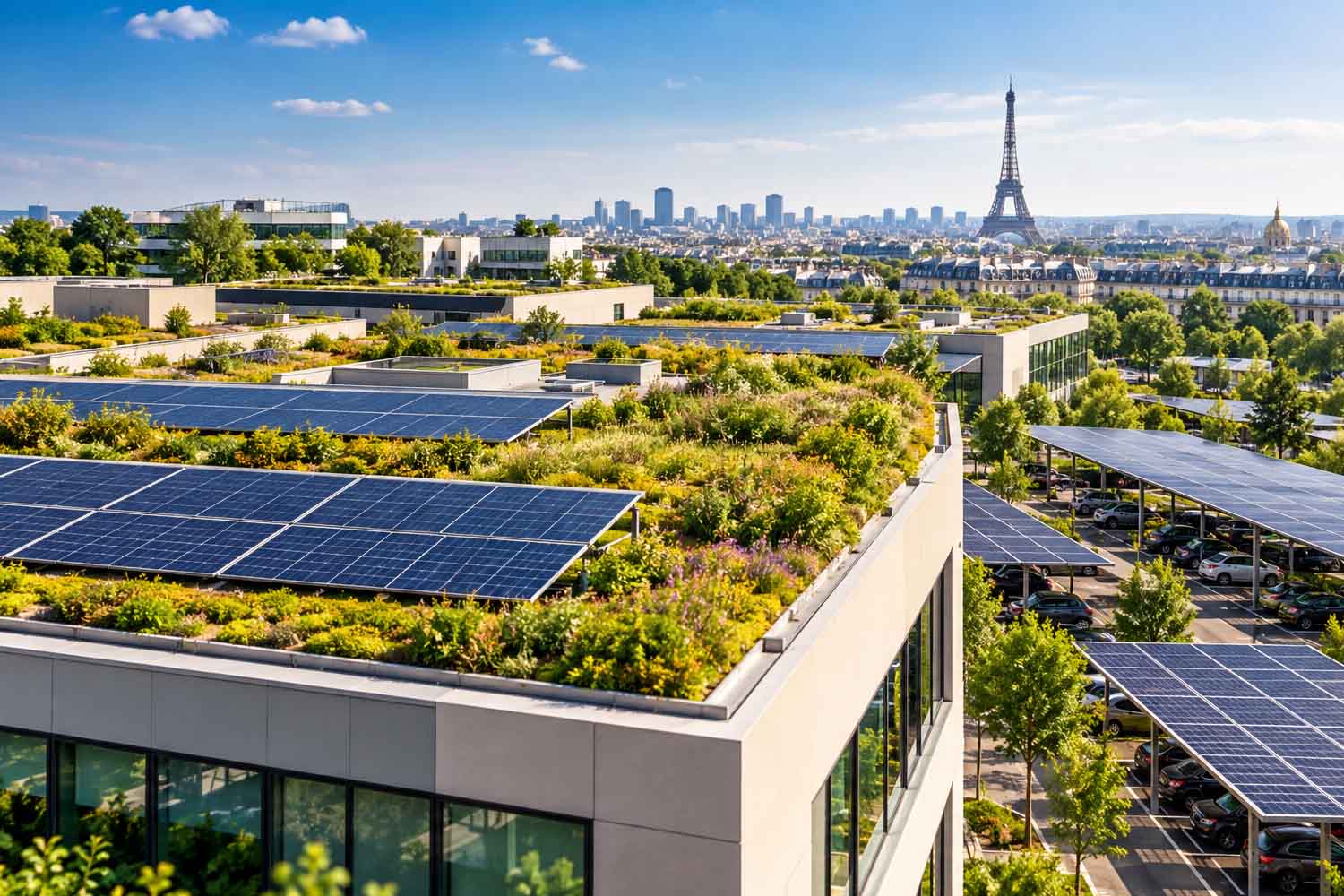
A roof of 10 thousand square meters, in France, can mean 4 thousand square meters dedicated to producing energy, hosting vegetation or a combination of the two. From 1 July 2026 this is the minimum quota required for many new buildings and heavy renovations that fall under French legislation. From July 2027 it will rise further, up to 50%.
It is a progression already written in the Code de la construction et de l’habitation: 30% from 2023, 40% from July 2026, half of the coverage from July 2027. A part of the large French roofs is therefore changing its function. From a surface that protects a building to a space that produces electricity, retains water, hosts vegetation and helps cool cities.
From the roof of the supermarket to that of the school
@AI generated
The measure concerns buildings with over 500 square meters of ground surface intended for commercial, industrial, artisanal and administrative activities, but also offices, warehouses, hospitals, sports and recreational facilities, schools, universities and covered car parks open to the public. The same discipline enters into heavy extensions and renovations above that threshold.
The choice left to the projects is wide. The roof can host systems for the production of renewable energy or a vegetal cover. However, the French text asks for something more precise than a few plants placed up there: the plant systems must limit the use of drinking water, guarantee thermal and insulation performance and promote biodiversity.
Photovoltaics and green roofs can also coexist. It is one of the most interesting features of this approach: the same surface can produce energy and, at the same time, contribute to the management of heat and rainwater.
French buildings thus begin to do more work together. The roof must not be limited to being above our heads, which would already be a very dignified use.
Even parking lots stop being just asphalt
The same logic goes down a few meters lower and arrives in the car parks. For new outdoor car parks over 500 square meters connected to the buildings affected by the legislation, at least half of the surface must integrate paving, hydraulic arrangements or vegetation capable of promoting the infiltration or evaporation of rainwater. The Code de l’urbanisme also requires vegetation or shade structures on at least half of the area.
Then there are the much larger car parks. The French law of 10 March 2023 on the acceleration of renewable energy concerns external spaces over 1,500 square meters and aims to cover at least half of it with shelters that integrate systems to produce renewable energy.
From November 2025 the discipline also allows mixed solutions, combining energy shelters with vegetal devices to achieve the required shading surface overall. The result significantly changes the image of the classic shopping plaza: cars in the shade, panels above heads and a surface that, instead of baking undisturbed in the summer sun, is also used to produce electricity.
Use the surfaces that are already there
The French choice brings together two problems that often occupy the same square meters in cities: the need to increase production from renewable sources and the need to adapt urban spaces to increasingly higher temperatures and intense rainfall.
Roofs, sheds and parking lots have one rather obvious advantage: they already exist. Using them allows you to add energy capacity without looking for a new free surface every time and, in the case of vegetal covers and permeable car parks, it can add other functions to the same space.
However, the legislation provides for exemptions linked to technical, safety, architectural, patrimonial or economic constraints. However, the direction remains very legible: when large buildings are constructed or heavily intervened on, an increasing share of the roof becomes part of the energy and environmental project.
And in Italy?
Italy also has obligations to integrate renewable sources into buildings. From 2026 the framework has been updated with the legislative decree of 9 January 2026, n. 5, which for new buildings requires 60% of the expected consumption for domestic hot water and 60% of the sum of consumption for hot water, heating and cooling to be covered with renewables.
However, France has also chosen to intervene directly on the surfaces: percentage of the roof, vegetation, shading, permeability of the car parks. And this is perhaps the most concrete aspect of the French model. Part of the energy transition is sought above supermarkets, schools, warehouses and parked cars. From July 2027, many new large buildings affected by the law will reach half the roof. Thousands of square meters that were simply “above” something finally acquire a second job.
