
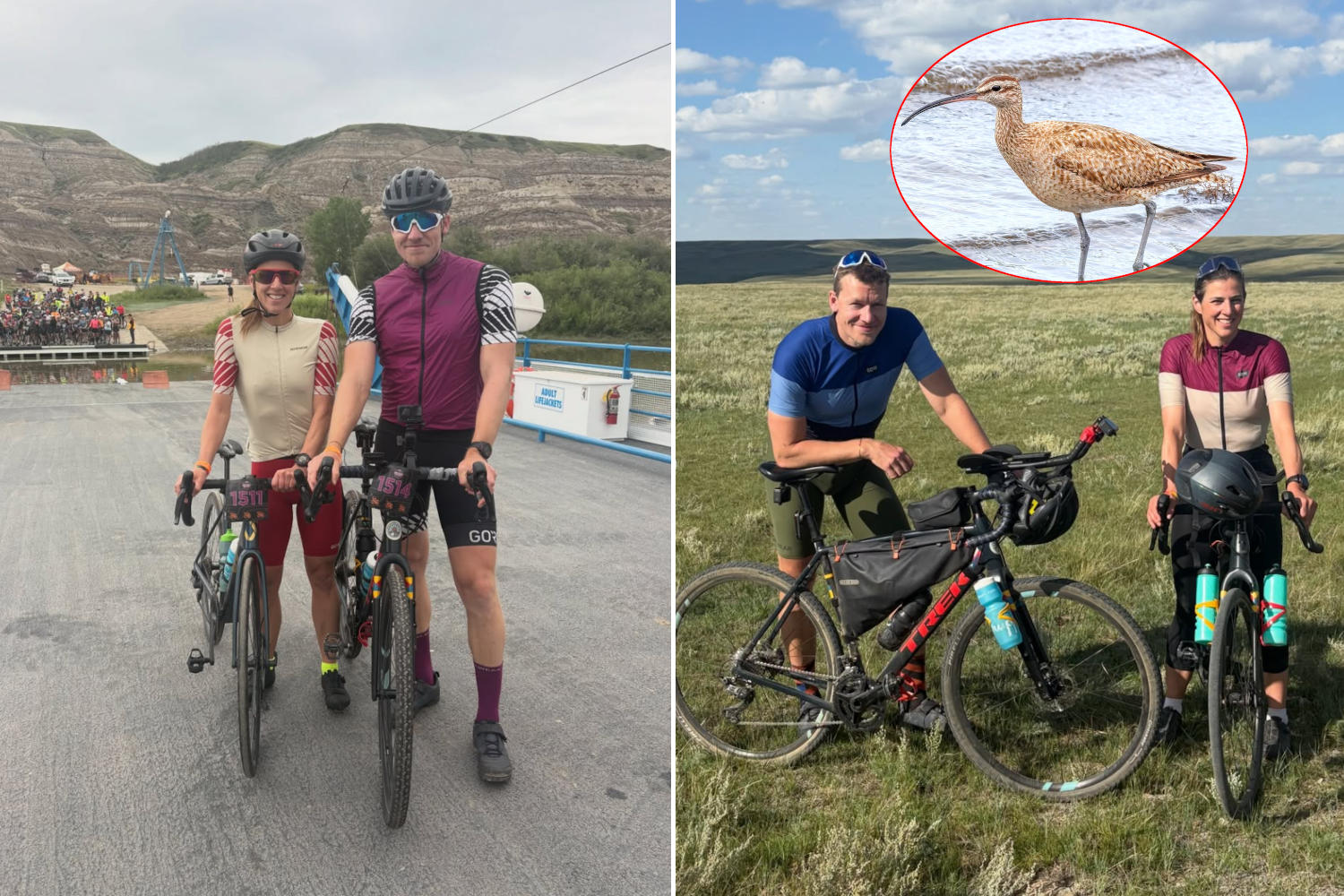
A crazy journey, tiring but necessary. Ecologist Timm Döbert and athlete Leanna Carriere decided to leave behind every comfort to pursue a dream as bold as it is fragile: to cycle 30,000 kilometers along the entire migratory route of the American curlew. Departing on August 1, 2026 from Prudhoe Bay, Alaska, the two explorers are crossing 15 countries with a single objective: to document in real time the fate of an extraordinary bird and its fragile ecosystems, put to the test by human impact and climate change.
Record-breaking flight and satellite technology
The project, called Wings of Survival, was not born by chance but from a rigorous scientific basis. Before departure, the team marked some specimens of American curlews with tiny GPS devices (Numenius hudsonicus) directly on the island of Chiloé, in southern Chile. Those small technological “backpacks” are revealing exceptional routes, such as that of an individual capable of covering 9,000 uninterrupted kilometers in just 5 days to reach Baja California. With an average weight of less than 400 grams, this limiform with its characteristic curved beak makes a titanic round trip every year, facing oceans of land and increasing dangers.
View this post on Instagram
View this post on Instagram
An endangered species and habitat fragmentation
However, behind the spectacle of nature lies a silent emergency. Over the last 30 years, the populations of this species have suffered an estimated collapse of 70%, part of a dramatic global trend that has already decreed the tragic extinction of the curlew cousin, made official in 2025. The real danger for survival does not lie only in the Arctic nesting places or in the southern wintering sites, but in the progressive destruction of the dense network of stop-over sites: wetlands, coasts and marshes that serve the birds to fill up on energy and which today are rapidly disappearing due to urbanization and intensive agriculture.
View this post on Instagram
Virtual lessons for schools while traveling
While the roadmap clocks up kilometers – exceeding 6,000 after just 60 days in the saddle – the expedition combines athletic achievement with scientific dissemination. Through virtual lessons open to schools and meetings with local communities along the route, Timm Döbert and Leanna Carriere expose human fatigue by contrasting it with animal resilience. There is no engine, there is no safe asphalt for these birds who fly the skies without a passport. And as the bicycle continues to roll south, the hope is that this choral tale can awaken global attention before the sky loses one of its most extraordinary navigators forever.
View this post on Instagram
