
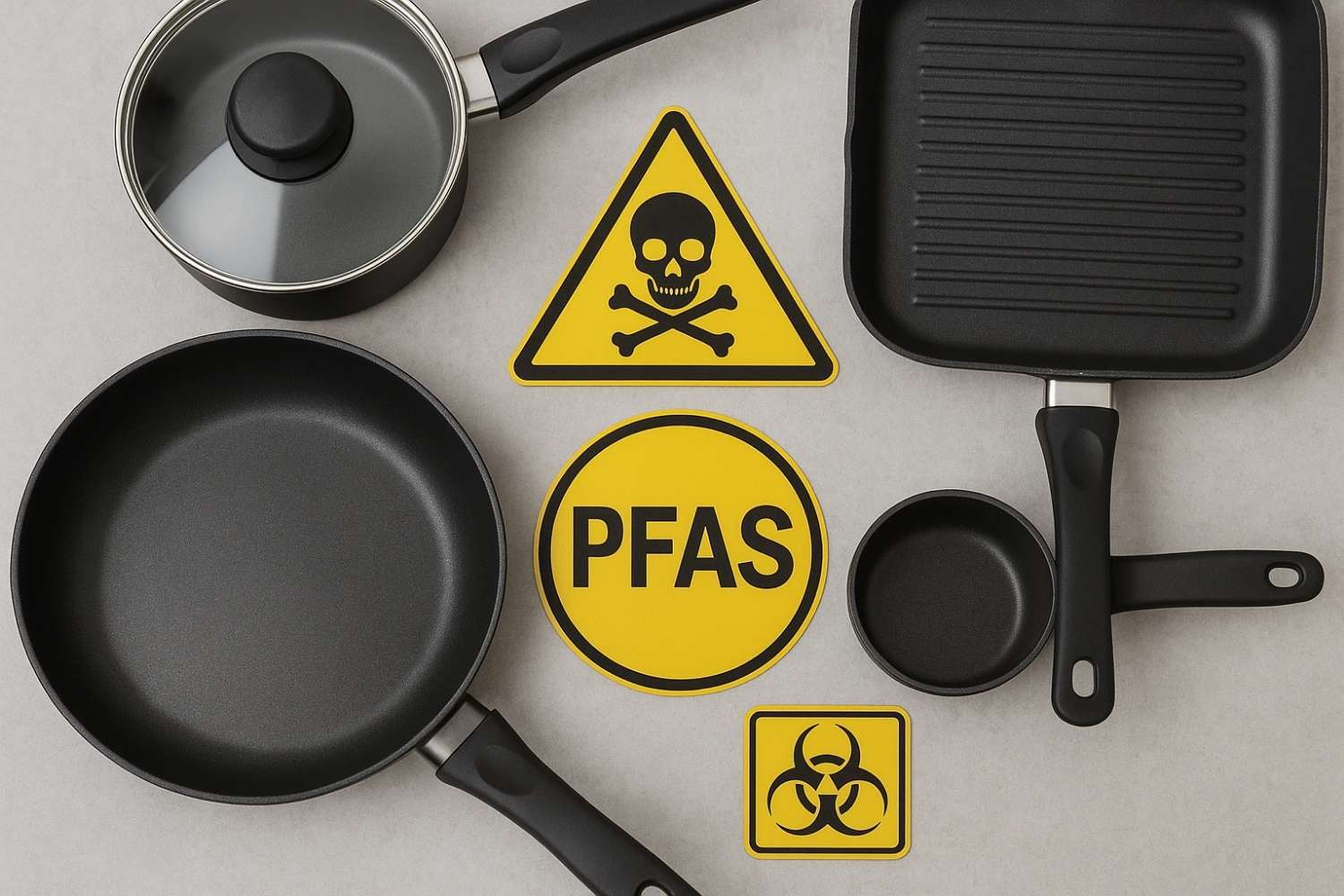
Nowadays we talk about it more and more often: PFAS, eternal chemicals, may be present in the coatings of the pans we use every day. But understanding whether a non-stick pan contains them or not is not always easy, even by consulting the information available online. This was highlighted by a market inspection conducted by the Verbraucherzentrale NRW, the consumer protection organization of North Rhine-Westphalia, Germany.
The investigation examined 31 pans sold online, verifying the information published by manufacturers and distributors on non-stick coatings. When data was not available, researchers contacted companies directly, including via email and chatbots, or consulted user manuals.
What did they discover? From the information collected by the researchers, it emerged that 17 of the 31 pans examined had a coating indicated as containing PFAS, while for 9 the manufacturers or retailers declared the absence of these substances. For another 5, however, it was not possible to clarify the composition of the coating.
A significant fact concerns the transparency of the information: for 18 pans out of 31, it was initially not possible to understand, by consulting online sites, whether the coating contained PFAS or not. To get answers, researchers had to go directly to manufacturers and retailers.
It is important to point out that it was not a laboratory test, the Verbraucherzentrale NRW collected and compared the information provided by the companies, assuming its reliability, without directly analyzing the coatings. The results therefore concern the specific models selected and cannot be automatically extended to all pans of the same brands.
Why PFAS are used in pans
PFAS, an acronym that indicates per- and polyfluoroalkyl substances, are a vast family of chemical compounds used in numerous products thanks to their properties, including resistance to water, fats and high temperatures. Some are also used in the production of non-stick coatings.
Among the materials to know is PTFE, also known by the commercial brand Teflon. It belongs to the PFAS family and allows food to stick to the surface of the pan less easily, making cooking and cleaning easier.
The problem mainly concerns the environmental persistence of these substances: many PFAS degrade very slowly and can accumulate in the environment. Some compounds are also associated with adverse health effects, including changes in the immune system, liver and thyroid function, as well as an increased risk of certain cancers. The effects, however, vary depending on the substance and type of exposure.
Are non-stick pans dangerous for your health?
The presence of a coating containing PFAS does not automatically mean that cooking with that pan poses an immediate risk. According to the Bundesinstitut für Risikobewertung (BfR), the German Federal Institute for Risk Assessment, pans with PTFE coating can be used in everyday life without particular risks if used correctly.
The situation changes in case of overheating. If a PTFE pan is left empty on a heat source, the temperature can rise rapidly and, around 360°C, the coating can begin to decompose, releasing dangerous fumes. Inhalation can cause flu-like symptoms; these fumes are particularly dangerous for domestic birds, which are very sensitive.
Another aspect concerns wear. Scratched or deteriorated coatings can release PTFE particles. For this reason it is advisable to follow the manufacturer’s instructions and replace the pans when the coating is very damaged.
How to recognize a pan with PFAS
One of the problems highlighted by the German investigation is the difficulty of identifying the composition of the coatings. A first element to check is the presence of PTFE, the polymer belonging to the PFAS family and also known by the Teflon brand. Commercial names such as Titanium, Stone, Diamond or ceramic, however, are not sufficient, on their own, to establish whether a pan is PFAS-free: they often describe commercial or technological characteristics, not necessarily the complete chemical composition.
Even the wording “PFOA-free” or “PFOA-free” is not the same as “PFAS-free”. PFOA is a specific substance belonging to this family, the use of which has been severely limited. Its absence does not automatically exclude the presence of other PFAS, including PTFE.
Before purchasing it is therefore useful to check that the manufacturer explicitly declares that the coating is free of PFAS, rather than limiting itself to indications such as “PFOA-free” or “PFOS-free”. If the description is not clear, you can consult the technical data sheet or ask for written confirmation from customer service, asking in particular whether the coating contains PTFE or other fluorinated compounds.
The instructions for use may offer some clues, but are not sufficient to identify the covering material with certainty. To have more reliable information, the manufacturer’s confirmation therefore remains the most useful reference. If you don’t get a clear answer, you can’t definitively determine the presence or absence of PFAS based on the brand name or surface appearance alone.
Does the problem also concern those who buy pans in Italy?
Yes, the issue also affects Italian consumers. The survey was carried out in Germany and does not demonstrate that the same percentages apply to the Italian market, but it highlights a difficulty that can also arise when purchasing pans online in other European countries: information on the composition of the coatings is not always easily available.
Different brands market products in multiple European markets, but it cannot be assumed that all models, versions or trims are identical. To understand whether a specific pan sold in Italy contains PFAS, it is therefore necessary to check the information relating to that product.
Furthermore, Europe’s restrictions on certain PFAS do not amount to a blanket ban on all such substances in every type of pan. It is important to distinguish limitations already applicable to specific compounds and products from any broader measures still under discussion.
PFAS-free pans, which alternatives to choose
Those who prefer to completely avoid coatings containing PFAS can opt for uncoated pans made of stainless steel, iron or cast iron. They are materials that do not require a non-stick PTFE layer, but have different characteristics and methods of use.
There is therefore no perfect pan for every need, the choice depends on the type of cooking, the maintenance you are willing to do and the duration you expect from the product. Those who want to reduce exposure to PFAS can start from a simple criterion: favor uncoated materials or products for which the manufacturer provides a clear and verifiable declaration on the composition.
