
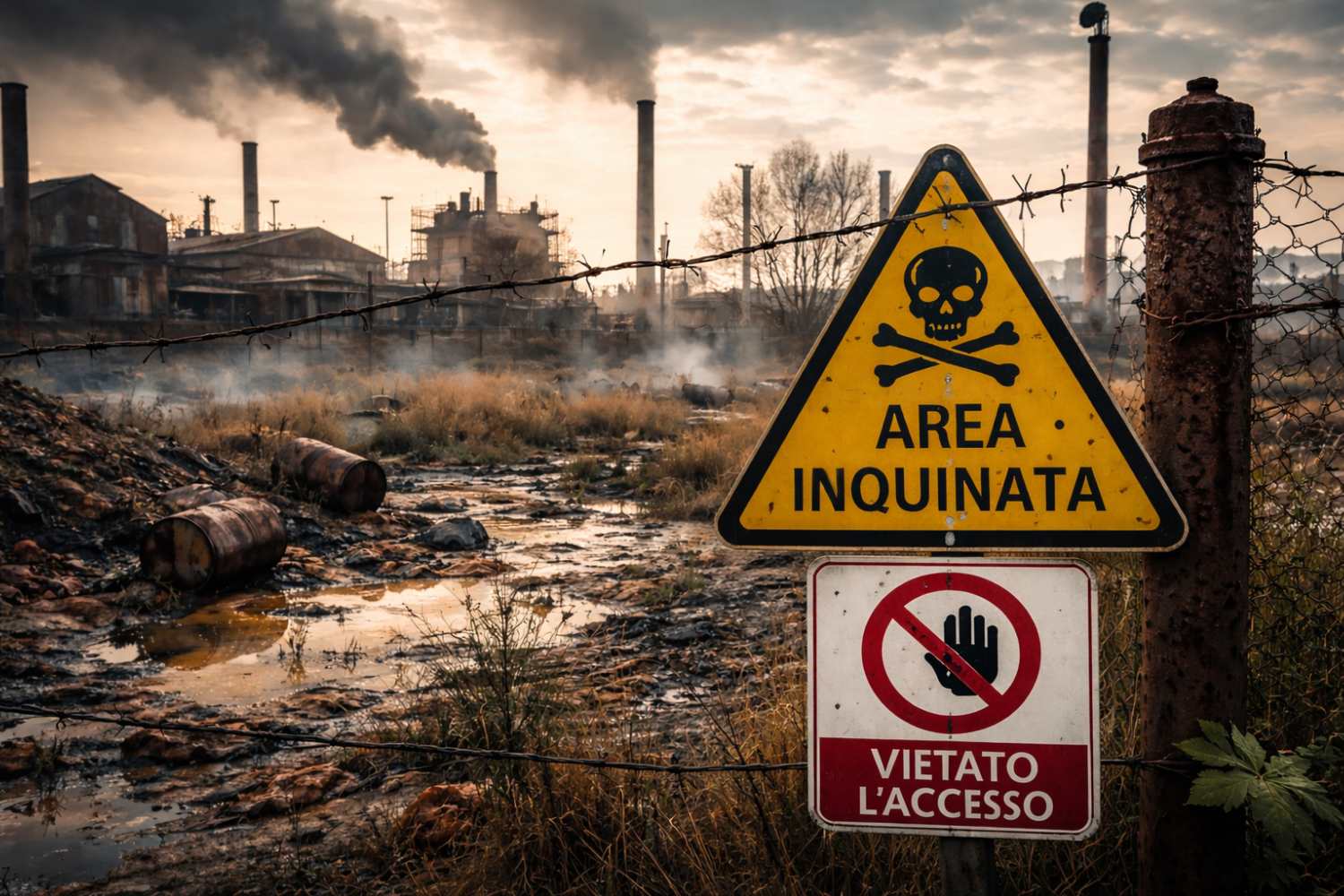
Report, the Rai 3 investigative program hosted by Sigfrido Ranucci, has turned the spotlight back on one of our country’s deepest environmental wounds: the remediation of polluted sites. The investigation “Reclamation: 1000 years of promises“, clearly shows us how far a real solution is still for the Sites of National Interest (SIN), the most contaminated areas of our country.
Forty years of promises and few results
To understand the roots of this announced disaster we need to go back to 1986, when with Law no. 349, the Ministry of the Environment was established for the first time, laying the foundations for the protection of polluted territories. Since then, thanks to subsequent monitoring and regulations, 42 Sites of National Interest have been identified to be reclaimed, scattered along the entire peninsula: from Bagnoli to Taranto, from Sulcis to Porto Marghera, passing through Gela, Priolo, Brindisi and many others. Immense areas, seriously contaminated, which represent a real risk for the environment and for the health of millions of citizens.
Yet, after almost four decades of regulations, extraordinary commissioners and institutional promises, the definitive reclamation has reached just 6% of the land. A failure that translates into dramatic numbers: according to some estimates, the accumulated delays total around 992 years. It’s not a typo, we’re talking about almost a thousand years of cumulative delays on the necessary reclamation.
Sites of National Interest: a risk map
As already mentioned, in Italy there are 42 SINs and involve approximately 6.2 million people. Created by law in 1998 with the aim of characterizing, securing and reclaiming contaminated soil, these sites represent a health and ecological emergency. Here are the main ones.
Bagnoli
The former iron and steel hub of Bagnoli, in Naples, is the perfect emblem of failed promises. The infamous “Colmata”, a 195,000 square meter platform made up of industrial waste, continues unabated to release heavy metals and hydrocarbons directly into the sea, poisoning a stretch of coast that could be a paradise.
Over the years, the reclamation projects have been continually revised. While initially it was envisaged to completely remove the polluting materials to finally restore the beach, today the strategy simply aims to fill up the land, a choice motivated in part by the need to prepare the area for the 2027 America’s Cup.
But the real paradox is political and economic, worthy of a grotesque novel: the Caltagirone Group, former owner of Cementir which contributed to the pollution, handed over the area to the State without paying a single euro for the clean-up. And guess what? The same group then won the public tender for the renovation works, which will be paid for with taxpayers’ money. In practice, those who have polluted are also paid to clean up, while citizens pay the bill twice.
Sardinia and Veneto
In Sardinia, Sulcis and Macchiareddu cover 521 square kilometers contaminated by decades of wild mining and industrial activities. The reclamations? Only 1% of the territory completed. In Macchiareddu, despite the environmental disaster agreements that seemed to mark a turning point, the works are blocked by an endless whirlwind of appeals and bureaucratic delays that would make Kafka pale.
In Veneto, however, PFAS pollution affected approximately 300,000 people, causing an estimated 4,000 excess deaths between 1985 and 2018. Four thousand deaths that could have been avoided. Yet, and here’s the kicker, the area has never been recognized as a Site of National Interest. This means no structured remediation plan, no adequate resources, no systematic studies on contaminated food. The Venetian population was literally abandoned to itself.
The Solvay case
Report’s investigation also delves into the role of Solvay, one of the main players in the production of polluting chemical substances, in particular PFAS, highly persistent and dangerous substances for health.
The Spinetta Marengo site has been under the scrutiny of the Prosecutor’s Office and the Court of Alessandria for years for environmental pollution. Recently, the Court of Assizes brought the former Solvay, now renamed Syensqo, to trial as responsible for PFAS pollution in the area.
But the most chilling part emerges from the documents brought to light by Report’s investigation: it seems in fact that the managers of Solvay and Miteni were perfectly aware, years before, of the high and dangerous levels of PFAS in the workers’ blood. Since 1996, large manufacturers such as Solvay, DuPont, 3M and Miteni have met regularly to compare employee toxicology data and blood tests. In short, they knew everything but this information was kept secret.
Double standards: In the United States, Solvay was forced to pay billions in compensation for PFAS pollution. In Italy, however, in the trial against Miteni in Vicenza, nothing was requested from the company. For Spinetta Marengo, negotiations are currently underway between Solvay and the Ministry of the Environment, while the local communities await justice and real clean-ups.
Paths: the observatory closed in general silence
Until 2007, in Italy there was not even an organic plan to study the impact of pollution on the health of the populations living in Sites of National Interest. The situation was so serious that a group of researchers from the Istituto Superiore di Sanità and the CNR decided to fill this information gap by giving life to the Sentieri project.
Since 2010, the Sentieri observatory has published 6 reports in-depth analyzes of mortality and hospitalizations for each SIN, making an enormous contribution to the knowledge of the impact of pollution on the territories, developing fundamental awareness in the populations living in these areas. These studies have documented rates of cancer, respiratory diseases and other conditions significantly higher than the national average, providing irrefutable scientific evidence of the link between pollution and public health.
But in 2023, amid the general silence of the institutions and the indifference of the majority of public opinion, Sentieri closed its doors. An incomprehensible decision precisely at the moment in which these data would have been more necessary than ever to monitor the evolution of the situation and evaluate the effectiveness of the reclamation interventions.
But then, following the pressure unleashed by Report’s investigation, the Minister of Health Orazio Schillaci decided to refinance the study. However, the damage remains, the temporary block has in fact led to the loss of precious data relating to the years 2023, 2024 and 2025.
Regulatory obstacles
One of the main problems is a regulatory vacuum that allows companies to postpone work for decades, presenting continuous changes to reclamation projects. In fact, the law punishes those who do not communicate or do not carry out the remediation, but not those who carry it out too slowly.
The problem is that behind the statistics, percentages and delays there are stories of entire communities that have lived for decades with poisoned soil, contaminated aquifers and alarming cancer rates. Citizens who see their children getting sick, general practitioners and oncologists who report anomalous peaks in pathologies, local associations who are clamoring for free and regular cancer screenings.
The central issue that emerged from Report’s investigation is not technical but political. The skills exist, the remediation protocols are known, the technology is available. What is missing is the political will to really tackle the problem, allocating adequate resources and guaranteeing continuity of interventions.
Too often, reclamations get stuck in endless legal disputes over who should pay, in contested contracts, in projects that remain on paper while populations continue to live with the poisons. The “polluter pays” principle clashes with the reality of failed or disappeared companies, while the State and the Regions pass on responsibilities and costs.
Solvay’s reply
This is Solvay’s response following the broadcast of the programme, on the Report website you can also find those of the other companies involved:
A purely commercial relationship existed between Miteni and Solvay, which ended in 2018. Until 2018, Solvay/Syensqo subcontracted to Miteni only part of the final production process of the patented fluorinated surfactant C6O4, and a circular recovery process of C6O4 from the resins used for water treatment, in full compliance with the current authorization and regulatory framework.
Syensqo does not comment on what is alleged in the Miteni trial as it is not part of the trial in any capacity. The company carefully monitors the health of its workers. The results of the epidemiological and biomonitoring studies conducted from 2013 to today are shared transparently and constantly with employees, unions and health authorities present in the area as well as published in scientific journals.
The Judge of the Preliminary Hearing granted two postponements of the proceedings to allow the definition of as many settlements as possible, noting in his order that the defenders of the defendants and of the civilly liable party had correctly taken action in this regard and that a good part of the discussions with the civil parties had a positive outcome or had in any case been initiated, also specifying that, for the entire duration of the postponement, the limitation period remains suspended.
In addition to the significant environmental investments already made and those planned for the next few years, the company has undertaken a path of transparency and collaboration with all the public authorities involved in environmental protection. These obviously include the Ministry of the Environment, which is regularly informed on the most significant progress.
In this regard, it is specified that the Company has already stipulated – and still intends to stipulate – settlement agreements with the various public bodies and exponential bodies that were civil parties in the Alessandria criminal proceedings as part of a renewed spirit of constructive collaboration and civil coexistence with the local community and public authorities.
