
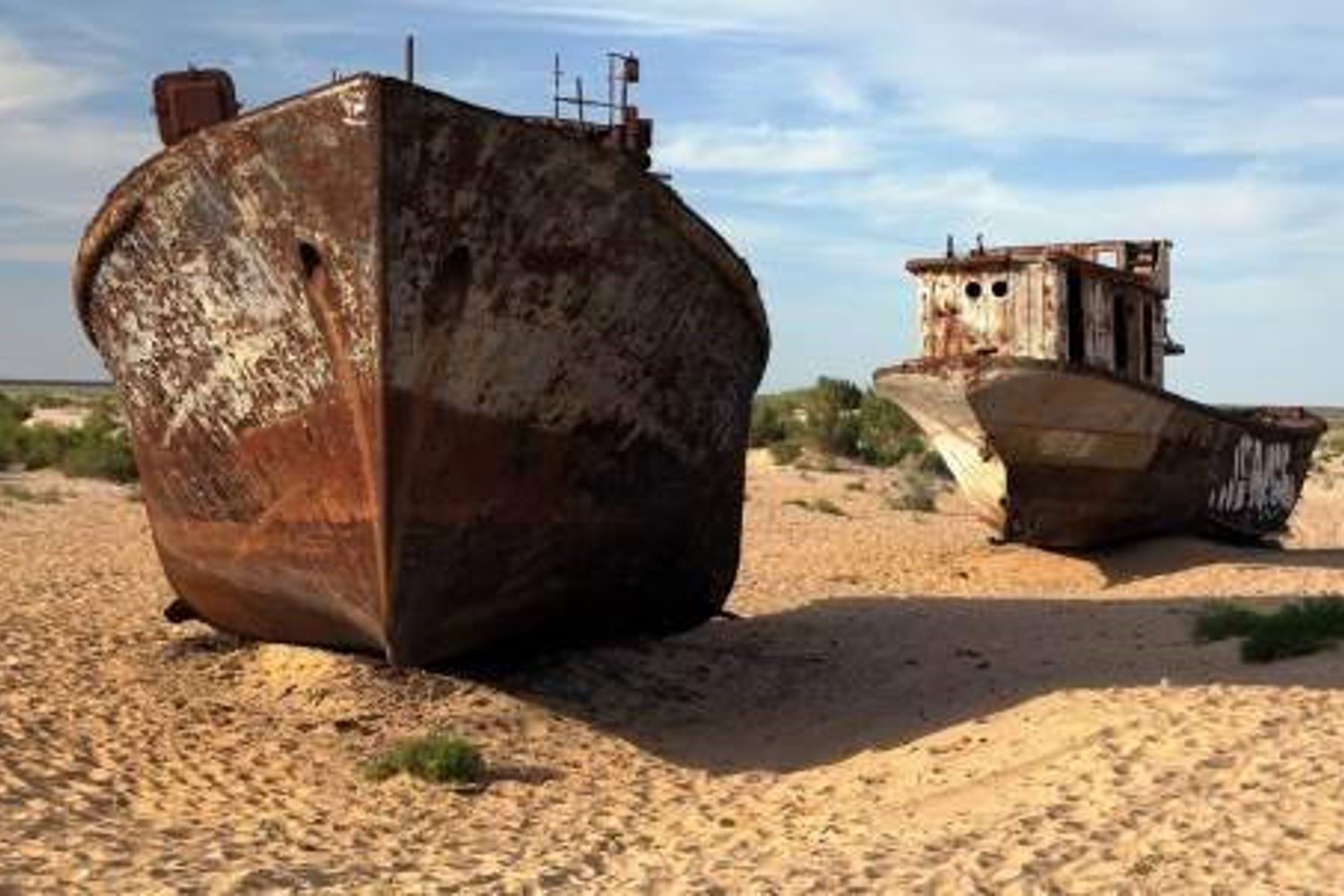
In the 1960s, the Soviets decided to divert rivers Amu Darya And Sir Darya – the main immissaries of Lake Aral – to enhance the Cotton and rice production. It was the beginning of the end, of what – before the 1960s – was The fourth largest lake on the earthwhich shone for kilometers beyond the borders of Uzbekistan and Kazakhstan. Then nothing.
Lake Aral it gradually went disappearing In the last six decades, causing water and food insecurity, influencing the health of people in the countries of the pelvis and influencing the climate of the regions.
In short, most of that surface has reduced to an arid expanse, giving life to the newer desert on Earth and hitting 3 million people who live in the surrounding region. A few years ago he kicked off theAral Sea Conservation Project which, financed by Kazakhstan and the World Bank, led to the construction of the Kokaral dam To prevent the water from dispersing in the sand and contaminated with salt.
Since then, perhaps, something has changed, but very small steps.
What happened
Lake Aral once extended for 68 thousand square kmbut the relationships now suggest that everything that remains currently is about 8 thousand square km of water. The rest of its white seabed forms now the Aralkum desert.
It is certainly one of the largest environmental disasters in the world, Ibrahim Tiaw, executive secretary of the United Nations Convention for the fight against desertification last year.
And not only that: the studies also discovered that the loss of this internal sea almost doubled the dust atmospheric of the region between 1984 and 2015, from 14 to 27 million tons: The winds infurian and raise toxic powders everywhere.
The slow recovery
The volume of water from the north part of Lake Aral (the small Aral lake) increased by 42% and reached 27 billion cubic meters at the end of the first phase of the project to preserve the northern area, announced the Kazakh Ministry of water resources and irrigation, Nurzhan Nurzhigitov.
In 2008 theAral Sea Conservation Projectan initiative financed by Kazakhstan and the World Bank that led, as we said, to the construction of the Kokaral dam. This structure was built to avoid water dispersion in the sand and its contamination with salt, thus contributing to the recovery of the lake ecosystem.
Already in 1993, however, the Ifas was born (International Fund for Saving the Aral Sea), an organization that involved Kazakhstan, Tagikistan, Turkmenistan, Uzbekistan and Kyrgyzstan (the latter as a country’s country) with the aim of combining efforts to counter desertification and restore the natural environment of the region.
Last September, Minister Kazakh of water resources and irrigation announced an important milestone: from the beginning of 2024, 1.9 billion cubic meters of water were placed in the lake, with a significant reduction in salinity and the return of aquatic life.
During the period of maximum irrigation of this year, the Syr Darya river brought to the lake a flow of 80 cubic meters of water per second, a figure clearly higher than the only 6 cubic meters per second recorded last year, said the Minister.
According to ministerial data, 75% of the flow of Syr Darya came from Kyrgyzstan, 20% from Uzbekistan and 5% from Kazakhstan. It is an attempt to return to the lake part of the deviated waters for over fifty years, a practice that has caused that ecological disaster of enormous proportions.
Certainly the situation is far from being resolved: to stem, even partially, such a disaster serves much more.
