
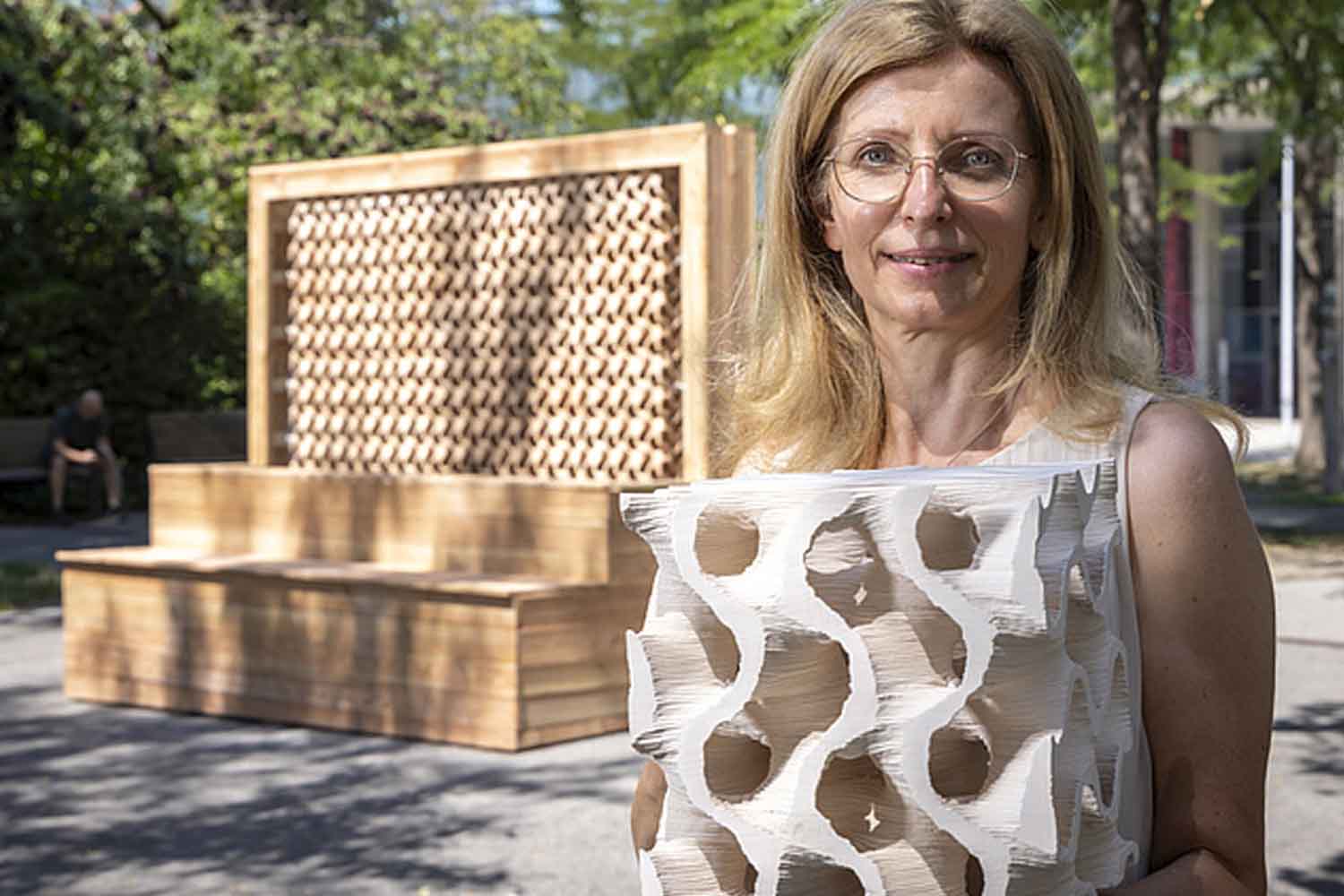
A clay cube of just 23 centimeters, filled with water, managed to lower the temperature measured in its immediate vicinity by almost 7 °C during a test in a hot attic of the Technische Universität Graz, in Austria. No refrigerant gases and no compressor: what does the job are water, ceramic and an almost excessive amount of small pores. From these modules the researchers also built a two by two meter cooling wall, installed on the university campus.
The project, presented by TU Graz, takes a centuries-old principle – evaporative cooling – and puts on it a geometry possible thanks to 3D printing. When water evaporates it absorbs heat from the surrounding environment. Here the ceramic is specially designed to give you as much surface area as possible on which to do this.
A cube full of curves to evaporate more water
Looking at it, it almost seems like a decorative object: a perforated block crossed by curves, cavities and passages. That form, however, has a very practical task. The researchers use a geometry called triple periodic minimal surfaceor TPMS, which allows you to obtain a very large internal surface using relatively little material.
The cubes are digitally designed and printed in a clay-based mixture. Cooking takes place at relatively low temperatures, so as to maintain a highly porous structure. When water is added, capillarity causes it to rise and distribute within the material, a bit like what happens when the edge of an absorbent sheet touches a puddle. Except that here the route was designed on the computer. The more wet ceramic comes into contact with air, the greater the surface area becomes available for evaporation.
The system was born from the work developed at the ShapeLab of the Institute of Architecture and Media of the TU Graz. In 2024 Kristijan Ristoski dedicated his master’s thesis to it Clay 3D Printed Triply Periodic Minimal Surface Structures for Energy Efficient Evaporative Cooling; today those individual modules have been combined into a wall with a controllable water circuit.
The mushrooms enter the clay and then disappear into the oven
The most curious part comes before cooking. To further increase porosity, the group is experimenting with mixtures containing mycelium and wood chips. The fungus grows inside the material forming a network of very thin filaments; then the piece ends up in the oven.
At that point mycelium and wood burn. There is not a living wall left of the mushroom nor any unlikely façade to be watered: what remains is its cast, in the form of a web of micro and macropores. It is precisely these tiny voids that facilitate the distribution of water inside the ceramic. It is one of the areas on which the group has been working for years, combining clay, mycelium and three-dimensional printing to modify the properties of materials.
Researchers are also trying less conventional raw materials. Among these is the silt dredged from Lake Neusiedl, between Austria and Hungary, a sediment that must be periodically removed to slow down the silting of the lake and which could be recovered as a raw material for 3D printing rather than simply being disposed of.
Those almost 7 °C must be read in the right place
The number inevitably destined to take center stage is that of seven degrees. The measure, however, deserves its surrounding meter.
TU Graz reports that, during a controlled test in a very hot attic, the temperature in the immediate vicinity of a cube filled with water dropped by just under 7 °C. The researchers report that the effect was also perceptible in the room, but the data communicated by the university does not equate to a seven degree reduction in the temperature of an entire room, and even less of a street or square.
There is also another caution. TU Graz today presents a prototype and a demonstration plant; the work behind the system is also documented in Ristoski’s master’s thesis. The university sources available on the project do not yet provide complete data on the performance of the two-metre wall in real urban conditions, nor on the water consumption necessary to use it on a large scale. In short, the leap from the cube that works in the attic to the neighborhood that breathes better is yet to be made.
And it is an important step because evaporative cooling depends on environmental conditions: it works by exploiting the evaporation of water and therefore has different characteristics depending on temperature, ventilation and humidity. Even the TU Graz prototype, although based on a passive physical phenomenon, integrates the modules into a controllable water circuit. Simply defining it as a wall that cools “without energy” would be doing the project a favor that its own data, for now, does not ask for.
Where the trees struggle to find a place
The idea is especially of interest to those urban spaces where putting in a new tree requires something more than good will: courtyards, stops, highly mineralized squares, buildings, passages and waiting areas. TU Graz itself cites homes, offices, schools and public spaces among the possible applications and has already built a two by two meter demonstration wall on the Neue Technik Campus; another installation can be seen at the Museum der Wahrnehmung in Graz.
This does not turn ceramics into a substitute for trees. A recent work coordinated by the Cnr-Ibe with Ispra simulated reductions of more than 4 °C in the hottest hours for Rome and Florence through combinations of greenery, trees and surfaces capable of retaining less heat. Cities need different interventions, often on the same block.
The Austrian wall adds a rather concrete piece to that toolbox: clay, water, geometry and even mushrooms that work for a time and then politely step aside in the oven. Now it’s up to larger-scale tests to understand how cool it can really come out of all those holes.
