
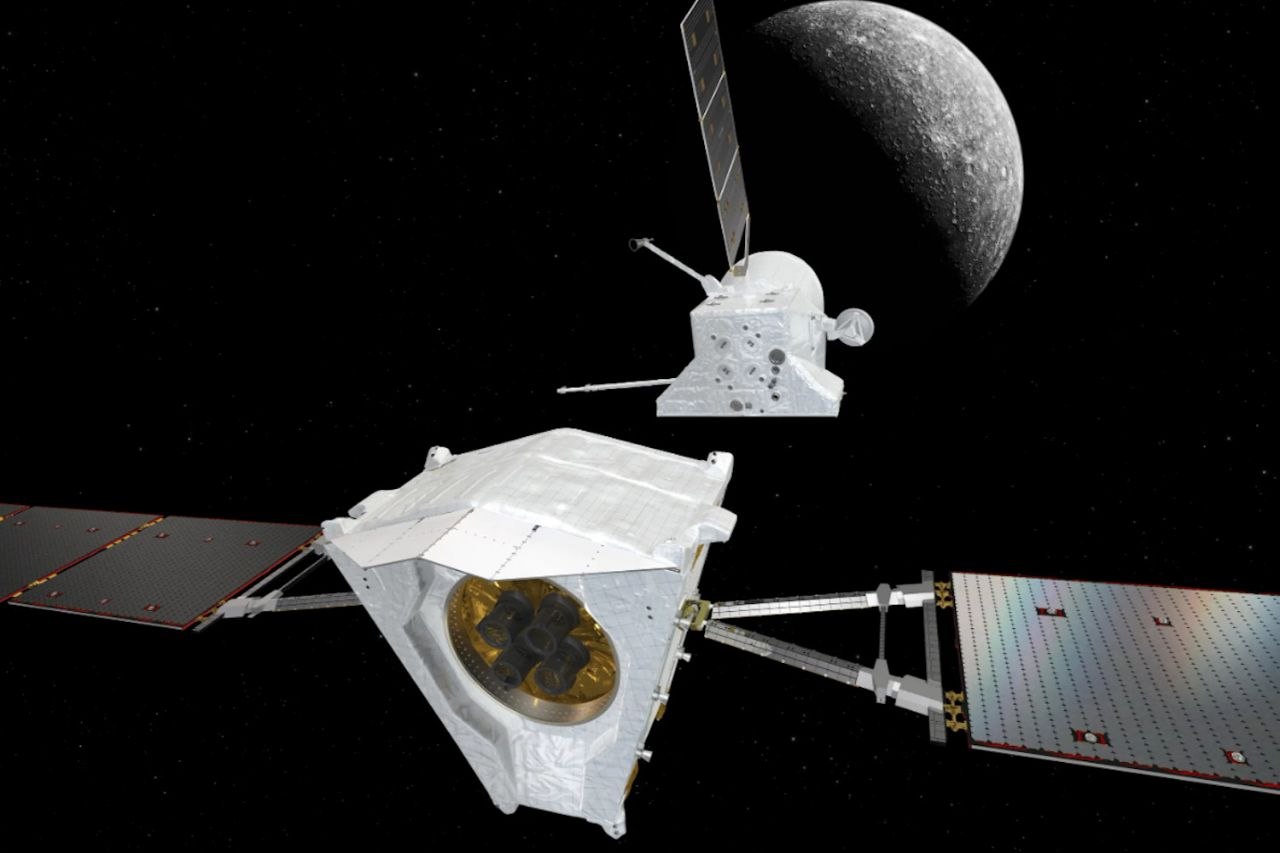
It left the earth on 20 October 2018. Today, after more than 8 years through the solar system, the Bepi Colompo probe will enter the orbit of Mercury, one of the planets closest to the Earth and absolutely the closest to the sun. A mission considered epic given that the probe conducted a very long journey covering approximately 10 billion km.
Today will be a historic day for Mercury who is about to interrupt his solitude and is about to receive a visit. Today at 7.24pm Italian time, BepiColompo will have to carry out a maneuver as fascinating as it is delicate: the two probes that compose it, Mpo (Mercury Planetary Orbiter) and Mio (Mercury Magnetospheric Orbiter), will enter the planet’s orbit joined together. MPO and Mio will separate from each other between December 9 and 10, 2026. The science phase of the mission is expected to begin in April 2027.
@ESA
Mercury is the smallest rocky planet in the Solar System and also has another record: it is the closest to the Sun. It is also, in addition to Earth, the only planet to possess a global magnetic field. Despite its proximity to us, it is practically unexplored.
According to ESA, BepiColombo is a world-class scientific mission led by the European Space Agency (ESA) in collaboration with the Japanese Aerospace Agency (JAXA). It will be there first mission to orbit Mercury with two space probes: ESA’s Mercury Planetary Orbiter (MPO) and JAXA’s Mercury Magnetospheric Orbiter (Mio), which will orbit the planet at the same time.
It won’t be a walk of health. Mercury, in fact, is a planet that is anything but hospitable. Its proximity to the sun makes it difficult to visit. Suffice it to say that its temperatures can be very high but also very cold. In fact, it goes from 430° to -180°C. Furthermore, the planet is literally bombarded by violent solar radiation.
Until now, it has not been easy to observe it closely and reveal its secrets. And this is precisely the objective of the new BepiColombo mission. One of these mysteries concerns the presence of ice in its craters, which is difficult to explain given its proximity to the sun. Furthermore, the probes will also study the particular cavities that cover the surface of the planet.
The National Institute for Astrophysics (Inaf) explains that the probe is made up of 4 modules including the European satellite (MPO) and the MTM which will transport the other modules during the journey. Of these, the MPO and the MMO will have the purpose of producing scientific data and will settle on two different orbits.
The European module, in particular, will have 11 instruments on board, 4 of which will be “made in Italy”. SERENA which will study the interaction between the surface, the exosphere, the magnetosphere and the solar wind, SIMBIO-SYS which is a suite of 3 optical instruments which will provide images of the planet’s surface in both 2D and 3D, MORE which aims to determine the gravitational field together with the size and physical state of the planet’s core and finally ISA which will measure the non-gravitational forces and together with MORE will improve the knowledge of some constants of the theory of Relativity Einstein’s General.
There are many scientific reasons that have sparked the curiosity of scientists, who will try to understand how the planet was born, its evolution but also its special interaction with the Sun and the extreme weather conditions to which it is subjected.
