
As Europe tries to reduce its dependence on fossil fuels, a decisive part of the transition is played out inside our homes. Boilers, heating networks, building renovation and heat pumps can make the difference. It is precisely on this ground that Rome is struggling: among 15 European capitals analyzed by Greenpeace, our capital is placed in penultimate place, ahead only of Bucharest.
The new report says so “Gas-Free Cities? European Urban Heat Transition Ranking” by Greenpeace Central-Eastern Europe, which compares 15 large European cities to understand how advanced they really are in abandoning fossil gas for heating buildings. A study that looks at emissions, but also at policies and planning, infrastructure, investments, governance and social protection measures.
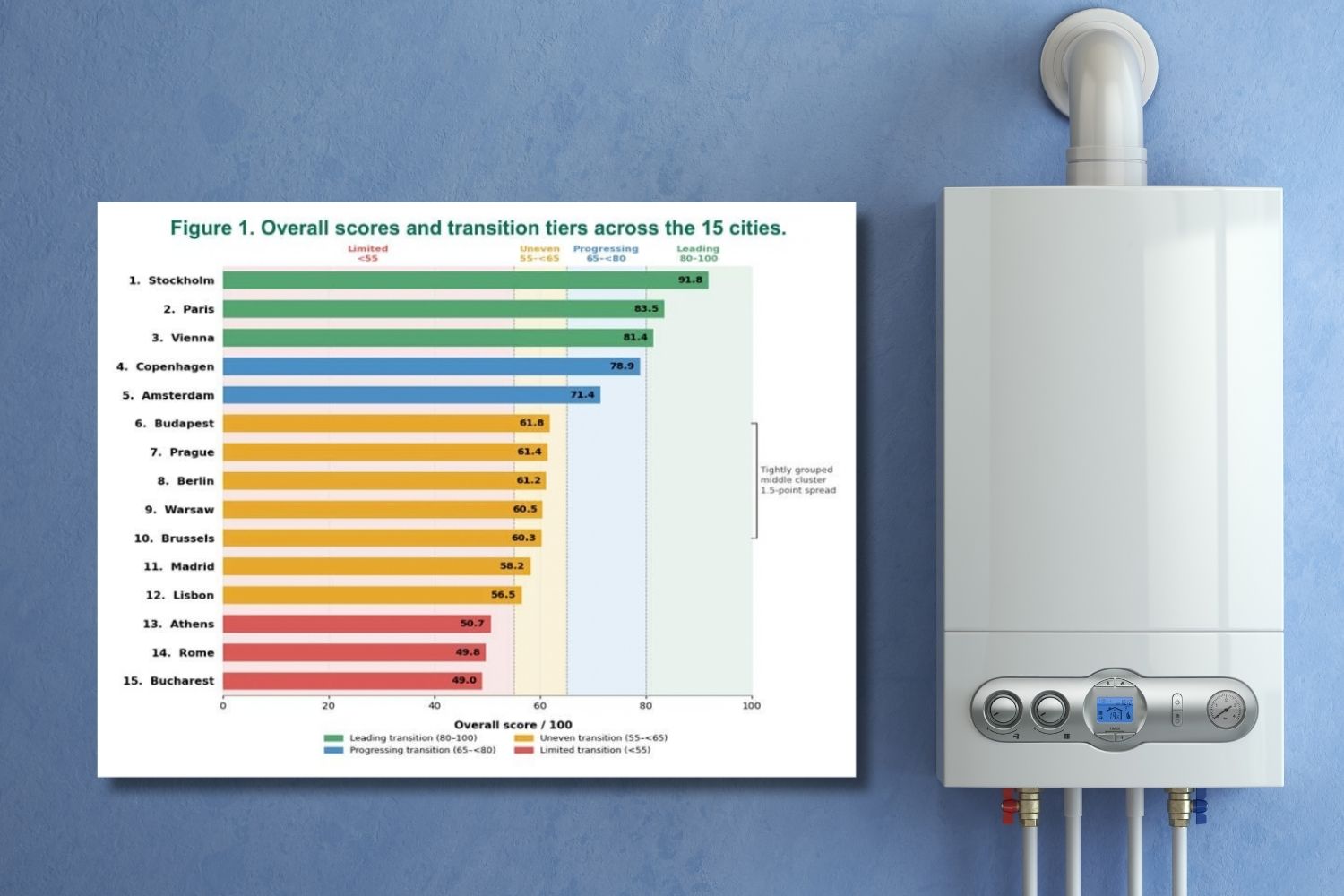
The result for Rome is anything but flattering: 49.8 points out of 100, “limited transition” and fourteenth place in the rankings.
The ranking
In the lead we find Stockholm, with 91.8 points, followed by Paris with 83.5 and Vienna with 81.4. The three cities reach the top for different reasons. Stockholm has reduced the direct consumption of fossil fuels in buildings to a minimum and has a highly developed heating system, although – according to the report – the strong dependence on the incineration of waste, including plastics of fossil origin, prevents it from being considered completely renewable.
Paris is rewarded for rapid reductions in building emissions, investments in heat networks and social measures. Vienna, on the other hand, has one of the clearest paths: its plan to 2040 includes the replacement of around 600 thousand gas heating systems.
At the bottom of the ranking are Athens, Rome and Bucharest. According to Greenpeace, in these three capitals the dependence on fossil fuels, incomplete planning and limited implementation of the transition weigh more than the initiatives already started in the field of redevelopment and electrification.
The ranking:
- Stockholm – 91.8
- Paris – 83.5
- Vienna – 81.4
- Copenhagen – 78.9
- Amsterdam – 71.4
- Budapest – 61.8
- Prague – 61.4
- Berlin – 61.2
- Warsaw – 60.5
- Brussels – 60.3
- Madrid – 58.2
- Lisbon – 56.5
- Athens – 50.7
- Rome – 49.8
- Bucharest – 49.0
@Greenpeace
Why is Rome so behind
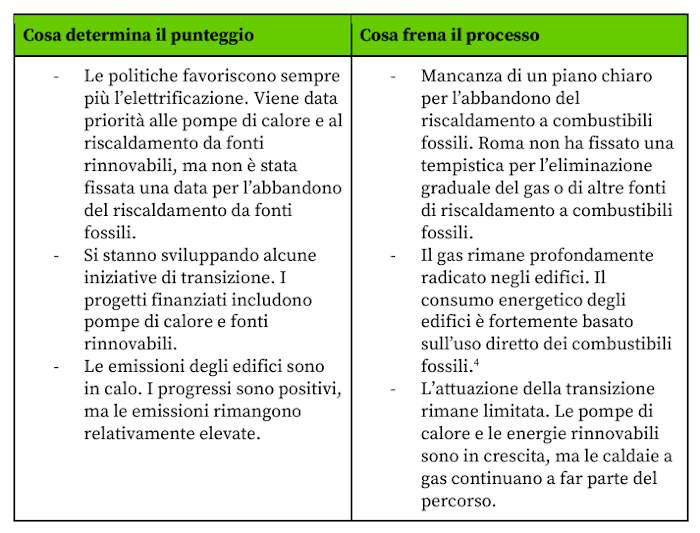
Although the report recognizes a growing trend towards the electrification and energy retrofit of buildings, its transformation still remains “in the embryonic stage”.
The Climate City Contract of Rome connects the decarbonisation of the building stock to a series of planned investments and interventions are already underway on schools and other public buildings, with projects involving renewable energy and low-emission heating systems, but what matters is the fact that here gas continues to have a central role for heating and the production of hot water.
About 57.6% of the energy used directly in buildings still comes from fossil fuels, according to data reported in the study. Building emissions fell by 6.5% between 2020 and 2024, but remain relatively high: 1,674 tonnes of CO2 per capita from fossil fuel use in buildings in 2024.
@Greenpeace
Furthermore, the capital has not yet set an official date by which to abandon heating powered by gas and other fossil fuels. And there is also a lack of a dedicated territorial thermal plan, i.e. a tool that allows you to establish, neighborhood by neighborhood, which technologies and infrastructures to use to progressively replace gas.
The 2026 energy requalification strategy envisages a gradual replacement of gas with heat pumps, building insulation, photovoltaics, solar thermal and geothermal energy. But, the report highlights, this approach has not yet transformed into a city-wide transition.
Then there is another element destined to weigh on future choices: the long-term concession relating to the distribution of gas in the ATEM Roma 1, which, according to Greenpeace, introduces further uncertainty on the times with which the fossil network can be progressively dismantled.
In general, policies are increasingly pushing towards heat pumps and renewable sources and several projects already financed are going in this direction, but gas boilers continue to be included in the transformation path and there is not yet a defined timeline for their elimination.
However, there are also some concrete examples of change: in Torrino-Mezzocammino Rome is building the first almost zero energy school, designed with a geothermal system for heating and cooling, solar thermal and a 192 kWp photovoltaic system, with the aim of making the building energetically self-sufficient.
The new “Gas-Free Cities” campaign
Greenpeace launched the “Gas-Free Cities” campaign, asking mayors and local governments to join the Gas-Free Cities Declaration. The objective is to obtain precise commitments: to establish a date for the abandonment of fossil gas and to implement local policies consistent with that goal.
The first cities to join were Chortkiv and Trostyanets, in Ukraine, and Vienna, which became the first European capital to sign the Declaration.
For Rome, the priorities indicated in the report are very clear: set a date for the elimination of fossil fuel heating, complete a territorial thermal plan, accelerate the diffusion of heat pumps and systems powered by renewable sources and ensure that future renovation programs no longer include the installation of new fossil boilers.
Greenpeace also asks European governments to set the abandonment of gas by 2035, accompanying cities with investments in renewables, electrification and energy efficiency.
In short, the energy transition is certainly decided in national and European strategies, but in the end it takes shape in neighborhoods, condominiums, schools and homes. And it is precisely here that, according to this ranking, Rome still has a long way to go.
You can find the full Greenpeace CEE report HERE.
The summary in Italian with the fact sheet on Rome can be found HERE.
