
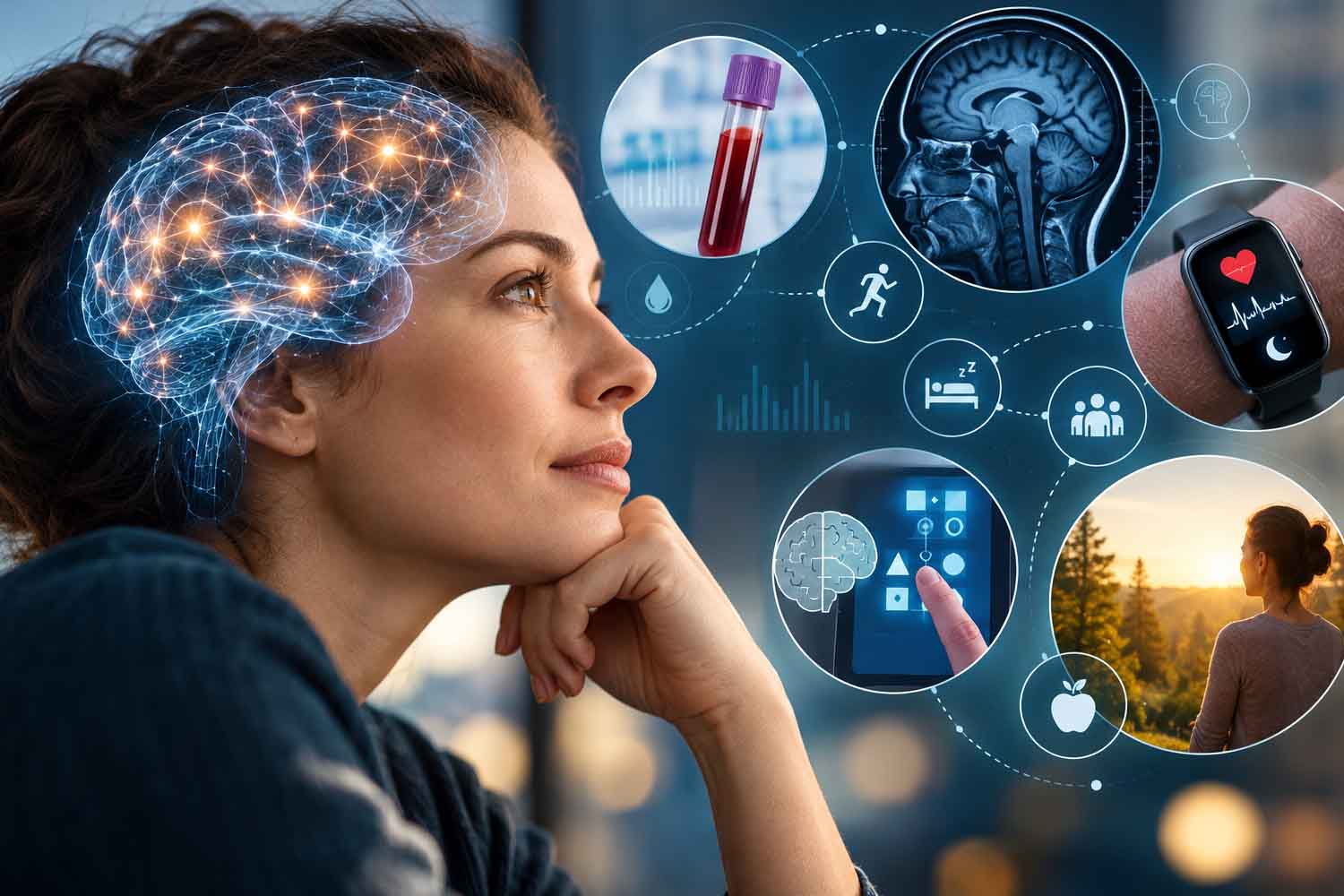
Blood pressure has a number, cholesterol too. The brain, for now, is much less cooperative. We can eat better, sleep more, do physical activity and keep our mind trained, but understanding whether all this is really leaving a measurable mark among neurons is decidedly more complicated. Something, however, is changing.
In May 2025, the US FDA authorized the first blood test intended to help diagnose Alzheimer’s: it measures p-tau217 and beta-amyloid in people aged 55 and older who already have signs or symptoms of cognitive decline. A test tube can therefore intercept part of the biology of the disease which until a few years ago required decidedly more demanding tests, such as PET or analysis of cerebrospinal fluid. To know generically how “fit” a brain is, however, the terrain is much less orderly. In fact, the FDA itself specifies that that test serves as a support for diagnosis, not as a check-up for healthy people.
In the meantime, tools are multiplying: biomarkers in the blood, MRIs transformed into scores, online cognitive tests, sleep data and even heart rate variability recorded by smartwatches. The promise is quite tempting: treating brain health a bit like blood pressure and cholesterol, measuring it over time, and understanding whether what we do to protect it is working.
For now, however, the cerebral equivalent of the blood pressure monitor is missing. And some very precise numbers risk seeming more definitive than they are.
Blood always sees Alzheimer’s better
Among the most mature tools are blood biomarkers of Alzheimer’s. In a study published in JAMA Neurologythe p-tau217 test was evaluated on 786 people from three different cohorts. The ability to identify the abnormal presence of beta-amyloid has reached very high accuracy values, with areas under the curve between 0.92 and 0.96; similar results emerged for tau pathology. In those cohorts the test performed comparably to some biomarkers obtained from cerebrospinal fluid.
It’s a huge advance diagnostically. The next leap, however, requires more caution: using these tests in people without symptoms to predict what will happen many years later.
The Alzheimer’s Association guidelines in fact concern people with already documented cognitive impairment and include biomarkers within a complete clinical evaluation. The association also specifies that the blood tests available today are not screening tests intended for the healthy population. Even the most recent diagnostic criteria avoid, for now, recommending in normal clinical practice the search for Alzheimer’s pathology in cognitively intact people.
The same goes for DNA. Knowing that you have the APOE ε4 variant can provide information about risk, without determining a person’s fate. The National Institute on Aging reminds us that genetic tests to predict Alzheimer’s are not routinely used: many people with APOE ε4 will not develop the disease, and numerous other factors contribute to the overall risk.
We also look for traces of inflammation in the blood
Another path is more experimental: looking for the consequences of brain inflammation in the blood.
In 2024, a group from the University of Cambridge developed an ultrasensitive test capable of identifying ASC specks, protein aggregates produced during the activation of the inflammasome. In the study published on Nature Communicationsnumber and shape of these particles were different in samples from people with early Alzheimer’s or Parkinson’s compared to controls. By combining them with other protein aggregates, the researchers obtained high values in the ability to distinguish the groups studied.
The sample, however, was small and the authors themselves ask for checks on much larger numbers. It is promising research, still far from a test that can be booked tomorrow morning together with the blood count.
An MRI can condense the brain into a number
Already in 2018, some British researchers tried to bring together different information obtained with MRI into a single Brain Health Index. The original method combined four MRI sequences to simultaneously recognize atrophy and various signs of vascular or white matter damage. In the first study, conducted on 288 participants, the index showed stronger associations with cognitive performance and reaction times than some individual measures considered separately. The study was published inInternational Journal of Stroke.
Five years later the team calculated reference values for 2,990 participants from the UK Biobank, aged 48 to 77. The score was lower, among other things, in people with type 2 diabetes, hypertension and smoking habits. However, the sample was 97% composed of white people, a rather important detail when trying to transform an experimental measure into a reference valid for everyone. The authors themselves call for data from more diverse populations.
A subsequent validation confirmed several associations between the index, cognition and risk factors, without however finding a significant change in BHI in the subgroup followed longitudinally. In short, the number exists; using it as your brain’s personal speedometer still requires a lot of work. The validation study is available here.
The smartwatch sees indirect signals
Then there’s what many already have on their wrists. Smartwatches record sleep, physical activity, heart rate and often also HRV, the variability of the interval between one beat and another.
HRV reflects the functioning of the autonomic nervous system and is studied in relation to numerous conditions. A meta-analytic review published in Translational Psychiatry examined the differences in HRV observed in several psychiatric disorders, while highlighting how its clinical application remains complex. A value on the smartwatch, therefore, does not diagnose depression, dementia or brain health.
However, there is an interesting trend that concerns sleep. During rest, coordinated oscillations of neural activity, vessels and cerebral fluids also come into play, also linked to the so-called glymphatic system, involved in the removal of waste products. Maiken Nedergaard, one of the researchers who has studied this system the most, discussed in 2026 on Science the possible link between these sleep rhythms and neurodegenerative diseases. Transforming HRV measured at the wrist into a reliable window on the “cleanliness” of the brain remains, however, a hypothesis to be tested directly in humans. The work is indexed in PubMed.
An index that also measures relationships and emotional balance
Another route gives up on the idea that brain health can be contained entirely within one scan.
The BrainHealth Project at the University of Texas at Dallas aims to follow up to 100,000 adults for at least ten years. Participants repeat an assessment every six months that combines cognitive performance and questionnaires on social, emotional and lifestyle aspects. The score is divided into three broad areas: cognitive abilities, social connections and emotional balance.
Here the target also changes. The goal is not just to identify a deficit, but to observe the same person’s trajectory over time. The project is still ongoing and its design is open-label and single-arm, so robust data will be needed before attributing any improvements to the proposed activities. However, it has a rather concrete advantage: it treats the brain as something that lives inside a person who sleeps, moves, gets stressed, meets other people and maybe every now and then even does two things at the same time believing that they do both well.
The most useful test may be far less futuristic
All this technology comes as we already have quite a bit of information about the factors that influence dementia risk. The Permanent Commission of The Lancet of 2024 identified 14 potentially modifiable throughout life, including hypertension, elevated LDL cholesterol, diabetes, smoking, physical inactivity, hearing and vision loss, social isolation and air pollution. The Commission estimates that addressing these factors could prevent or delay approximately 45% of dementia cases at a population level. It is an epidemiological estimate, not the promise that individual risk can be cut by the same percentage.
To measure brain health, therefore, today we have an increasing number of pieces: proteins in the blood, MRI images, cognitive tests, sleep, HRV, blood pressure, metabolism, physical activity and social relationships. The interesting part could be to follow them over time, instead of chasing the single score capable of giving a rating to the brain. They haven’t invented the green car dashboard-style light, at least for now.
